Sarnath archaeological site: essential pre-visit checklist
A visit to the Sarnath archaeological site is easy to underestimate. The monuments lie within a relatively compact heritage zone north of Varanasi, but the experience is divided between an open-air…
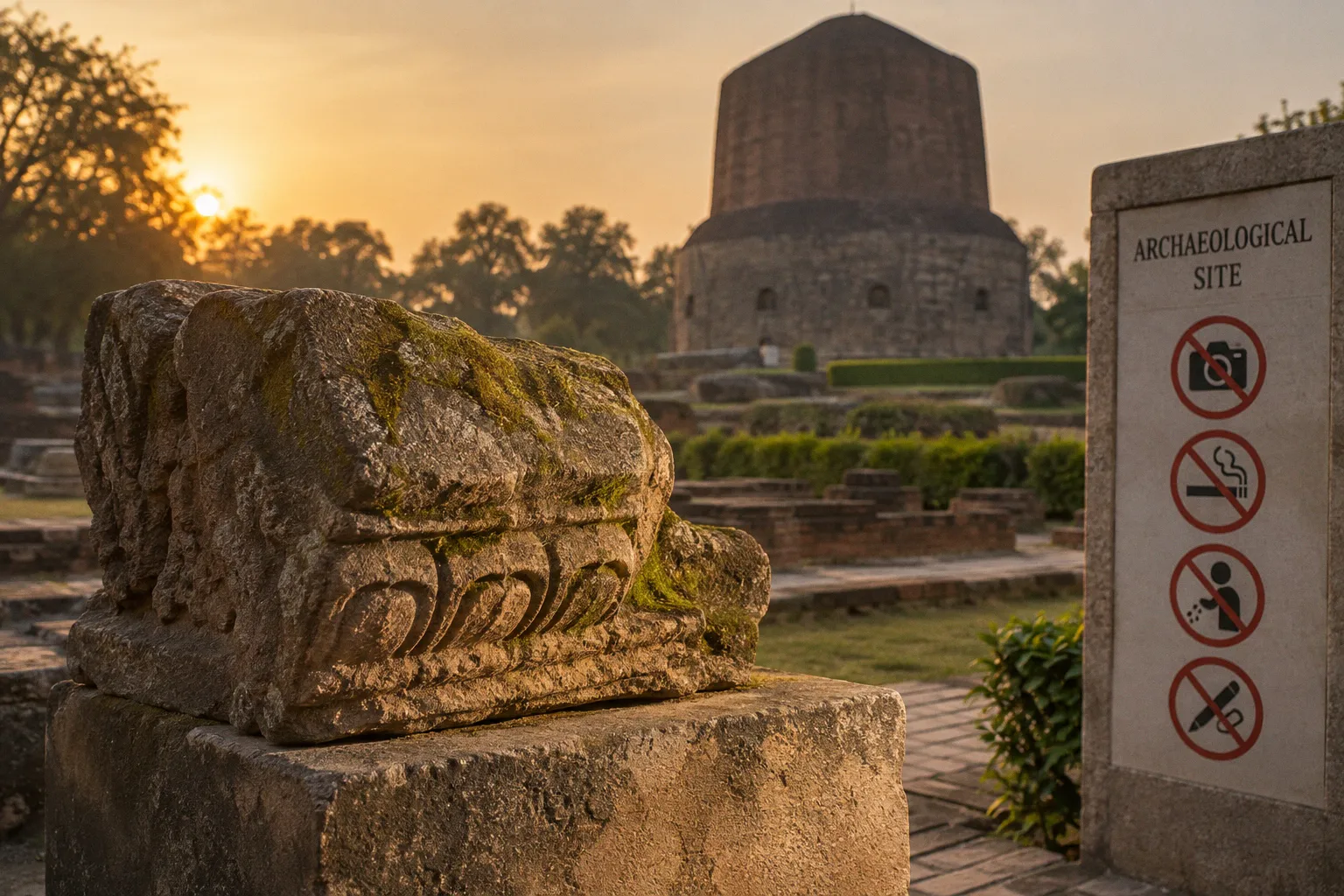
A visit to the Sarnath archaeological site is easy to underestimate. The monuments lie within a relatively compact heritage zone north of Varanasi, but the experience is divided between an open-air archaeological complex, the Archaeological Survey of India (ASI) museum, and several Buddhist institutions outside the protected ruins. They do not necessarily share the same entrance arrangements, opening hours, or visitor rules.
That makes preparation less about covering a long distance and more about understanding the site’s divisions before arriving. A little planning prevents the most common frustrations: reaching the museum on its weekly closing day, leaving too little time for the ruins, arriving without suitable clothing or footwear, or treating exposed archaeological remains like ordinary public architecture.
Mapping the Sarnath archaeological complex
Sarnath is associated with the Buddha’s first sermon, traditionally understood as the beginning of the teaching known as the Dharma Wheel. The protected archaeological area preserves the remains of structures built and rebuilt over many centuries, while the museum holds important sculptures and architectural fragments recovered from the site.
The principal visitor stops are close enough to connect on foot, but they are not one undifferentiated monument.
The main archaeological enclosure contains the Dhamek Stupa, the remains of the Ashoka Pillar, the Dharmarajika Stupa area, the Main Shrine, and the foundations of monastic buildings. The ASI museum stands separately nearby. Outside the archaeological compound are active religious sites, including Mulagandha Kuti Vihara and other monasteries associated with the modern Buddhist presence in Sarnath.
The distinction matters because the atmosphere changes sharply from one place to the next. The ruins are open to the sky and spread across lawns and archaeological trenches. The museum is a controlled indoor space where the visitor’s attention shifts from landscape and scale to sculpture, inscriptions, and fragments. The living monasteries are functioning religious institutions rather than museum extensions.
What to understand about the main monuments
- Dhamek Stupa: The largest and most visually dominant structure in the ruins complex. Its present cylindrical brick mass is the result of later construction and rebuilding over an earlier sacred monument. The Ashokan period is important to the history of the site, but the visible Dhamek structure should not be described as an untouched third-century BCE building.
- Ashoka Pillar remains: The archaeological site preserves the broken pillar shaft and its base. The famous Lion Capital associated with Sarnath is displayed in the ASI museum rather than standing on the original pillar.
- Dharmarajika Stupa: Only part of the ancient monument survives, but the remains help explain the density and changing layout of the sacred complex.
- Main Shrine and monastic remains: These foundations require more imagination than the Dhamek Stupa. Their importance lies in the plan of the settlement and in the evidence of successive Buddhist communities that occupied the area.
- ASI Archaeological Museum: The museum’s collection includes the Lion Capital of Ashoka and other sculptures, architectural elements, and images recovered from Sarnath. It is not a decorative supplement to the ruins; it supplies the details that the weathered remains can no longer show outdoors.
The Dhamek Stupa is often described as approximately 28 metres across, while the visible monument rises considerably higher than that. The more important point for a first-time visitor is historical rather than mathematical: the structure seen today is not simply the original Ashokan stupa preserved intact. It incorporates later phases, including substantial Gupta-period work, over an earlier foundation and sacred core.
At Sarnath, the ruins and the museum are two halves of the same evidence: one shows the scale and setting of the sacred landscape, while the other shows the craftsmanship that time has removed from the open air.
A short historical sequence
The site’s chronology is layered rather than linear.
- Ashokan period: A pillar and early stupa-related construction mark the importance of Sarnath under Mauryan patronage.
- Later ancient periods: The principal monuments were enlarged, rebuilt, or embellished, and Buddhist institutions expanded around them.
- Medieval period: The religious settlement declined, and many structures were damaged or dismantled.
- Modern archaeological investigations: Excavations brought the remains back into historical and scholarly view, while recovered sculptures became part of the museum collection.
- Modern Buddhist revival: New monasteries and temples established Sarnath as a living international Buddhist centre as well as an archaeological site.
This sequence is useful when walking through the enclosure. Not every brick belongs to the same century, and not every low wall represents a complete building. The archaeological landscape is a record of rebuilding, reuse, damage, and interpretation.
Timing the visit without relying on assumptions
The best time for a Sarnath heritage tour depends on what you want from the site. Visitors who want quiet, softer light, and more comfortable conditions outdoors should begin early. Those who want to include the museum need to fit their visit around its separate schedule.
The archaeological ruins generally open during daylight hours, while the museum follows fixed institutional hours and has a weekly closing day. The ASI museum is commonly closed on Fridays, but schedules and holiday closures can change. Confirm the current arrangement through an official source or locally before travelling, particularly during national holidays, festival periods, or long weekends.
Do not plan the whole day around an assumed opening time copied from an old travel listing. Sarnath is a site where a small schedule change can alter the order of the visit.
A practical rhythm is:
1. Begin with the museum if it is open and you want to see the sculptures before the outdoor walk.
2. Move to the archaeological enclosure while you still have enough time to walk slowly around the monuments.
3. Leave space for one of the active Buddhist temples if that is part of your interest.
4. Keep a margin before the final closing time rather than arriving at the gate as staff are preparing to shut the site.
The ruins can be seen in a short visit, but a rushed circuit reduces Sarnath to a photograph of the Dhamek Stupa. Allow more time if you want to read the interpretation panels, understand the foundations, visit the museum properly, and pause at the smaller remains.
Morning, midday, or late afternoon?
Early morning is usually the safest choice for the open-air complex. The light is less harsh, the ground is more comfortable to walk, and the site often feels less pressured than it does later in the day. It is also a good period for visitors who want to sit quietly near the monuments, although the archaeological enclosure remains a public heritage space rather than a private meditation retreat.
Midday can be workable in cooler months, but the exposed paths and lawns offer limited relief from the sun. Carry water and avoid assuming that every part of the enclosure will provide shade.
Late afternoon can produce attractive light on the brickwork, especially when the low sun brings out the texture of the Dhamek Stupa. The trade-off is that you have less time to recover from a delayed journey or a closed counter. A late arrival is sensible only when the museum is not an essential part of the plan.
For a complete visit, the most reliable approach is to treat the museum and ruins as separate appointments. Check the museum’s current opening hours first, then build the outdoor portion around them.
Dhamek Stupa visitor requirements and site conduct
Sarnath is both a protected archaeological site and a place of continuing religious significance. The rules are not difficult to follow, but they require a different attitude from a conventional city attraction.
The exposed brick, carved stone, stucco, and archaeological surfaces are vulnerable to contact, moisture, pollution, and repeated physical pressure. A visitor leaning against a wall for a photograph may appear harmless, but thousands of similar gestures gradually damage a surface that cannot be replaced without altering the monument’s meaning.
Expect the following basic restrictions:
- Do not climb, sit on, lean against, or touch the monuments and exposed remains.
- Do not scratch names, initials, or other marks into brick or stone.
- Avoid flash photography where signs or staff prohibit it, especially around museum objects.
- Do not smoke, spit, or use tobacco products inside the protected area.
- Keep food and drinks away from monument surfaces.
- Follow barriers and marked paths even when a shorter route appears tempting.
- Ask before using professional equipment, tripods, or other equipment that may obstruct circulation.
- Dress respectfully around active Buddhist institutions and follow their photography rules separately from those of the ASI site.
The museum has its own restrictions. Large bags may need to be left in a designated storage area, and photography rules can differ from gallery to gallery. Never assume that a camera permitted in one room is permitted throughout the building. Signs at the entrance and inside the galleries take precedence over general travel advice.
What to carry
The most useful preparation is modest:
- water in a sealed bottle;
- sun protection, including a hat or umbrella;
- comfortable footwear suitable for walking on uneven ground;
- a small amount of cash, even if digital payment is available;
- a phone with enough battery for tickets, maps, and transport;
- a light covering for visits to religious institutions;
- only the minimum luggage needed for the visit.
Avoid bringing a large backpack if you can. It is easier to move through the enclosure without repeatedly turning, brushing against barriers, or worrying about where to place your bag.
Photography is part of the appeal of Sarnath, but the strongest photographs usually come from patience rather than proximity. The Dhamek Stupa does not need a visitor standing against its base to establish scale. Give the monument room, and let the surrounding archaeological landscape remain visible.
Sarnath museum entry guidelines
The ASI museum is essential for visitors who want to understand Sarnath beyond its largest surviving structure. Outdoor remains are necessarily incomplete: walls have collapsed, decorative programmes have been separated from their original buildings, and many sculptures are no longer in their first location. The museum reunites some of that evidence, even when it cannot recreate the original setting.
The Lion Capital is the collection’s best-known object. It is also the reason to approach the gallery with more attention than a quick photograph allows. Look at the relationship between the polished stone, the animal figures, the wheel symbolism, and the architectural function of the capital. The object is not only a national emblem in isolation; it is part of the political and religious history of Sarnath.
Other museum displays help fill out the chronology of the site. Buddha images, bodhisattva figures, inscriptions, fragments of railings, and architectural pieces show how artistic styles and religious imagery changed over time. The collection is particularly useful after walking through the ruins, because the outdoor circuit gives scale while the galleries provide surface detail.
A sensible museum sequence
Begin with the major sculptures, but do not stop there. After seeing the most famous objects, look for the less immediately recognisable fragments:
1. Identify pieces that once formed part of a larger architectural setting.
2. Compare images from different periods rather than treating all Buddhist sculpture as visually interchangeable.
3. Read the labels for provenance and archaeological context.
4. Return to the larger works with the outdoor ruins in mind.
5. Observe the gallery rules instead of relying on what another visitor is doing.
The museum may feel quieter than the open-air complex, but it is not simply a place to cool down. If the visit is scheduled for the middle of the day, use the indoor time to examine details that would be difficult to read under strong sunlight outdoors.
Admission arrangements and fees can change, and the museum and archaeological enclosure may not operate through one universal ticketing system. Check the current fee structure and payment options before entering. Keep any ticket or receipt until the visit is complete, but do not rely on an assumed re-entry privilege or combined pass unless the current rules explicitly provide one.
This is a small distinction with practical consequences. A visitor who leaves the museum expecting to return without checking the conditions may find that the day’s sequence no longer works.
Transit from Varanasi to the heritage zone
Sarnath is close enough to Varanasi for a half-day visit, but the journey should not be treated as a fixed-distance calculation. Traffic, road conditions, school hours, religious events, and the starting point within the city can all affect the trip.
Auto-rickshaws, e-rickshaws, taxis, app-based cars, and buses may all be available, though their convenience varies by time and location. Agree on the fare before departure when using a vehicle without a meter, and confirm whether the quoted amount covers the full ride or only one passenger. App-based services may be convenient for the outward journey but less predictable for the return, especially if you leave from a quieter part of the heritage zone.
A private car or taxi is useful for travellers combining Sarnath with other stops, older visitors, or anyone carrying luggage. It is not automatically faster. The vehicle still has to deal with the same roads, and it will not take you inside the protected archaeological enclosure.
Public transport is cheaper but demands flexibility. Routes and departure intervals may be less predictable than a visitor expects, and shared vehicles may not leave immediately. If the museum’s closing time is central to the plan, a private or pre-arranged return is less stressful.
Ashoka pillar viewing tips and movement inside the site
The Ashoka Pillar remains are easy to overlook because the broken shaft does not dominate the landscape in the way the Dhamek Stupa does. Read the site plan before beginning the walk, then locate the pillar base as part of the archaeological sequence rather than searching for a standing column.
The museum visit should follow or precede this stop deliberately. Seeing the Lion Capital indoors and then standing near the pillar remains outdoors makes the separation between surviving object and original setting clearer. The capital is not merely missing from the pillar; its preservation in the museum is part of the reason the object survives for close study.
Inside the ruins, follow the paths in a way that lets you see the large monument first and then return to the smaller foundations. The Dhamek Stupa provides orientation, but the low walls and platforms reveal how much of Sarnath’s importance depended on the surrounding monastic and ceremonial buildings.
Transport planning by time of day
Leave Varanasi with more time than the map suggests. A journey that looks short on a phone can become slow during busy periods. Early departure is the sensible option for visitors who want to reach the museum near opening time or who have a fixed return train, flight, or appointment.
For the return journey, arrange transport before you are ready to leave if you are using a taxi or private car. If relying on a shared vehicle, ask at the start of the visit where the return stand is located. Do not assume that the vehicle that brought you will still be available several hours later.
Parking and drop-off arrangements can change, and vehicles are not permitted inside the protected monument area. Follow local signs and staff instructions rather than treating the nearest possible stopping point as the correct entrance.
Building a workable first visit
There is no single correct route through Sarnath, but a first visit benefits from a clear priority. The following order works when both the museum and ruins are open:
1. Check the day’s opening arrangements before leaving Varanasi.
2. Arrive with enough time to complete the museum without watching the clock.
3. Visit the main galleries, giving particular attention to the Lion Capital and the wider collection of Sarnath sculpture.
4. Walk to the archaeological enclosure and begin with the Dhamek Stupa.
5. Continue to the Ashoka Pillar remains, the Dharmarajika Stupa area, the Main Shrine, and the monastic foundations.
6. Take a quiet pause away from the monument walls rather than sitting on them.
7. If time and energy allow, continue to Mulagandha Kuti Vihara or another nearby Buddhist institution.
8. Start the return journey before the final closing period and before transport becomes harder to arrange.
On a Friday, confirm the museum situation before setting out. If the museum is closed, the archaeological enclosure can still form the main visit, while the surrounding monasteries provide a different perspective on Sarnath as a living Buddhist destination. They should be approached on their own terms, with attention to worship, photography, footwear, and silence.
A longer visit is worthwhile for anyone interested in architecture, conservation, Buddhist history, or the relationship between an archaeological site and its modern religious landscape. A shorter visit can still be satisfying if it is focused. The mistake is not spending only a few hours; it is spending those hours moving between entrances without understanding what each part of Sarnath contributes.
Reading the site as a place of preservation
The condition of Sarnath is uneven because the site itself is uneven. Some remains are robust enough to communicate their form from a distance. Others are low, fragmentary, or protected by barriers because their significance lies in details that are easily lost through weathering and contact.
The Dhamek Stupa illustrates the problem clearly. Its brick surface is visually solid, but age, rain, heat, biological growth, and visitor pressure all affect exposed masonry. The fact that a monument appears stable does not mean that its surface is indestructible. Nor does every visible brick belong to the earliest phase associated with the site.
The same caution applies to the smaller ruins. A foundation may look like an ordinary low wall to a hurried visitor, yet its position can reveal the arrangement of a shrine, monastery, courtyard, or processional space. Interpretation panels and site plans are therefore not optional extras. They are what turns scattered masonry into an archaeological argument.
Conservation also explains why access is sometimes restricted, why a path may seem indirect, and why a familiar photographic position may be unavailable. These decisions can be inconvenient, particularly when a visitor has travelled a long way, but the alternative is to treat irreplaceable remains as scenery.
The museum extends that preservation logic indoors. Objects that could not remain safely exposed are kept in a controlled setting where they can be studied without the same direct pressure from weather and crowds. Visitors contribute to that effort in simple ways: keeping distance, following photography rules, not touching displays, and resisting the urge to make every object part of a personal photograph.
The most respectful way to see Sarnath is to accept that some of it will remain incomplete. The gaps are not failures of the visit; they are part of the history the site has managed to preserve.
Final preparation for a Sarnath heritage tour
Before leaving Varanasi, check four things: whether the museum is open that day, how you will reach the site, whether your clothing and footwear suit both the ruins and religious institutions, and how much time you are genuinely willing to spend outdoors.
The central facts are straightforward. The Dhamek Stupa is a later visible structure built over an earlier sacred foundation. The Ashoka Pillar remains are outdoors, while the Lion Capital is preserved in the ASI museum. The archaeological enclosure, museum, and active monasteries are related but distinct places. Their rules and schedules should not be treated as interchangeable.
That is the practical meaning of sarnath archaeological site visit preparation. It is not a demand for an elaborate itinerary. It is a way of arriving with the right expectations: the famous monument will be the easiest thing to recognise, but the smaller remains, the museum objects, and the boundaries between ancient site and living religious centre are what make Sarnath worth more than a quick stop on a Varanasi circuit.