Varanasi Junction redevelopment: navigating transit delays
Varanasi Junction, also known as Varanasi Cantt, is being rebuilt as part of a wider railway and urban-transit programme.
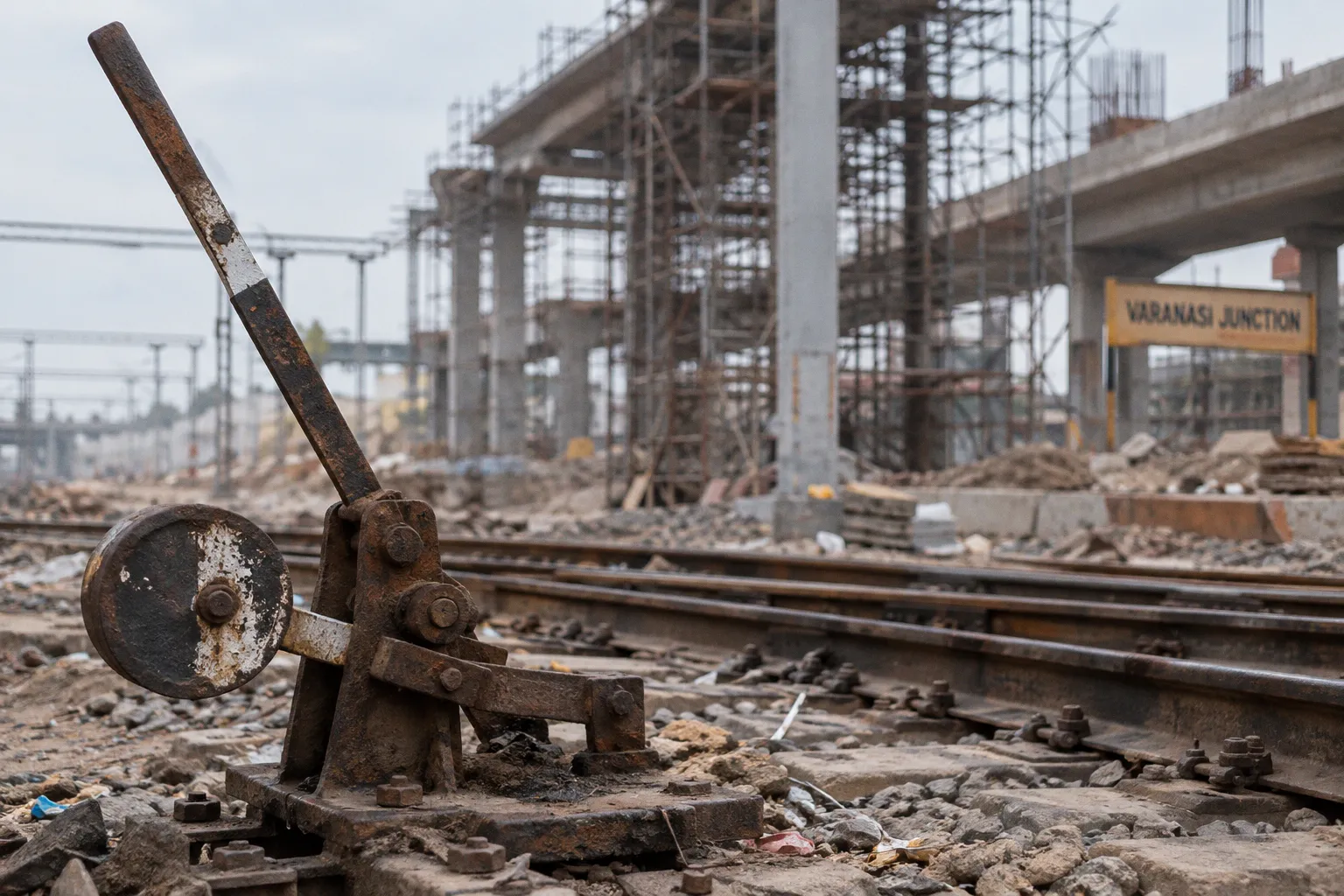
The station’s ₹568 crore yard remodelling has added Platforms 10 and 11, extended platforms to as much as 600 metres, introduced computerised signalling, installed four washing lines, and created new track connections towards Lohta and Kashi.
The result is a more capable railway hub, but the construction process has altered how trains enter, terminate, and depart from the city. During intensive work blocks, railway authorities have used diversions, cancellations, and the redistribution of passenger traffic among Banaras, Lohta, Varanasi City, and Varanasi Junction. The practical consequence is direct: a ticket for Varanasi does not always mean a simple arrival at the same station.
The current problem is therefore not that Varanasi Junction is closed. It is that its spatial role is changing while trains continue to operate through a constrained and regularly adjusted network.
The scale of the Varanasi Junction redevelopment
The station upgrade is best understood as a yard project rather than a cosmetic renovation. Passenger buildings attract attention, but the decisive work is taking place in the infrastructure behind the platforms: track connections, signalling, washing capacity, platform length, and the distribution of train movements.
The ₹568 crore remodelling programme added two platforms, numbered 10 and 11. Platform extensions reaching up to 600 metres allow the station to handle longer train formations without splitting passenger operations across shorter usable sections. Four new washing lines expand the capacity for train servicing and preparation. Track connections to the Lohta and Kashi lines provide additional routing options within the Varanasi rail network.
These changes address several separate constraints:
- Platform capacity. Longer platforms make it easier to receive extended train formations and reduce the need for operational compromises at the station throat.
- Yard circulation. New connections allow trains to be routed through the wider Varanasi system rather than forcing every movement through the same sequence of tracks.
- Signalling. Computerised systems improve the management of conflicting train movements, although they do not eliminate disruption while physical works are under way.
- Train servicing. The four washing lines increase the railway’s ability to clean and prepare rakes without occupying passenger platforms for longer than necessary.
- Regional distribution. The project fits into a multi-station strategy in which Varanasi Cantt, Kashi, Banaras, and Varanasi City operate as parts of a single railway hub.
The construction phase has a different spatial logic from the completed station. Tracks may be available in the final layout but inaccessible during a block. A platform may exist physically but not be assigned to a particular train. A route may remain open for passenger services while trains normally using it are diverted elsewhere.
That distinction explains why the Varanasi railway station construction status cannot be judged only by looking at the station façade or by asking whether trains are still running. The relevant question is which routes, platforms, and station functions are operational on the date of travel.
Varanasi Junction is not a single point of failure anymore, but during construction the passenger must understand the entire station network rather than one station name.
A major 45-day block began on September 1, 2023, during intensive yard remodelling and non-interlocking work. Railway authorities managed the resulting congestion through route diversions, selected cancellations, and the transfer of boarding or terminating services to alternate stations. Such blocks are temporary, but their effects are not always obvious from a journey plan prepared weeks in advance.
Strategic station hopping: Banaras, Lohta, and Kashi
Varanasi’s railway geography is now operationally distributed. This matters because travellers often plan around the city name displayed on a ticket, while the actual station determines the final road journey, the available transport, and the time required to reach the ghats or hotel district.
The principal stations involved in the current arrangement are not interchangeable.
| Station | Operational role during redevelopment | Practical consequence for passengers |
|---|---|---|
| Varanasi Junction, or Cantt | Main rebuilt interchange with expanded yard and new platform capacity | The most central reference point, but also the station most directly affected by block works and platform reassignment |
| Banaras | Alternate hub for selected trains and redistributed passenger loads | Can be a better arrival point when a service is shifted away from Cantt, but the onward road journey must be checked separately |
| Kashi | Connected to the wider yard and route structure | Useful for services assigned to the Kashi side of the network; not a substitute in terms of immediate access to every neighbourhood |
| Varanasi City | Regional alternative for selected boarding and termination movements | May prevent cancellation of a journey, but requires a separate transfer plan |
| Lohta | Important in route diversion and track integration arrangements | Its relevance is mainly operational; passengers should not assume that every diverted train will be convenient for local sightseeing districts |
The safest approach is to treat the station as part of the itinerary, not as a minor ticket detail. A traveller staying near Dashashwamedh, Godowlia, Sigra, or the riverfront may have a very different transfer requirement depending on whether the train terminates at Cantt, Banaras, Kashi, or Varanasi City.
This is particularly significant for early-morning arrivals. At that hour, the difference between a station with immediate road access and one requiring a longer transfer can affect hotel check-in, connections to the ghats, and onward travel to the airport. It is also more difficult to improvise when taxis, auto-rickshaws, and app-based vehicles are operating with lower availability.
The operational substitution works in both directions. A traveller boarding at Varanasi may find that the departure station is not Cantt but Banaras or another hub. A passenger whose ticket originally showed Varanasi Junction may receive a revised termination point. The change is manageable when identified in advance. It becomes expensive when discovered after the traveller has already arranged a hotel transfer or an intercity connection.
How to plan the transfer between stations
A practical station-hopping plan has four components:
1. Read the boarding and termination station separately. Do not rely on the city name alone. Confirm the exact station code and station name shown in the latest railway information.
2. Allow a road-transfer margin. A change from Cantt to Banaras or Kashi is not a platform change. It is a separate urban journey subject to congestion, roadworks, and demand.
3. Keep the first and last legs flexible. The most vulnerable parts of the itinerary are the journey from the station to the hotel and the connection from one station to another.
4. Avoid tightly matched onward tickets. If a train arrives at one Varanasi hub and the next service departs from another, a short nominal gap is not a reliable connection during infrastructure work.
The city’s road network adds another variable. Varanasi Junction is linked to major urban corridors, but the route towards a hotel in the old city is not determined only by distance. Narrow access roads, restricted vehicle movement, congestion around major intersections, and riverfront traffic can make a short map distance operationally slow.
Decoding operational blocks and train diversions
A railway block is a scheduled period during which normal train movements are restricted so that track, signalling, bridge, platform, or yard work can proceed safely. The passenger may encounter several consequences:
- a train runs by a different route;
- a service begins or ends at an alternate station;
- a train is cancelled for a specific date;
- boarding is shifted from Varanasi Junction to another hub;
- the platform is reassigned close to departure;
- a train’s public timetable remains familiar while its operational path changes.
These outcomes should not be treated as evidence that the station has ceased operating. Varanasi Junction continues to handle trains, but the pattern of movement can change during specific work windows.
The 45-day block associated with the 2023 yard remodelling illustrates the scale of the disruption-management problem. Authorities did not simply stop services. They redistributed the load through diversions, cancellations, and alternate stations, allowing the wider network to continue functioning while sections of the yard were unavailable.
This is why a historical timetable is not sufficient evidence for a future journey. A train that normally boards at Cantt may be reassigned during a later block. A service that previously passed through the city may be regulated, diverted, or terminated short of its usual station. The exact response depends on the work programme and the available routes at that time.
A more reliable way to monitor a journey
Passengers travelling through Varanasi during station upgrades should monitor the journey at several points rather than conducting one check at the time of booking.
- At booking: record the exact station, train number, scheduled arrival, scheduled departure, and final destination.
- Several days before travel: check whether the service has acquired a diversion, revised boarding point, or altered termination station.
- On the day before departure: verify the latest operational information and check the route from the assigned station to the accommodation.
- At the departure station: confirm the platform and any last-minute announcement. Construction periods increase the value of arriving earlier than the nominal minimum.
- After arrival: re-check the station for the return journey. The return service may be assigned to a different Varanasi hub.
The unknowns are significant. There is no reliable basis for assigning a single delay percentage to the redevelopment, and the exact completion date for every part of the integrated railway master plan has not been established. Delay risk therefore has to be managed through time and route flexibility, not through a fabricated average.
What the redevelopment does not mean
The Varanasi Cantt station redevelopment timeline should not be read as a continuous closure schedule. The available information describes works carried out through defined blocks and phased interventions. Passenger operations continue, with adjustments made when particular tracks, platforms, or yard sections are unavailable.
Nor does the existence of diversions mean that every train arriving in Varanasi will use an alternate station. The effect depends on the service, the date, and the work window. Broad warnings such as “all trains are shifted to Banaras” are operationally inaccurate and can create as many problems as they solve.
The wider railway network: from station upgrade to regional capacity
The Junction project is only one element of a larger capacity plan. Indian Railways is implementing an integrated master plan across Varanasi Cantt, Kashi, Banaras, and Varanasi City. The stated objective is to increase the handling capacity of the Varanasi region from approximately 150 trains per day to between 400 and 500 trains per day.
That target changes the interpretation of the current inconvenience. The strategy is not simply to make one station larger. It is to create a more distributed regional system in which multiple stations, routes, platforms, and servicing facilities can absorb train movements.
A second major intervention is the Varanasi–Pt. Deen Dayal Upadhyaya multi-tracking project. Approved at a cost of ₹2,642 crore, the project has a four-year timeline and includes third and fourth railway lines, as well as a new rail-cum-road bridge over the Ganga. Its purpose is to address a bottleneck on one of the most heavily used approaches to the Varanasi rail network.
For passengers, additional tracks should eventually reduce the pressure created when long-distance, regional, freight, and local movements compete for limited paths. During construction, however, extra infrastructure can temporarily reduce operational flexibility because existing routes must coexist with new works.
The effect is similar to a road widening project in a dense city. The completed carriageway may carry more traffic, but construction requires lane restrictions before the additional capacity becomes available. Railway infrastructure has the same temporal imbalance: the disruption arrives first, while the capacity benefit is delayed.
The elevated Varuna corridor and the city’s transfer problem
Railway delays cannot be isolated from road access. The passenger’s journey through Varanasi does not end at the platform. It continues through the road network to a hotel, ghat, bus connection, airport transfer, or another railway station.
The Cabinet Committee on Economic Affairs approved a ₹10,998.32 crore elevated corridor extending 43.218 kilometres along the Varuna River. The planned connection links NH-31, Varanasi Junction, Kashi Railway Station, and Lal Bahadur Shastri International Airport. Its stated purpose is to reduce road congestion around major transit points and create a more direct urban connection between the railway and airport systems.
This corridor is a large-scale decongestion project, not an immediate solution to current station transfers. Its relevance for present travel planning is that Varanasi’s infrastructure programme is being developed as an interlocking system:
- railway yard remodelling increases train-handling capacity;
- multi-tracking addresses congestion on the Varanasi–DDU approach;
- the elevated corridor addresses surface movement between transit hubs;
- station redistribution allows trains to use more than one urban node;
- improved access should eventually make alternate stations more practical.
Until those projects are complete and fully integrated, the passenger experiences the system in fragments. A train may be operationally successful but inconvenient because the arrival station is poorly connected to the final destination. A station may have new platforms but remain difficult to reach during a road bottleneck. A technically efficient diversion may produce a longer door-to-door journey.
The relevant unit is not the platform. It is the complete movement from the train’s assigned station to the traveller’s actual destination.
This distinction is especially important for visitors using Varanasi Junction as a gateway to the old city. The riverfront and temple districts are not arranged around the railway station. Their access depends on the final road section, where congestion and vehicle restrictions can dominate the journey even when the train itself is on time.
Building a workable travel schedule during the upgrades
A robust itinerary should assume that the railway component and the city-transfer component can fail independently. A train may arrive at its revised station on time, while the road journey to the hotel takes longer than expected. Conversely, a train may be diverted while the road network is clear.
The following planning method is more reliable than simply adding an arbitrary delay allowance:
1. Separate the journey into three locations. Record the train’s scheduled station, the station actually confirmed before travel, and the final destination in Varanasi. These may not be the same place.
2. Map the alternate station before departure. Identify the road route from Banaras, Kashi, Varanasi City, or Lohta to the accommodation. Do not wait until arrival to determine whether the transfer is short or substantial.
3. Protect fixed appointments. Temple entry windows, airport departures, intercity buses, and hotel check-in arrangements should not be scheduled immediately after an arrival affected by a possible block.
4. Use the latest railway information, not a static booking record. The booking establishes the journey but may not reflect a later operational adjustment.
5. Carry the station name in written form. In a multilingual and congested transport environment, the exact station name is more useful than a generic instruction to go to “Varanasi railway station.”
6. Treat return travel separately. Construction impacts can differ by direction, date, and station assignment. The outbound plan does not automatically apply to the return.
7. Keep luggage compatible with a transfer. A station change can turn a simple platform movement into a road journey involving vehicle changes and uneven access points.
8. Arrive with a time margin that covers orientation. The problem is not only train delay. It is also finding the correct entrance, platform, vehicle stand, or alternate station connection.
The most exposed travellers are those with a chain of tightly timed bookings: arrival at Cantt, transfer to a hotel, visit to a temple, return to another station, and onward departure on the same day. The more interdependent the itinerary, the more one station reassignment can affect the entire schedule.
A slower itinerary is structurally safer. One full day without a fixed intercity connection gives the railway network room to absorb a diversion or a late arrival. This is not a statement about the city’s efficiency. It is a response to a construction environment in which final operating conditions may be confirmed close to the date of travel.
Preservation, expansion, and the changing railway city
Varanasi Junction redevelopment is part of a broader negotiation between historic urban form and modern transport demand. The city’s railway infrastructure must handle more trains and longer formations while connecting to a dense urban area whose roads, neighbourhoods, and riverfront districts were not designed around present passenger volumes.
The immediate traveller sees inconvenience: revised platforms, unfamiliar station names, diversions, and additional road transfers. The infrastructure view is wider. A station capable of handling more trains, a rail corridor with additional lines, and a road system that links the airport to multiple railway hubs can reduce pressure on the historic core over time.
That outcome is not automatic. New capacity must be matched by clear passenger information, reliable station-to-city transfers, and preservation controls around the old urban fabric. A larger railway system that leaves passengers unable to identify their actual departure point is not a complete transport solution.
For now, the correct response to the Varanasi Junction railway station redevelopment delays is neither alarm nor complacency. Varanasi Junction remains operational, but its role is being reorganised through phased construction and network-wide redistribution. Passengers who verify the exact station, monitor the service close to departure, and keep the road-transfer segment separate from the train journey can manage the disruption.
The long-term direction is clear: Varanasi is moving from a single dominant railway gateway towards a connected system of stations and corridors. The current construction period is the difficult interval between those two models.