Banaras Gharana music venues for authentic cultural immersion
Finding an authentic Banaras Gharana music performance venue in Varanasi is not simply a matter of locating a concert hall and purchasing a ticket.
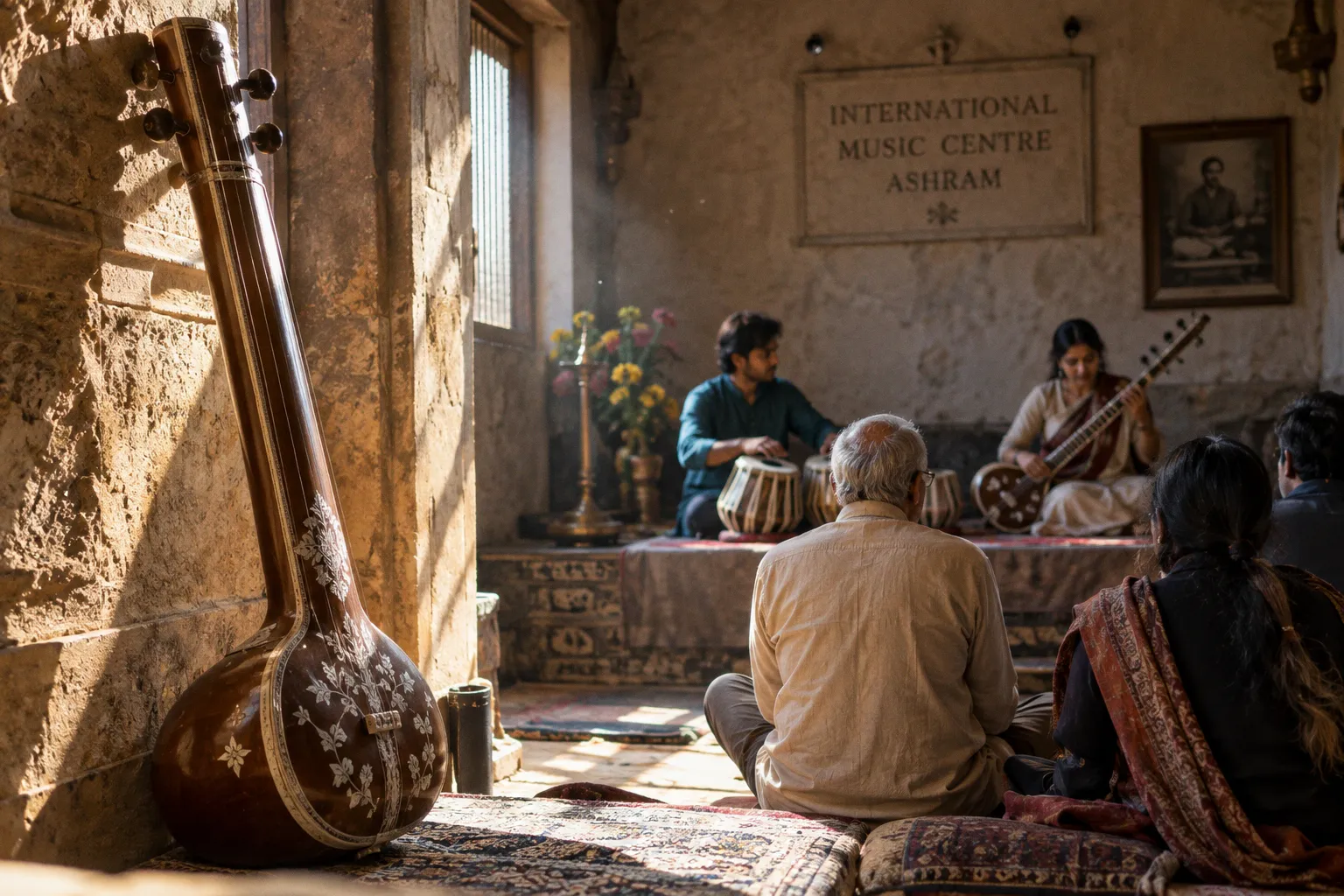
The city’s classical music tradition is encountered through different forms of observance: a dawn gathering at Assi Ghat, an intimate baithak in an ashram, or a temple festival where audiences and musicians share the same open devotional setting. Each environment carries a different significance, and the etiquette expected from you changes accordingly.
The Banaras Gharana, also known as the Benares or Varanasi tradition, is not one single sound confined to one institution. It is a living lineage of Hindustani music shaped by vocalists, instrumentalists, and percussionists, with especially strong associations with tabla and pakhawaj traditions, devotional performance, temple culture, and the broader artistic life of Kashi. To listen well here, we need to understand not only when music is performed, but why it is being performed in that particular place and at that particular hour.
Subah-e-Banaras: the dawn tradition at Assi Ghat
For many visitors, Subah-e-Banaras is the most accessible entry point into Varanasi’s classical music culture. The programme takes place daily at Assi Ghat, beginning around 5:00 to 5:30 in the morning, before sunrise. Its name combines subah, meaning morning, with Banaras, and the programme is designed around the cultural and ritual atmosphere of the early day rather than around a conventional ticketed concert.
Subah-e-Banaras was initiated on November 24, 2014. The morning unfolds through a sequence of observances and performances, with live classical music recitals following the early rituals. The setting matters as much as the repertoire: the riverfront, the first light, the movement of worshippers, and the gradual arrival of the city all form part of the experience.
You should arrive before the music begins rather than treating the programme as a performance you can enter casually halfway through. At this hour, Assi Ghat is already active, but it is not yet operating at the more crowded pace familiar from later in the day. Sit quietly, keep your phone muted, and allow the programme to proceed without turning every moment into a photograph. The significance of Subah-e-Banaras lies partly in its continuity. It is a recurring morning observance, not a spectacle arranged solely for visitors.
The exact artist line-up changes from day to day, so you should not assume that every morning will feature the same instrument, vocalist, or style. This variability is part of the programme’s character. One morning may foreground a vocal recital; another may offer an instrumental performance or a different combination of classical and devotional elements. If you are hoping to hear a specific artist, confirm the schedule locally rather than relying on a general description of the programme.
How to approach the morning
Subah-e-Banaras works best when you treat it as the opening of a cultural day in Kashi, rather than as an isolated attraction. After the recital, you can remain at Assi Ghat for the changing riverfront activity, walk into the adjoining lanes, or continue towards temples and neighbourhood markets. The early start also gives you a chance to observe how music, ritual, and public space overlap in Varanasi without requiring a formal festival pass.
A few practical habits will make your participation more respectful:
- Arrive ten to fifteen minutes early so that you can settle without interrupting the gathering.
- Wear clothing suitable for a public religious and cultural setting, particularly if you plan to continue to nearby temples.
- Avoid loud conversation during the recital, even if people around you appear to be moving through the space.
- Ask before photographing performers at close range, and do not place a phone or camera between the musicians and the audience.
- Keep footwear and personal belongings arranged so that they do not obstruct passageways or ritual areas.
At Subah-e-Banaras, the music is not an ornament added to the morning; it is part of the way the morning is observed.
This distinction helps explain why the programme may feel different from an evening concert in a formal auditorium. The performance is connected to the time of day, the riverfront, and the rhythm of communal observance. Listening attentively is therefore a form of participation.
The International Music Centre Ashram: intimate baithaks in Kashi
If Subah-e-Banaras introduces you to public dawn performance, the International Music Centre Ashram offers a more intimate route into the city’s classical music environment. The ashram hosts Indian classical music concerts featuring emerging artists every Wednesday and Saturday, beginning at 8:00 PM and continuing for approximately two hours.
The distinction between this setting and a large public festival is important. A baithak traditionally refers to a seated gathering, often intimate in scale, where musicians and listeners share a closer relationship than they would in a commercial auditorium. The term is not merely a synonym for any concert. Its significance lies in the proximity, concentration, and conversational quality of the setting, where the audience may experience a raga developing over time rather than receiving a sequence of abbreviated stage appearances.
The International Music Centre Ashram was founded in 1975 and is organised by tabla player Shri Keshava Rao Nayak and santoor player Shri Shivaji Rao Nayak Kevale. Its history places it within the institutional lineage of Varanasi’s classical music life, while its regular Wednesday and Saturday schedule makes it one of the more dependable options for visitors seeking evening classical music sessions in Kashi.
You should not describe the ashram as hosting nightly concerts: the documented schedule is Wednesday and Saturday at 8:00 PM. Because programmes and performers can change, confirm the evening’s details before travelling across the city. The ashram is most useful to visitors who can shape their itinerary around a particular evening rather than those looking for a performance at any hour.
What makes an ashram concert different
In a baithak-style environment, the audience’s attention becomes part of the atmosphere. Classical music, especially a raga-based performance, is not always arranged around quick transitions or familiar refrains. The musician may establish the mood and tonal world gradually, and a listener who arrives expecting constant visual or dramatic movement may misread the performance as slow. In fact, the unfolding is the point.
The word raga is often translated as a melodic framework, but this definition is only a beginning. A raga is associated with particular melodic movements, emotional colours, and performance conventions, and its identity emerges through the way a musician inhabits those possibilities. The same raga can sound different depending on the artist, instrument, time, and setting.
Tabla accompaniment introduces another layer. In Hindustani music, tala refers to a rhythmic cycle, while the tabla articulates and elaborates that cycle through a vocabulary of strokes. You do not need technical training to listen meaningfully, but it helps to notice how the music moves from a spacious melodic opening towards increasingly defined rhythm and interaction.
A respectful listener does not need to pretend to understand every technical detail. You can simply observe the development:
1. The opening may be unhurried, with the musician establishing pitch, melodic identity, and atmosphere.
2. The rhythmic structure may become clearer as the performance progresses.
3. Exchanges between soloist and accompanist can become more animated without turning the piece into a competition.
4. The conclusion may arrive with a sense of resolution that is difficult to predict if you are accustomed to verse-chorus song structures.
This kind of listening is especially valuable for anyone researching traditional music heritage sites in Varanasi, because it reveals the social mechanics of classical performance. The music is not only preserved through monuments or written archives. It survives through teaching, rehearsal, accompaniment, patronage, and the repeated act of gathering to listen.
Sankat Mochan Sangeet Samaroh: temple heritage and public access
The Sankat Mochan Sangeet Samaroh represents a different scale and a different relationship between classical music and sacred space. It is an annual festival held on the premises of the Sankat Mochan Hanuman Temple in Varanasi during Hanuman Jayanti. Admission is free and open to the public, and the festival is known for its extended sequence of performances rather than a single evening programme.
The festival began in 1923 as an informal gathering and later developed into a five- to six-night event featuring nearly sixty classical performances. That history gives the Samaroh a particular place in Banaras Gharana cultural heritage: it is not simply a festival that borrows the prestige of a temple, but an event whose identity has grown through the long relationship between devotional space, musicians, and public listeners.
Because the festival takes place within temple premises, you should approach it with the etiquette you would bring to any religious site. The musical programme may attract visitors who are primarily interested in renowned performers, but the temple remains an active sacred environment. Dress modestly, follow local instructions, and understand that movement through the venue may be shaped by worship, security, crowd management, or ritual activity.
The open admission is a significant part of the festival’s character. You should not plan on paid VIP seating or assume that access depends on purchasing a premium ticket. At the same time, free entry does not mean unlimited convenience. A large, multi-night public festival requires patience, and the most popular evenings may involve considerable attendance. Arrive with realistic expectations about seating, entry procedures, and the duration of the programme.
Comparing the principal listening settings
| Venue or programme | Typical timing | Setting | Best suited to | Main etiquette concern |
|---|---|---|---|---|
| Subah-e-Banaras at Assi Ghat | Around 5:00–5:30 AM daily | Open riverfront gathering | First introduction to morning music and public cultural observance | Arrive quietly and respect the dawn ritual atmosphere |
| International Music Centre Ashram | Wednesdays and Saturdays from 8:00 PM | Intimate ashram concert setting | Focused listening and emerging classical artists | Avoid treating a baithak as a drop-in entertainment venue |
| Sankat Mochan Sangeet Samaroh | Annual festival during Hanuman Jayanti, over five to six nights | Temple premises and large public gathering | Extended exposure to classical music and festival culture | Follow temple etiquette and prepare for crowds and long sessions |
The strongest choice depends on your purpose. Subah-e-Banaras is the most practical for a first encounter and requires no elaborate planning beyond waking early. The International Music Centre Ashram is better for a concentrated evening performance in a smaller setting. Sankat Mochan Sangeet Samaroh offers the deepest immersion in the relationship between temple observance and classical music, but it requires more flexibility and tolerance for a busy festival environment.
Listening beyond the performance: lineage, place, and patience
Visitors sometimes approach Banaras Gharana as though it were a fixed product: a recognisable sound that can be consumed in one performance and checked off an itinerary. That expectation overlooks the meaning of gharana. The term refers to a lineage or school of musical practice, including methods of training, performance habits, aesthetic preferences, and relationships between teachers and students. A gharana is carried by people and institutions, not stored in a building like an object in a museum.
This is why the same city can offer several valid pathways into its musical heritage. A temple festival, an ashram concert, and a dawn riverfront gathering do not replicate one another. They reveal different parts of the cultural ecology that allows the tradition to continue.
The music also sits within a wider Banarasi environment that includes devotional singing, classical dance, tabla and pakhawaj practice, local festivals, Sanskrit learning, and the patronage networks that have historically supported artists. A visitor who hears only the most public performance may still have a meaningful experience, but the significance becomes clearer when you pay attention to the surrounding conditions: who has come to listen, how the audience behaves, whether the performance is connected to a ritual calendar, and how much time the musicians are given to develop their work.
For this reason, it is worth allowing at least one performance to remain unhurried. Do not leave immediately because the opening seems quiet. Do not judge a recital by how quickly it produces a recognisable climax. Classical music in Banaras often rewards sustained attention, and the mechanics of that attention are themselves part of the cultural encounter.
If you are planning a broader Banaras Gharana cultural heritage tour, use these venues as connected points rather than unrelated stops. Begin with the public accessibility of Subah-e-Banaras, attend an evening baithak if your schedule permits, and consider the Sankat Mochan festival when its calendar aligns with your visit. The sequence allows you to move from open public observance to intimate performance and then to the larger devotional and historical framework of the temple festival.
A practical route for culturally respectful participation
A thoughtful itinerary does not need to be crowded. One well-chosen recital can teach you more than several hurried stops, particularly if you leave time to reflect on the setting.
A useful approach is:
1. Start at Assi Ghat before sunrise. Attend Subah-e-Banaras without expecting a fixed artist line-up, and observe how the recital follows the morning rituals.
2. Reserve an evening for the ashram. If your stay includes a Wednesday or Saturday, plan around the 8:00 PM concert at the International Music Centre Ashram and confirm the evening’s arrangements locally.
3. Treat the festival calendar as decisive. Sankat Mochan Sangeet Samaroh is an annual event during Hanuman Jayanti, not a daily performance venue, so it belongs in a festival-focused itinerary rather than an ordinary sightseeing route.
4. Listen for development rather than spectacle. Notice the movement from melodic exploration to rhythmic structure, and allow the performance enough time to establish itself.
5. Let etiquette guide your presence. Keep conversations low, follow temple and venue instructions, ask before close photography, and remember that the musicians are not performing solely as a backdrop for travel content.
The most important preparation is not musical vocabulary but an understanding of your position as a guest. You may be welcomed warmly, yet you are entering spaces shaped by religious observance, artistic discipline, and local relationships that existed long before your arrival.
Authentic immersion in Banaras music begins when you stop asking whether a performance looks traditional and start asking what relationship it has to the people and place sustaining it.
The practical takeaway
For a reliable introduction to classical music concerts in Varanasi, choose Subah-e-Banaras at Assi Ghat and arrive before dawn. For a more concentrated evening encounter with emerging Indian classical artists, look to the International Music Centre Ashram on Wednesday or Saturday at 8:00 PM. If your travel dates coincide with Hanuman Jayanti, the free, multi-night Sankat Mochan Sangeet Samaroh offers the most substantial opportunity to experience music within the living environment of a major temple festival.
These venues do not offer interchangeable versions of the same tradition. Each carries its own lineage, schedule, audience, and etiquette. When you understand that difference, your visit becomes more than the search for an authentic sound. You begin to participate, carefully and respectfully, in the cultural life through which Banaras Gharana music continues to be heard.