Dev Deepawali in Varanasi: common planning mistakes to avoid
The most common misunderstanding among first-time visitors planning a Dev Deepawali trip to Varanasi is a quiet but consequential one: the festival is not Diwali itself.
It falls fifteen days later, on Kartik Purnima, the full moon night of the Hindu month of Kartik. By the time many travelers realize the distinction, accommodation near the riverfront is already heavily committed and the boat operators with practical routes are returning polite regrets.
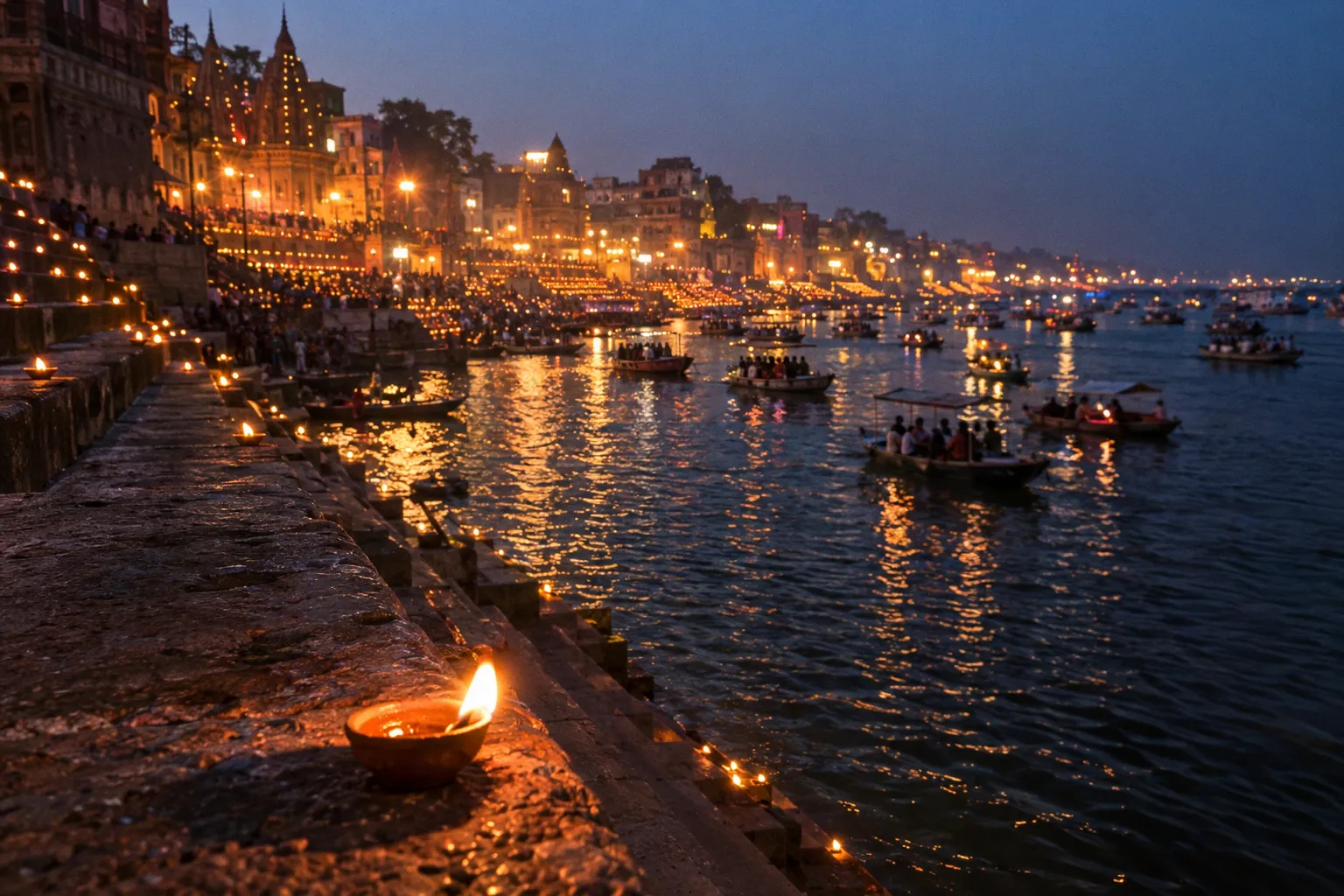
That difference is not a small calendrical footnote. Diwali and Dev Deepawali are separate observances, with different rhythms and different planning pressures. Kartik Purnima has an ancient place in the religious life of Varanasi, while the large, coordinated illumination of the ghats that visitors now associate with Dev Deepawali is a comparatively recent organized tradition. The modern festival has grown into one of the city’s defining public evenings: hundreds of thousands of earthen oil lamps, or diyas, are arranged along the riverfront in honor of Lord Shiva’s mythological victory over Tripurasura.
The lamps face the Ganga. That single practical detail changes everything. It affects where you should stand, how early you need to arrive, whether a boat is worth the expense, and how you should move through a city whose riverfront becomes exceptionally dense. The evening rewards preparation, but not the kind of preparation that turns a religious observance into a rigid tourist itinerary. You need a route, a meeting point, realistic expectations, and enough time to stop treating the ghats as a place you can simply wander into.
A Dev Deepawali evening is not a festival you wander into — it is one you walk toward, slowly and deliberately, with a plan that respects both the ritual and the geometry of the ghats.
The Logistics of Arrival: Why 4:30 PM is Your Deadline
If there is one time that should organize your Dev Deepawali planning, it is 4:30 PM. Treat it as a working deadline for reaching the riverfront, not as the time to leave your hotel.
As the afternoon advances, security arrangements become more restrictive, designated entry lanes narrow, and the steps around Dashashwamedh, Assi, and the central ghats begin to absorb a vast and steadily moving crowd. The significance of arriving before this point is not aesthetic. You are not arriving early merely to find a beautiful place for photographs. You are arriving before the approach routes lose their flexibility.
After the crowd compresses, you may no longer be able to choose a ghat according to your original plan. You take the route that remains open, move at the pace of the people around you, and accept that an apparently short walk can become slow and tiring. A visitor who reaches the riverbank in the early evening may still see the lamps, but will have fewer options about where to pause, how to leave, or whether to move to another ghat once the lighting begins.
The timing matters even more because the most visually important part of the festival occurs around twilight and after sunset, precisely when access is under the greatest pressure. The lamps are lit as an act of devotion by families, priests, pilgrims, and local groups that have been preparing for the occasion. The riverfront is not being arranged solely for spectators. A good arrival time gives you room to understand what is happening before the light fades and the crowd becomes difficult to read.
Reaching the ghats early also leaves time for the small decisions that are easy to underestimate:
- finding the actual descent to the ghat rather than relying on a map pin;
- identifying a place where you can stand without blocking pilgrims or ritual movement;
- using the restroom before entering the densest part of the riverfront;
- removing footwear where appropriate and keeping it securely with you;
- explaining the evening’s meeting plan to everyone in your group;
- buying water before the busiest period rather than searching for it later.
Do not build the evening around the hope of arriving at the exact moment the diyas are lit. That is the most stressful version of the experience. If your accommodation is outside the central riverfront, leave with enough margin for a delayed taxi, a drop-off farther from the ghats than expected, and a walk through unfamiliar lanes.
Navigating the 1.5 km Vehicular Exclusion Zone
Another recurring planning mistake is assuming that a cab or auto-rickshaw will take you to the entrance of your chosen ghat. During Dev Deepawali, vehicular access near the principal riverfront areas is restricted, and visitors should expect to walk the final stretch. The exclusion zone is commonly described as extending roughly 1.5 kilometers from the main ghat areas, although the exact barriers, entry points, and traffic arrangements can change with the administration’s final plan.
That last qualification matters. Do not treat the distance as a guaranteed route from one fixed parking point to one fixed ghat. Barricades may redirect pedestrians, some lanes may be closed, and a driver may have to leave you well before the place you had entered into your itinerary. Parking areas that are accessible earlier in the day can fill quickly, especially around the approaches to the riverfront.
The practical consequence is simple: your arrival plan must include walking. You may be moving through lanes crowded with pilgrims, flower sellers, families carrying lamps, local residents, and other visitors who are all trying to reach the same general area. A route that looks short on a map can be slow in practice. Stairs, uneven paving, bottlenecks, and abrupt changes in pedestrian flow all become more significant when you are carrying luggage or trying to keep a group together.
This is why accommodation location matters more than the room’s distance from the city center. A property advertised as being near the ghats may still be separated from the river by lanes where vehicles cannot operate during the festival. Ask the property for a practical arrival description: where a vehicle is likely to drop you, which ghat is closest on foot, and whether staff can explain the route without relying on a live map.
Hotels and guesthouses within easy walking distance of the riverfront are usually the first to become difficult to secure. Properties farther away, including areas behind Godowlia and in parts of Sigra, may offer more availability, but they require a deliberate transport-and-walking plan. The right choice depends on your group. A younger group traveling light can tolerate a longer walk. A family with small children, an older traveler, or anyone with mobility limitations should prioritize a simpler pedestrian route over a marginally lower room rate.
If possible, walk part of the route during daylight before the festival. You do not need to rehearse every turn, but you should know the broad sequence: vehicle drop-off, pedestrian approach, ghat entrance, meeting point, and exit direction. Varanasi’s lanes can feel entirely different once the light changes and the crowd fills them.
Carry only what you need for the riverfront:
- a small shoulder bag that closes securely;
- a sealed water bottle;
- a fully charged phone and, ideally, a power bank;
- a small flashlight for uneven paths;
- essential medication;
- some cash kept separately from your phone and cards;
- any modest ritual offering you genuinely intend to make.
Heavy luggage is not merely inconvenient on this evening. It limits your movement, makes it harder to stay with a group, and turns every pause in the crowd into a negotiation.
The Reality of Boat Bookings and Premium Pricing
The boat question creates more disappointment than almost any other part of Dev Deepawali planning. The reason is not that the ghats are impossible to view from land. They are not. The reason is that the lamps are arranged toward the river, so the river offers the clearest sense of the illuminated waterfront as a whole.
From the steps, you experience the festival at close range. You see individual diya arrangements, priests and families at work, the movement of worshippers, and the texture of the ritual. From a boat, you gain distance and continuity. The long line of illuminated ghats becomes easier to read, and the reflection of the lamps on the water becomes part of the scene rather than something glimpsed between people on the steps.
A boat is therefore the strongest option for the broadest panorama, but it is not the only meaningful way to experience the evening. That distinction matters, especially when late bookings become expensive or unavailable.
Festival-night boat prices can be substantially higher than ordinary evening rates. Shared boats, semi-private arrangements, and private charters are often sold as different products, with the cost influenced by the departure point, duration, route, passenger capacity, and the operator’s position near the main ghats. Last-minute walk-up arrangements are the least predictable. They may involve long waits, a poor departure time, or a route that does not match what was promised verbally.
Ask practical questions before paying:
- Is the booking for the entire boat or for one seat?
- What is the departure ghat?
- How long will the boat remain on the river?
- Does the route pass the central ghats during the lighting period?
- Is the quoted price inclusive of all passengers and fees?
- What happens if access to the departure point changes?
- Is there a clear cancellation or rescheduling policy?
Keep the booking confirmation, operator’s phone number, and departure instructions offline. Network congestion can make it difficult to retrieve a message at the exact moment you need it.
The boat is not automatically a luxury, but it is the clearest way to understand the festival’s river-facing design. From land you enter the ritual; from the water you see its scale.
A shared boat is often the most practical compromise for travelers who want the river view without paying for a private charter. It may be less comfortable and less flexible, but it can place you in the right visual relationship with the ghats. A private boat offers more control over pace and position, although no boat can guarantee an uninterrupted view if the river is crowded or the route is adjusted for safety.
If a boat is outside your budget, do not assume the evening is lost. Look for a legal and respectful viewpoint on the ghats or at an elevated terrace, understanding that the experience will be different. You will see less of the river-facing arrangement from some locations, and you may be farther from the central rituals, but you can still witness the scale of the illumination. Another possibility is the opposite bank of the Ganga, including viewpoints in the area around Ramnagar Fort. This provides distance and perspective rather than proximity, and it requires its own transport planning. Ramnagar is across the river from the main Varanasi ghats, not on the northern shore.
The choice is not simply boat versus failure. It is a choice between intimacy, panorama, convenience, expense, and the amount of crowd exposure you are willing to accept.
Managing Connectivity and Group Safety in Crowds of Hundreds of Thousands
Dev Deepawali draws an exceptionally large crowd to the Varanasi riverfront. On the central evening, the number of people can reach the scale of hundreds of thousands, and the practical consequence is more important than the headline figure: mobile connectivity may become unreliable at the busiest time.
Calls can fail to connect. Messages may be delayed. Maps can take too long to load. A digital payment may remain pending just when a vendor is waiting for confirmation. None of this should be treated as a certainty at every ghat, but it is unwise to build your evening around uninterrupted mobile service.
Before leaving your accommodation, agree on a meeting point away from the densest riverfront traffic. It should be specific enough for everyone to recognize: a named temple, a clearly identified terrace, a particular entrance, or a fixed point on an upper lane. Avoid choosing the middle of a busy ghat as the meeting place. If someone gets separated, the person who is lost should know to remain in the agreed area rather than moving through the crowd in search of everyone else.
For families and larger groups, write down the plan. Children should know the name of the meeting point and the name of the hotel or neighborhood where they are staying. Each adult should carry the same basic information. If your group includes people who do not speak the local language, add a written address and a contact number in a form that can be shown to a driver or police officer.
A few simple preparations make a disproportionate difference:
| Preparation | Why it matters on the night |
|---|---|
| Agree on a meeting point away from the riverfront | Phone calls and messages may fail during peak crowd periods |
| Save accommodation details offline | Maps and booking apps may not load when you need them |
| Carry a small flashlight | Steps and lanes can be uneven or poorly lit |
| Wear secure, comfortable footwear | The evening involves long periods of walking and standing |
| Bring water and a light snack | Vendors may be busy, and queues can become slow |
| Charge phones fully and carry a power bank | Cameras, maps, and emergency calls all consume battery |
| Keep some cash in a zipped inner pocket | Digital payments may be disrupted by network congestion |
| Dress in layers | The evening can feel different on the river, on the steps, and in packed lanes |
Group safety is mostly a matter of movement. Walk with the current rather than trying to force a route against it. Keep children physically close, especially near stairs and the river’s edge. Do not stop suddenly in the center of a narrow passage to take a photograph. Move to the side first, check that you are not blocking ritual activity, and then take the picture.
The ghats are not a hostile environment, but they are a high-density environment. That distinction helps. You do not need to be anxious about every person around you; you do need to remain aware of your belongings, your companions, the direction of the crowd, and the location of the nearest open route.
Avoid carrying more equipment than you can manage. A large camera bag, tripod, or loose shopping bags become obstacles in the same places where you most need both hands. Keep valuable items in a closed bag worn in front of the body, and do not leave phones or wallets in easily accessible pockets while watching the lamps.
Strategic Positioning for the Best View of the Diyas
The final decision is where you want to be when the lighting begins. There is no single best location for every traveler. There are several legitimate ways to see Dev Deepawali, and each produces a different evening.
The central boat position
A boat in front of the central ghats, especially around Dashashwamedh, provides the classic river-facing view. This is where many visitors expect to see the most concentrated ritual activity and the strongest visual density of lamps. It is also the position most dependent on an advance booking.
The central route is busy, noisy, and highly sought after. If your purpose is to photograph the main ceremony or to be close to the most recognizable section of the festival, it may be the right choice. Do not expect solitude. A boat can offer distance from the steps, but it does not remove you from the broader movement of the festival.
A quieter position along the river
A boat slightly removed from the busiest central point can provide a more continuous view of the illuminated riverfront. Instead of focusing on one ghat, you see the lamps stretching along the bank, with the architecture and reflections becoming part of a larger composition.
This option suits travelers who want to understand the scale of the illumination without remaining directly in the loudest part of the ceremony. It may also be more comfortable for photography, although the ideal position depends on the route, the number of boats, and the operator’s actual control over where the vessel can stop.
The ghats and elevated terraces
The steps provide a close view of the devotional work itself. You may see families arranging lamps, priests conducting rituals, and pilgrims moving through the spaces between the illuminated sections. This is a less panoramic experience, but it is often the most immediate one.
Choose your place carefully. Do not sit or stand where people are preparing offerings, descending for a ritual, or carrying lamps. If a family has arranged a line of diyas, leave room for them to tend it. The best position is not necessarily the one closest to the brightest display. It is the one where you can watch without becoming an obstacle.
Elevated terraces and upper viewpoints can offer a useful middle ground. They provide more distance than the steps while keeping you on the Varanasi side of the river. Access may be controlled by the property or venue, so confirm in advance rather than assuming that every rooftop is open to visitors.
The opposite bank around Ramnagar
The area around Ramnagar Fort, on the opposite bank of the Ganga, offers a distant view of the illuminated Varanasi waterfront. It is not a northern-shore vantage, and it should not be treated as a last-minute extension of a ghat visit. Reaching it requires separate transport planning, and the river crossing or road journey can be affected by festival traffic.
The reward is perspective. From across the river, the continuous line of lights and the shape of the city become more visible than they are from within the crowd. The trade-off is distance from the ritual center and less control over how close you can get to the main illuminated sections.
Whichever position you choose, the etiquette remains the same. Visitors are guests at a religious observance. The mass ghat-wide lighting associated with the modern form of Dev Deepawali has become a major public festival, but that does not turn every ritual space into a stage for spectators.
Photography is widely practiced, yet a camera does not create a right of access. Do not step over seated worshippers, move offerings, block a priest, or push into a family’s ritual space for a better angle. Keep flashes away from intimate ceremonies. Drones may be restricted over the ghats, and any local security instruction should be followed without argument.
Dev Deepawali rewards preparation, not improvisation. The travelers who leave with the deepest impressions are the ones who arrived early, moved deliberately, and treated the lamps as a devotional offering rather than a backdrop.
The ancient Kartik Purnima observance and the modern mass illumination are connected, but they are not interchangeable ideas. Remembering that helps set the right tone. You are not simply attending a light show scheduled beside the river. You are entering a citywide religious evening whose public scale has expanded in recent decades and whose logistics now require serious planning.
Book accommodation before the riverfront fills. Confirm your boat arrangement rather than relying on a street-side promise. Plan to walk the final stretch and check the administration’s latest traffic instructions close to the date. Establish a meeting point before network congestion begins. Aim to reach the ghats by 4:30 PM, carrying less than you think you need.
Those decisions do not guarantee a perfectly controlled evening. Varanasi does not offer that kind of guarantee, especially on Dev Deepawali. They give you something more useful: enough margin to remain attentive. With the route understood and the pressure points anticipated, the crowd becomes part of the experience rather than the thing that overwhelms it. The lamps are then allowed to do what they have always done best—draw the eye toward the river, and make the scale of Kashi visible one reflection at a time.