Varanasi urban ropeway and road transit travel time comparison
The corridor between Varanasi Cantonment railway station and Godowlia Chowk compresses one of the city’s central transport problems into less than four kilometres.
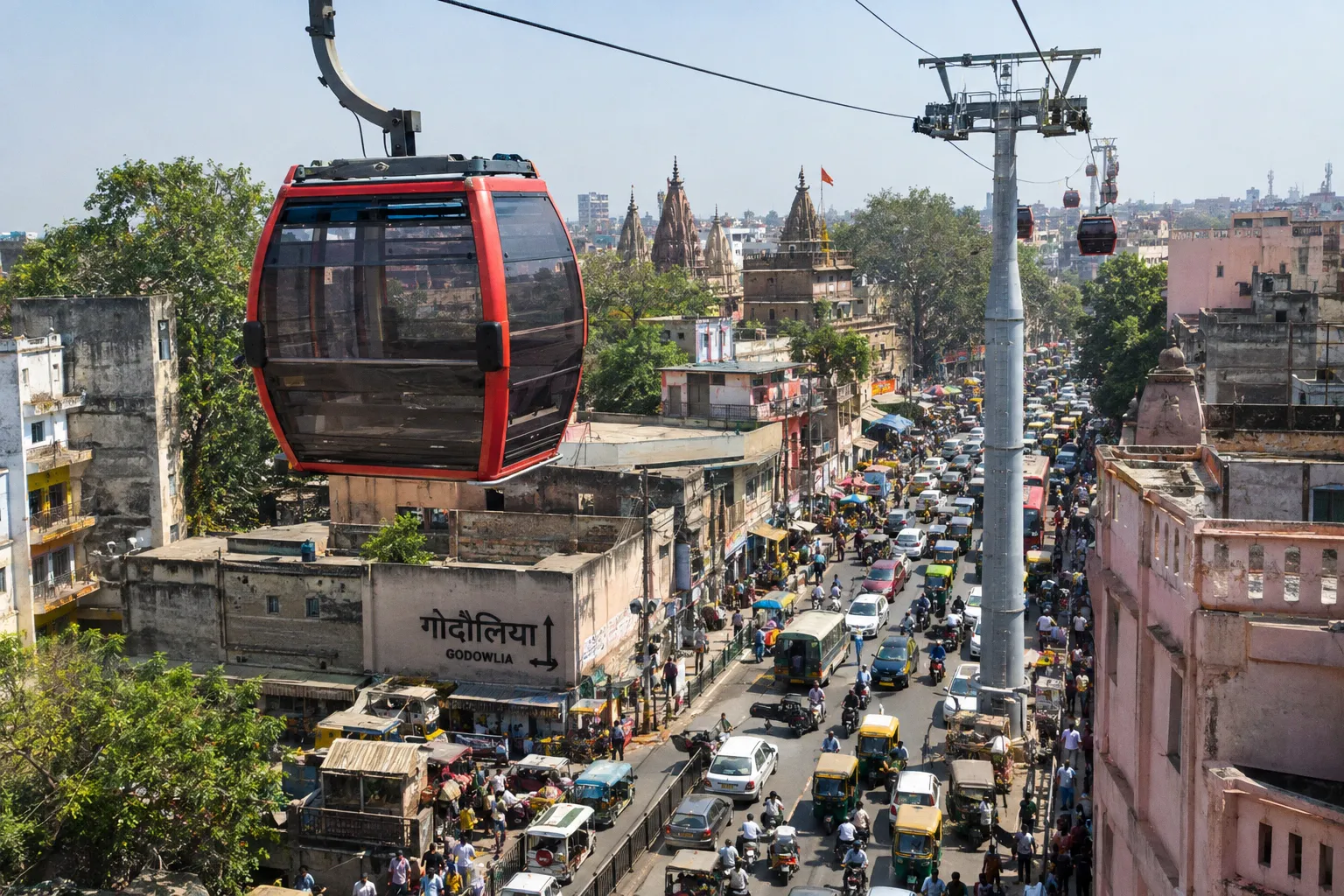
By road, the journey currently takes approximately 40 to 60 minutes because traffic must pass through a dense urban network with narrow lanes, frequent junction delays, and limited space for expansion. The planned Varanasi urban ropeway is designed to cover the same connection in approximately 15 to 16 minutes.
This is not a citywide replacement for road transport. It is a targeted intervention on one of Varanasi’s most constrained north–south travel corridors. Its purpose is to move passengers above the congested street network between the railway station, central commercial areas, and the approach to the old city.
The comparison between the Varanasi urban ropeway and road transport is therefore not simply a question of speed. It concerns spatial separation, passenger capacity, fare levels, access to the ghats and temples, and the practical limits of infrastructure in the historic core.
The anatomy of the Cantt-to-Godowlia bottleneck
Varanasi Cantonment railway station is the principal arrival point for many intercity passengers. Godowlia Chowk is the major access point to the historic city, including the pedestrian approaches leading toward the Kashi Vishwanath temple and the riverfront ghats. The two locations are geographically close by metropolitan standards. Their road connection is nevertheless slow.
The problem is the structure of the intervening city.
Traffic between the station and Godowlia does not move through a dedicated, uninterrupted corridor. It enters an established urban fabric containing mixed vehicle movements, commercial activity, pedestrian crossings, loading activity, intersections, and streets that cannot be widened without substantial demolition or displacement. The road network must carry local residents, auto-rickshaws, taxis, buses, private vehicles, delivery traffic, and visitors moving toward the old city.
Under these conditions, distance is less important than friction. A short road journey can consume more time than a much longer trip on a separated transport system.
The current road travel time is approximately 40 to 60 minutes. That range is more useful than a single average because conditions vary sharply by time of day, season, religious events, railway arrivals, and local traffic controls. The upper end of the range is not an exceptional failure of the network. It reflects the normal vulnerability of a corridor operating close to its practical capacity.
The ropeway addresses this constraint by changing the route’s vertical geometry. Instead of competing for space on the street, the gondolas will travel above it. The system does not remove congestion from every road in Varanasi. It creates a separate passenger path across the specific Cantt–Godowlia bottleneck.
The central gain is not the shortness of the ropeway route. It is the removal of street-level conflict from the journey.
Road transport and aerial transit compared
| Parameter | Road transport | Planned urban ropeway |
|---|---|---|
| Corridor | Varanasi Cantonment to Godowlia Chowk | Varanasi Cantonment to Godowlia Chowk |
| Travel time | Approximately 40–60 minutes | Approximately 15–16 minutes |
| Route length | Follows the existing street network | Approximately 3.75–3.85 km |
| Main constraint | Congestion, junction delays, narrow urban streets | Station access, operating schedule, and system capacity |
| Intermediate stops | Dependent on the road route and vehicle service | Kashi Vidyapeeth, Rath Yatra, and Girja Ghar |
| Full-route fare | Varies by vehicle and journey type | Finalized standard fare of ₹50 |
| Short-distance fare | Depends on the road service used | Starts as low as ₹10 |
| Passenger movement | Mixed with general traffic | Separated from street traffic |
| Operating period | Depends on the selected road service | Designed for 16 hours per day |
The comparison should not be reduced to a promise that every passenger will save the same amount of time. The ropeway’s approximately 15–16-minute figure refers to travel between the system’s endpoints. Passengers still need to reach a station, wait for boarding, exit at the destination station, and complete the final part of their journey on foot or by another mode.
Even with those access movements included, the system is intended to provide a materially faster connection for passengers whose origin and destination align with the five planned stations.
The ropeway route: five stations across a constrained urban zone
The planned Varanasi ropeway route is approximately 3.75 to 3.85 kilometres long. It includes five stations:
1. Varanasi Cantonment — the northern terminal, positioned to serve passengers arriving at the railway station.
2. Kashi Vidyapeeth — an intermediate station serving the institutional and residential areas around the university zone.
3. Rath Yatra — a central stop within an important commercial and transport area.
4. Girja Ghar — a further approach to the dense central city.
5. Godowlia Chowk — the southern terminal and principal gateway toward the historic core.
The route’s spatial logic is straightforward. It begins at the main railway arrival point and progresses through the central city before terminating at Godowlia. The intermediate stations are significant because they prevent the system from functioning only as an airport-style transfer between two endpoints. They allow shorter trips and distribute access across the urban corridor.
That distribution will determine much of the ropeway’s usefulness. A passenger traveling from Cantt to Godowlia is the clearest beneficiary of the full route. A resident traveling between Kashi Vidyapeeth and Rath Yatra may use the system for a much shorter trip, particularly if the fare and station access are convenient.
Godowlia is not the Kashi Vishwanath temple itself. It is a transport terminal at the edge of the historic street network. Passengers traveling to Kashi Vishwanath temple via the ropeway will still need to complete the final approach from Godowlia, generally on foot or through permitted local access arrangements. The ropeway improves the arrival corridor. It does not create a direct station inside the temple precinct or eliminate the pedestrian character of the old city.
This distinction matters for route planning. The system should be understood as a high-capacity connection to the edge of the historic core, not as a door-to-door temple service.
Why the intermediate stations matter
A direct terminal-to-terminal route would provide a simple travel-time comparison, but it would serve fewer local journeys. The three intermediate stations create a sequence of shorter transport segments:
- Cantonment to Kashi Vidyapeeth
- Kashi Vidyapeeth to Rath Yatra
- Rath Yatra to Girja Ghar
- Girja Ghar to Godowlia
- Any combination of these segments
The stated fare structure reflects this segmented use. The maximum standard fare for the complete Cantt-to-Godowlia route is ₹50, while short-distance fares begin at ₹10. This makes the ropeway relevant not only to railway passengers and tourists but also to residents making ordinary cross-city journeys.
The value of the intermediate stations will depend on the quality of the approaches around them. A station cannot solve a mobility problem if passengers must cross an unsafe road, navigate unclear pedestrian routes, or transfer through unmanaged traffic. Station integration is therefore part of the transport system, even though it is not included in the aerial travel time.
How the 16-minute aerial journey changes the comparison
The planned ropeway travel time between the two terminals is approximately 15 to 16 minutes. Compared with the current 40 to 60 minutes by road, this produces a nominal saving of approximately 24 to 45 minutes per journey.
That is a substantial range because the road journey itself is variable. Against a 40-minute road trip, the ropeway cuts the scheduled movement time by roughly half. Against a 60-minute road trip, the difference is greater. The system’s strongest advantage appears during periods when road traffic is moving at its slowest.
Aerial travel also changes the predictability of the corridor. Road travel time is affected by incidents outside the passenger’s control: temporary closures, traffic surges, roadside loading, procession routes, and congestion around railway arrivals. A ropeway operating on a separated alignment is less exposed to those conditions. Its reliability will instead depend on mechanical availability, weather protocols, station operations, and passenger boarding flows.
The distinction between speed and predictability is operationally important. A traveler going to a train, hotel check-in, or scheduled appointment may value a stable 16-minute movement more than an occasional faster road journey. Conversely, a passenger whose origin lies far from a ropeway station may receive little benefit if the first and final road legs remain congested.
The ropeway therefore creates a new middle-distance mobility option. It is not necessarily the fastest solution for every address in Varanasi. It is designed for journeys that intersect its five-station spatial layout.
Capacity and throughput: what 3,000 passengers per hour means
The system is designed to operate for 16 hours daily, with a peak throughput of approximately 3,000 passengers per hour per direction. It is expected to use between 148 and 153 gondola cabins, with each cabin accommodating 10 passengers.
These figures describe transport capacity, not guaranteed passenger volumes. A design capacity of 3,000 passengers per hour per direction indicates how many passengers the system is intended to move under peak operating conditions. Actual use will depend on demand, station dwell times, boarding behavior, service frequency, and the distribution of passengers between the five stations.
The cabin configuration provides a different operating model from a conventional bus or train. Passengers do not wait for a single large vehicle carrying hundreds of people. They are distributed across a continuous sequence of cabins. This can reduce the significance of one vehicle’s departure time, although it does not eliminate queues at busy stations.
The capacity is relevant to the road comparison because buses and cars consume street space for each passenger movement. A ropeway transfers a large number of passengers without requiring an equivalent increase in road lanes. Its infrastructure footprint is concentrated in towers, stations, maintenance systems, and the aerial alignment rather than in a continuous surface corridor.
That spatial efficiency is particularly valuable in central Varanasi, where expanding the road network is difficult. The system’s success will not be measured only by the number of passengers inside cabins. It will also be measured by whether it removes enough trips from the most congested streets to improve movement for people who continue to use road transport.
The likely traffic effect
The impact of the Varanasi ropeway on city traffic should be stated precisely. It is not expected to remove congestion across the entire city. Its direct influence is concentrated on the Cantt–Godowlia corridor and the approach roads feeding its stations.
Three effects are plausible within that corridor:
1. Passenger diversion from road vehicles. Some railway passengers and visitors may choose the ropeway instead of taxis, auto-rickshaws, or private vehicles for the central journey.
2. Reduced pressure on the most constrained street sections. If the system attracts regular users, it may reduce the volume of trips competing for road space between the station and Godowlia.
3. New station-area demand. Each station may generate additional pedestrian movement, feeder traffic, auto-rickshaw activity, and informal commerce. Congestion could shift toward station approaches unless these areas are planned and managed carefully.
The third effect is often overlooked. A separated transit system does not make access problems disappear. It relocates part of the demand to station entrances and exits. The quality of the pedestrian realm around Kashi Vidyapeeth, Rath Yatra, Girja Ghar, and Godowlia will influence whether the ropeway functions as an integrated urban service or as an isolated engineering project.
Fare structure and accessibility for daily users
The finalized standard fare for the complete route from Cantonment to Godowlia is ₹50. Short-distance fares begin at ₹10. This creates a relatively clear relationship between distance and cost, although the practical affordability of the system will depend on how frequently passengers use it and whether they need additional road transport at either end.
For a tourist arriving at Varanasi Cantonment, ₹50 for a direct connection to Godowlia may be easier to understand and budget than a road journey affected by traffic and vehicle negotiations. For a daily commuter, the calculation is different. The ropeway must be compared with the combined cost of a feeder ride, the aerial fare, and the final walking or road connection.
The five-station layout gives the fare structure greater relevance. A passenger making a short central-city trip may pay as little as ₹10, while a full-corridor traveler pays ₹50. That range supports both local and visitor use. It also prevents the ropeway from becoming exclusively a tourist facility, at least in its formal pricing model.
Accessibility will depend on more than the ticket price. The system must be usable by passengers carrying luggage, older passengers, people with mobility limitations, families, and travelers unfamiliar with the city. Signage, station entrances, pedestrian crossings, queue arrangements, and links to local road services will all shape the actual experience.
A fast system with difficult station access is not fast in practical terms. The relevant measure is the complete journey:
- movement from the railway platform or local street to the station;
- ticket purchase or entry;
- waiting and boarding;
- aerial travel;
- exit from the destination station;
- the final connection to a hotel, market, ghat, or temple approach.
The published 15–16-minute figure remains important, but it is only one component of the end-to-end journey.
The ropeway’s true travel time will be measured from the passenger’s origin to the final destination, not from cabin departure to cabin arrival.
Construction chronology and the route to operation
The foundation stone was laid and construction began in March 2023. The project has therefore moved through a multi-year construction period involving elevated infrastructure, station construction, cable systems, cabin procurement, and operational preparation.
Reports in September 2026 indicated that the project was more than 94% physically complete. That figure describes construction progress, not commercial availability. A project can be physically advanced while still requiring testing, certification, staff training, safety verification, trial operations, and coordination between stations and control systems.
The exact commercial launch date after the reported late-2026 completion remains uncertain. It would be inaccurate to treat physical completion as equivalent to opening day. For passengers planning a journey, the operational status must be confirmed separately from the project’s construction percentage.
This distinction is especially important in infrastructure reporting. The public usually experiences a project in binary terms: open or not open. Engineering progress is continuous. Commercial service begins only after the system can operate safely and consistently under passenger conditions.
The remaining path to operation is likely to include several categories of work:
- completion of unfinished station and alignment elements;
- installation or final commissioning of operating equipment;
- testing of cabins, cables, controls, and emergency procedures;
- staff preparation for ticketing, passenger movement, and incident response;
- inspection and approval processes;
- trial runs under conditions that approximate regular service.
No exact launch date should be inferred from the 94% completion figure alone.
What the ropeway changes for visitors and residents
For visitors arriving by train, the ropeway offers a direct strategic advantage: it connects the railway station to the urban threshold of the historic core without requiring the entire journey to be negotiated through road congestion. Godowlia provides access to the temple district and riverfront, although the last section remains a pedestrian-oriented urban journey.
For residents, the value is broader. The intermediate stations give the project a role in ordinary cross-city movement. Kashi Vidyapeeth, Rath Yatra, and Girja Ghar are not merely technical stops. They determine whether the system becomes part of daily transport or remains concentrated around visitor traffic.
For hotels and hospitality businesses, the route may alter the practical geography of central Varanasi. Properties near the stations could become easier to reach from the railway station. However, hotel access will still depend on the final road or pedestrian connection. A hotel described as ropeway-connected may be geographically close to a station while remaining difficult to reach with luggage if the surrounding streets are poorly organized.
For the old city, the effect may be more controlled. A significant number of visitors could arrive at Godowlia and continue on foot rather than being carried deeper into the narrow lanes by vehicles. That could support the pedestrian character of the historic core, but it may also concentrate foot traffic at the terminal and the surrounding approaches.
The ropeway should therefore be assessed as a redistributor of movement. It changes where passengers enter the historic city and how quickly they reach that point. It does not eliminate the need for pedestrian management, traffic control, waste collection, emergency access, or conservation planning around the old city.
Varanasi ropeway versus road: the practical decision
The ropeway will be the stronger option when the journey begins near one of its stations, ends near another, and time predictability matters. It is especially suited to railway passengers traveling toward Godowlia, visitors heading toward the temple and ghat district, and residents making cross-city trips along the corridor.
Road transport will remain necessary for addresses beyond the station network, for passengers carrying large quantities of luggage, for late-night journeys outside the ropeway’s operating hours, and for trips that require direct access to neighborhoods away from the alignment. The ropeway is designed for 16 hours of daily operation, not continuous service around the clock.
The choice can be summarized spatially:
- Use the ropeway for station-to-station movement along the Cantt–Godowlia corridor.
- Use road transport when the origin or destination lies far from the five planned stations.
- Combine both modes when the ropeway covers the congested middle section but a feeder vehicle is required at either end.
- Allow extra time for station access, queues, luggage handling, and the final walk to the destination.
The system’s full-route fare of ₹50 and short-distance fares from ₹10 make it a credible alternative to road transport, but affordability alone will not determine adoption. Station placement, pedestrian access, service reliability, and clarity of wayfinding will be equally decisive.
The preservation question
The Varanasi urban ropeway is a major mobility intervention in a city where historic fabric limits conventional road expansion. Its basic engineering argument is strong: provide a separated route over a congested corridor, move up to approximately 3,000 passengers per hour per direction, and reduce the terminal-to-terminal travel time from 40–60 minutes to approximately 15–16 minutes.
Its preservation implications are more complex. Infrastructure in and around the historic city must manage visual impact, station footprints, pedestrian pressure, and the relationship between new transport structures and older urban forms. The project’s success should not be judged only by construction completion or journey time.
The relevant assessment has four parts:
1. Mobility: Does the system provide a reliable alternative to road travel?
2. Access: Can passengers reach and leave each station safely and efficiently?
3. Urban integration: Are station areas connected to local streets, hotels, markets, and pedestrian routes?
4. Conservation: Does the project reduce pressure on historic streets without creating new unmanaged concentrations of traffic and footfall?
On the narrow question of travel time, the result is clear. The planned ropeway offers a substantial advantage over the current road journey between Varanasi Cantonment and Godowlia. Its approximately 15–16-minute aerial connection is not a replacement for the entire transport network. It is a precise intervention in a precise bottleneck.
The final judgment will depend on what happens below the cabins. If the stations are integrated with pedestrian routes, feeder services, and the historic city’s conservation requirements, the ropeway can become an efficient layer in Varanasi’s transport system. If those connections remain weak, the system will still be fast in the air but incomplete as urban infrastructure.