Panchkroshi Yatra routes and pilgrim path variations
The Panchkroshi Yatra is not simply a long temple walk outside Varanasi. It is a ritual circumambulation of Kashi’s sacred territory: a circuit of 25 krosha, approximately 88.5 kilometers, associated with 108 Shiva temples and shrines.
The route is therefore measured not only in road distance, but in acts of intention, direction, halting, worship, and return.
For pilgrims, the central question is rarely whether the journey can be completed. It is how to choose among the panchkroshi yatra route options for pilgrims without losing the lineage and significance of the observance. The traditional five-day walk remains the clearest expression of the pilgrimage, but three-day, one-day, and vehicle-based itineraries are also undertaken, particularly when age, health, season, or available time changes the practical shape of the journey.
The sacred geometry of the 25-krosha circuit
In Hindu pilgrimage practice, circumambulation is not an incidental way of moving from one shrine to another. The Sanskrit term pradakshina refers to moving clockwise around a sacred presence, keeping it to the right. In the Panchkroshi Yatra, the sacred presence is not one temple alone but the larger territorial body of Kashi.
The traditional circuit covers 25 krosha, a measurement that corresponds to approximately 88.5 kilometers, or 55.2 miles. The path encircles the sacred territory of Kashi and includes 108 Shiva temples and shrines positioned along the circumambulatory route. These are not all grand architectural complexes. Some are substantial temples; others are small Shiva shrines or lingas beside the road, embedded in village life and maintained through local observance.
That distinction matters. A visitor expecting 108 monumental buildings will misunderstand the character of the yatra. The route is a chain of sacred points woven through ordinary settlements, roads, fields, neighbourhoods, and changing urban edges. Its significance lies in the continuity of the circuit and in the pilgrim’s disciplined attention to each stage, rather than in the visual grandeur of every stop.
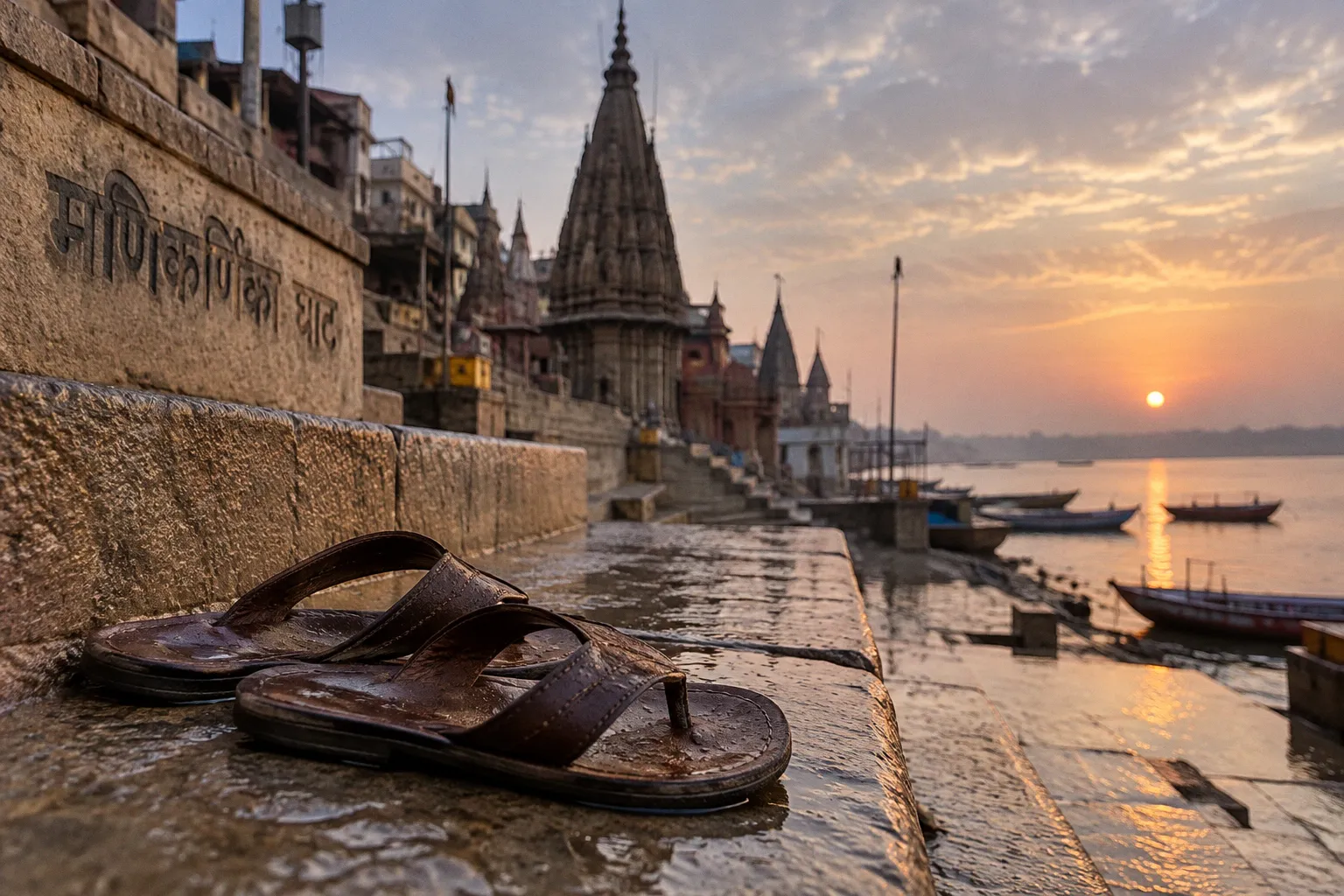
The yatra traditionally begins with a ritual dip and sankalp at Manikarnika Kund. A sankalp is a solemn vow or statement of intention: the pilgrim establishes what journey is being undertaken and places the observance within a ritual framework. From there, the customary sequence leads to Assi Ghat, where the clockwise walking circuit begins.
This opening movement can seem confusing if we approach the route as a modern loop on a map. Manikarnika and Assi are both central to the sacred geography of Varanasi, but they serve different ritual moments in the customary beginning of the pilgrimage. The preparation at Manikarnika Kund and the commencement of the outward circuit from Assi Ghat belong to the traditional logic of the observance.
The Panchkroshi Yatra is best understood as a vow carried across a landscape, not as a sightseeing route with 108 attractions.
For a first-time pilgrim, the practical lesson is simple: do not begin by asking only where the road goes. Begin by asking what form of observance you are able to undertake, which ritual opening you will follow, and how faithfully your chosen itinerary preserves the clockwise structure of the circuit.
The five traditional padavs and the logic of the stages
The classic walking pilgrimage is organized around five principal night halts, known as padavs. A padav is more than a convenient place to sleep. It is a recognized stage in the journey, a point at which the body rests and the pilgrim’s attention gathers again before the next section.
The five major padavs are:
1. Kardameshwar, also called Kardameshvara — the first major halt after the opening section of the circuit.
2. Bhimchandi — the second principal night halt.
3. Rameshwar, also written Rameshvram — the third major stage.
4. Shivpur — the fourth night halt.
5. Kapildhara — the fifth and final major halt before the pilgrimage sequence is completed.
The stages do not divide the route into five identical portions. Their distances and the physical experience of the road vary, which is one reason the five-day format should not be treated as a casual walking tour. The first section from Manikarnika toward Kardameshwar is approximately 12.5 kilometers, while the section from Kardameshwar to Bhimchandi is approximately 15.9 kilometers. Bhimchandi to Rameshwar is longer, at approximately 23 kilometers, and the later sections continue according to the traditional route rather than a neat daily symmetry.
This unevenness is part of the pilgrimage’s practical reality. A pilgrim may feel comfortable during one stage and considerably more tired during another, not because the spiritual significance has changed, but because roads, weather, traffic, surfaces, and the length of the day affect the body differently. A schedule that looks balanced on paper may not feel balanced on foot.
What happens at a padav?
The precise observance at each halt can differ according to family tradition, local guidance, season, and the organization of the pilgrimage. In general, however, the padav provides a rhythm of arrival, worship, rest, and preparation for the next stage.
You may encounter several kinds of accommodation along the route, including arrangements connected with temples, community spaces, pilgrim facilities, or privately organized travel groups. These conditions are not uniform, and the phrase “accommodation along the Panchkroshi Yatra route” should not be taken to mean a standardized chain of lodging at every stop. During busier pilgrimage periods, shared or basic arrangements may be more realistic than hotel-style rooms, while independent travelers may prefer to return to Varanasi or use a vehicle-supported itinerary.
For that reason, a pilgrim walking the full route should settle the night-halt plan before departure rather than assuming that every padav will offer the same level of access, privacy, or comfort. If your journey is organized through a local group, ask specifically where the night halt will take place, what bedding or food arrangements are included, and whether luggage is transported separately. If you are traveling independently, local guidance is especially valuable because modern road conditions and urban detours may not correspond neatly to older descriptions of the route.
Choosing between five days, three days, one day, and a vehicle
The panchkroshi yatra duration and stages depend on the pilgrim’s physical capacity, the intended level of observance, and the time available. The five-day walking itinerary is the standard form most closely associated with the traditional sequence of padavs, but it is not the only recognized way to undertake the circuit.
The principal options can be understood in this way:
| Itinerary | Character of the journey | Who may find it suitable | Main consideration |
|---|---|---|---|
| Five-day walking yatra | The fullest traditional walking rhythm, organized around the five major padavs | Pilgrims able to walk long daily stages and remain within the ritual pace of the circuit | Requires preparation for uneven distances, heat, road conditions, and basic night-halt arrangements |
| Three-day itinerary | A compressed walking pilgrimage with longer daily sections and fewer overnight pauses | Experienced walkers or pilgrims with limited time who still want substantial participation on foot | The shorter schedule can make the physical demand sharper, even though the total route remains the same |
| One-day itinerary | An abbreviated observance, often selected for a festival period or restricted schedule | Pilgrims who cannot commit to a multi-day journey or who are undertaking a focused devotional visit | The route becomes physically intense by road and may provide less time at individual shrines |
| Vehicle-based yatra | The circuit is covered by taxi, bus, or another motorized arrangement, with stops at selected shrines and stages | Older pilgrims, families, visitors with health limitations, and those balancing the yatra with other responsibilities | Vehicle access, parking, road diversions, and the sequence of shrine visits need to be arranged in advance |
The choice is not a moral ranking. Walking is not automatically more sincere, and a vehicle does not cancel the spiritual purpose of the journey. The traditional significance lies in undertaking the circuit with intention and appropriate etiquette, not in performing a physical feat beyond your capacity.
At the same time, the forms are not identical. A five-day walking yatra gives the pilgrim a slower relationship with the route: the body registers the distance, the night halts become part of the discipline, and the small shrines along the way are less likely to disappear into a sequence of hurried stops. A vehicle-based pilgrimage offers access and continuity for those who could not otherwise participate, but it requires more conscious effort to preserve the ritual order rather than treating the circuit as a drive between destinations.
The three-day and one-day forms sit between these approaches. They may be entirely appropriate, but they should be planned honestly. Compressing 88.5 kilometers does not remove the distance; it changes how much of it is covered at once and how much time is available for worship, meals, rest, and orientation.
Ritual protocol: from Manikarnika Sankalp to the 108 shrines
The opening sankalp at Manikarnika Kund establishes the pilgrimage as a vowed act. For visitors unfamiliar with the term, it is useful to think of sankalp not as a reservation or formal registration, but as a deliberate declaration of purpose. You are placing the journey within a sacred lineage and accepting the responsibilities of completing it according to the form you have chosen.
The customary sequence begins with a ritual dip at Manikarnika Kund, followed by the sankalp, and then proceeds to Assi Ghat for the start of the clockwise circuit. Ritual bathing carries different meanings in different contexts, and visitors should not assume that the same etiquette applies at every water site. Local priests or experienced pilgrimage organizers can guide you on appropriate conduct, offerings, clothing, and photography.
The most respectful approach is to observe before acting:
- Ask a priest or local guide whether bathing, offering, or photography is appropriate at a particular site.
- Keep the sanctum and ritual area clear, especially when local worshippers are conducting a family observance.
- Dress in a manner suitable for temple entry and be prepared for some shrines to have limited space rather than formal visitor facilities.
- Do not handle lingas, ritual vessels, offerings, or temple objects unless a custodian explicitly invites you to do so.
- Treat small roadside shrines with the same attentiveness you would bring to a larger temple, because their modest scale does not reduce their significance within the circuit.
- Carry water, necessary medicines, sun protection, and practical footwear without allowing the equipment of travel to overwhelm the ritual setting.
- Ask before photographing people, priests, ceremonies, or private devotional acts.
The 108 shrines along the path should not be approached as a collection to be counted for personal achievement. In Hindu sacred numerology, 108 carries established devotional significance, but the route’s meaning does not depend on a visitor collecting evidence at every point. Some shrines are roadside lingas; some may be difficult to identify without local knowledge; and the appearance of a site may change as the surrounding settlement develops.
This is also where the traditional and modern Panchkroshi path can diverge in practical terms. Older route descriptions may refer to village approaches, local paths, or recognizable sacred landmarks, while present-day travel may involve paved roads, traffic changes, construction, and urban bypasses. A modern vehicle may follow a practical road that reaches the same sacred stage without reproducing every footpath taken by earlier pilgrims.
That difference does not need to become a conflict between “authentic” and “inauthentic.” It is better understood as a question of continuity. Which elements are being preserved: the clockwise circuit, the opening vow, the major padavs, the shrine sequence, the devotional intention, or the physical walking itself? Different pilgrims will answer differently, and a responsible itinerary should state clearly what it includes.
When to undertake the Panchkroshi Yatra
The best time for the Panchkroshi Yatra in Varanasi depends on a balance between ritual calendar and physical conditions. The five-day form is traditionally considered especially auspicious during Purushottam Masa, also called Adhik Masa or Mala-Masa. This is an intercalary month in the Hindu lunar calendar, occurring approximately every two to three years.
Purushottam Masa is not the only time when the yatra may be performed. Pilgrims undertake the circuit throughout the year, and it would be misleading to present one season as the sole legitimate window. The distinction is between general availability and heightened ritual association: the journey can be undertaken year-round, while certain periods carry particular devotional importance for some pilgrims and communities.
Maha Shivaratri is another significant period for Shiva observance, and some pilgrims choose an abbreviated one-day form around that festival. The date follows the Hindu lunar calendar and generally falls in February or March. The broader cool season, including the months associated with Magha and Phalguna, is often more manageable for a long walking pilgrimage than the hottest part of the year. Spring months may also be selected, although conditions can change quickly as temperatures rise.
Before choosing a date, consider:
- Whether you can walk for several consecutive days in the expected weather.
- Whether your chosen padavs and overnight arrangements are confirmed.
- Whether a festival period will increase demand for transport, food, or shared accommodation.
- Whether your route depends on a vehicle whose access may be affected by traffic restrictions or temporary road changes.
- Whether a health condition, medication schedule, or mobility limitation requires a shorter itinerary.
- Whether you want the quietest possible movement or specifically wish to join a period of heightened communal observance.
The pilgrimage is demanding in a way that is easy to underestimate from a city map. Eighty-eight and a half kilometers may sound manageable when divided into stages, but those stages unfold across roads and settlements rather than a controlled walking trail. Heat, dust, traffic, waiting, shrine visits, meals, and ritual pauses all shape the day.
Making the route respectful and workable
For most visitors, the best panchkroshi yatra route options for pilgrims are not selected by choosing the most ambitious schedule. They are selected by matching the form of the pilgrimage to the body, the season, and the desired depth of participation.
If you have several days and are physically prepared, the five-day walking itinerary offers the clearest encounter with the traditional padav structure. If you want to walk but cannot commit to five days, a three-day route may be possible with careful planning and honest expectations about longer stages. If walking is not practical, a vehicle-based circuit can preserve the major ritual sequence and allow older or mobility-limited pilgrims to participate. A one-day itinerary may suit a focused devotional purpose, but it should not be mistaken for a relaxed temple circuit.
The most useful preparation is specific rather than elaborate:
1. Decide what you are undertaking. State plainly whether your plan is a five-day walk, a compressed walking route, a one-day observance, or a vehicle-supported yatra.
2. Confirm the opening sequence. Arrange guidance for the Manikarnika Kund dip and sankalp, then understand how you will proceed to Assi Ghat.
3. Map the padavs in advance. Identify Kardameshwar, Bhimchandi, Rameshwar, Shivpur, and Kapildhara within your actual travel plan.
4. Separate ritual needs from tourist expectations. A small shrine may have profound lineage and significance even when it has no signage, queue system, or visitor amenities.
5. Build in recovery time. Rest is not a failure of devotion; it allows the observance to continue without turning physical exhaustion into the main experience.
6. Use local guidance where the modern route is unclear. Older descriptions and current roads may not align perfectly, particularly where urban development has altered access.
7. Keep your conduct quiet and attentive. The people around the shrines are not scenery, and their daily worship should not be displaced by the visitor’s schedule.
The Panchkroshi Yatra asks us to move through Kashi with more care than ordinary sightseeing requires. Its route is a sacred circumference, but it is also a living network of villages, shrines, roads, households, priests, drivers, and pilgrims. Whether you travel on foot for five days or by vehicle in a shorter form, the obligation is the same at its heart: understand the observance you have chosen, follow its sequence with humility, and allow the landscape to remain a place of worship rather than turning it into a checklist of stops.