Boat rides in Varanasi: optimal timing and route planning
A boat ride in Varanasi is easy to arrange and surprisingly easy to get wrong. Pick the wrong hour and you will spend the trip in heat, traffic, or a bottleneck of boats near Dashashwamedh Ghat.
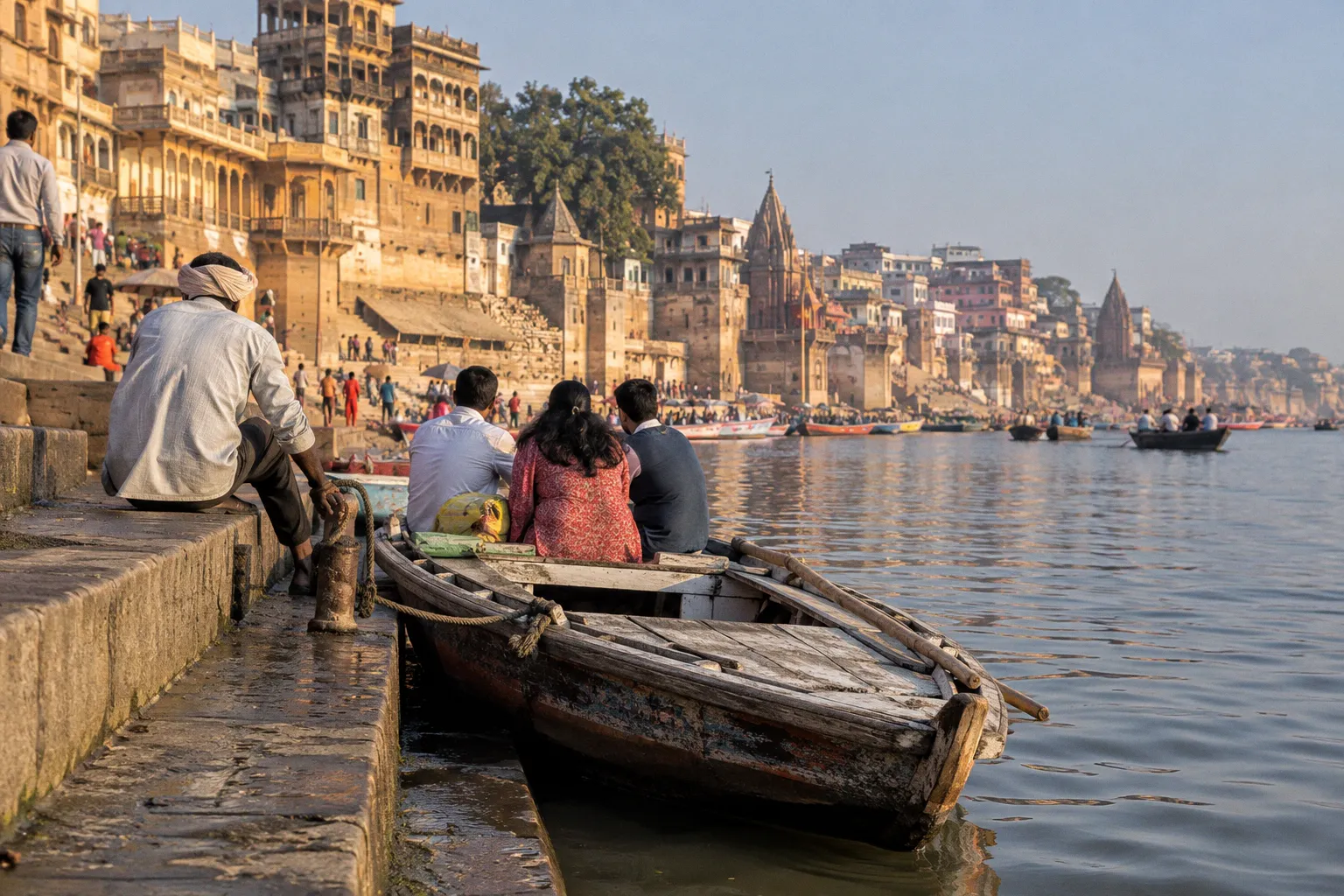
Pick the wrong route and you will pay for a full riverfront sweep when the shorter Assi-to-Manikarnika run would have covered the landmarks you actually wanted to see.
The best time for a boat ride in Varanasi depends on the experience you want. Sunrise gives you the cleanest operating window for a calm riverfront pass, morning prayers, bathers, and yoga sessions. Evening departures are built around the Ganga Aarti, but they require stricter timing, better positioning, and more patience with crowd density. During the monsoon, do not assume the regular timetable still applies.
I treat the riverfront as a logistics problem first. Set the boarding point, define the route, confirm the return time, and only then negotiate the boat price. That sequence bypasses most avoidable confusion.
Sunrise or evening: choose the operating window first
The standard sunrise boat ride window runs from roughly 5:00 AM to 8:00 AM. This is the optimal slot if your priority is to see the riverfront while activity is spread across the ghats rather than compressed into one ceremony zone.
The early departure also works better for travelers who want a route rather than a single event. From the water, you can pass the main bathing ghats, observe morning prayers, and continue along the riverfront without the evening concentration around Dashashwamedh Ghat. The light is generally more useful for photography from October through March, when the cooler season offers better conditions for an early start.
For a sunrise boat ride from Assi Ghat, plan to reach the boarding area before your agreed departure time. Do not treat 5:00 AM as a universal launch time for every boatman on every day. Actual boarding times can shift with the season, local demand, river conditions, and the availability of the boat you have arranged.
A practical morning sequence looks like this:
1. Reach the ghat before the boatman’s stated departure time, allowing extra minutes for the final walk through the lanes.
2. Confirm whether the quoted rate covers a short route, a return trip, or a one-way ride.
3. Fix the approximate duration before boarding. A low initial price can become less useful if the boat stops short of the landmarks you expected.
4. Keep the route flexible if the river is busy or the current is strong.
5. Return before late-morning heat removes the main advantage of the early departure.
The evening window is tighter. Boats for the Ganga Aarti experience typically begin boarding around 5:30 PM to 5:45 PM and continue through approximately 7:45 PM. The main ceremony at Dashashwamedh Ghat is generally observed between 7:00 PM and 7:45 PM, although the exact pace and crowd conditions can vary.
Do not leave your hotel at the time the ceremony begins. By then, the riverside approaches and the water near Dashashwamedh can already be congested. Board early, move into position, and treat the final part of the ride as a waiting and positioning exercise. That is the efficient approach.
Sunrise is the flexible window; evening Aarti is the fixed appointment. Plan the first around the river and the second around the clock.
Sunrise versus evening boat rides
| Factor | Sunrise boat ride | Evening Ganga Aarti boat view |
|---|---|---|
| Main operating window | Approximately 5:00 AM–8:00 AM | Approximately 5:00 PM–7:45 PM |
| Best for | Quiet movement, morning rituals, wider route coverage | Viewing the fire ceremony at Dashashwamedh Ghat |
| Main bottleneck | Early departure and limited sleep | Crowd density and boat congestion |
| Route flexibility | Higher, especially on longer riverfront routes | Lower once the boat must position near Dashashwamedh |
| Planning priority | Reach the boarding point before launch | Board around 5:30–5:45 PM and secure position early |
| Main risk | Assuming every operator follows the same morning schedule | Arriving late and losing useful viewing space |
If you have only one opportunity, use the sunrise departure for a proper riverfront survey and choose the evening trip when the Aarti itself is the priority. Trying to force both into one rushed outing usually produces two mediocre experiences.
Map the ghats before you choose the boat
The riverfront route is not one standardized circuit. Boatmen use several departure points and may describe the same section with different labels. Establish the endpoints in plain terms: where you board, which ghat marks the turnaround, and where you return.
The shorter classic route runs between Assi Ghat and Manikarnika Ghat. It covers approximately 3.5 kilometers and passes around 50 ghats. For many travelers, this is the optimal balance between coverage and time. It includes the most recognizable riverfront sections without committing to the full northward sweep.
The longer route extends toward Namo Ghat. It covers roughly 7 kilometers and can include up to 84 ghats. This is the better option if your purpose is to understand the full structure of the riverfront rather than simply collect a few familiar views. It also demands more time, more careful timing, and a clearer understanding of whether the boat is returning you to the original boarding ghat.
The short route: Assi Ghat to Manikarnika Ghat
The short route is the practical default for a first boat ride. Assi Ghat gives you a major southern starting point, while the stretch toward Manikarnika brings the boat past some of the most significant riverfront architecture and ritual spaces.
Assi is particularly useful for early departures. Morning activity begins there before the evening ceremony schedule becomes relevant, and the surrounding area is a common access point for sunrise programs. If you are already planning to attend Subah-e-Banaras or a morning riverside program, combining that start with a boat departure can reduce backtracking.
The approach to Manikarnika requires restraint. It is an active cremation ghat, not a normal sightseeing platform. Do not negotiate a trip on the assumption that the boat is entitled to close in on active cremation areas or that photography access is guaranteed. Your boatman may pass at a respectful distance, and local conditions may restrict the route further. Follow those limits.
The short route works well when:
- You have a limited morning schedule.
- You want the main ghats without a long charter.
- You are combining a boat ride with a walking route through the old city.
- You want to return to the same general area without spending the entire morning on the water.
- You are traveling during a season when current or river traffic makes extended routes less predictable.
The full sweep: Assi Ghat to Namo Ghat
The full-sweep route is for travelers who want scale. At approximately 7 kilometers and up to 84 ghats, it gives a broader view of the riverfront’s changing functions, architecture, access points, and levels of activity.
It is also the route most likely to expose weak planning. Confirm whether the quoted price covers the full distance, whether the boat waits at any point, and how the return is handled. A one-way ride toward Namo Ghat is not the same product as a round trip from Assi. The wording matters.
Namo Ghat is also part of a changing riverfront environment. Newer public infrastructure and riverfront improvements can alter access, traffic patterns, and the way visitors move between the water and the city. Treat it as a defined endpoint, not as a promise that every boat can stop wherever you want.
Use the full route when you have enough time to absorb it and when your departure point is logistically convenient. Otherwise, the longer distance can become a bottleneck: more time on the boat, less time for the ghats themselves, and a higher chance of arriving late for another fixed appointment.
Negotiate the price around the route, not the boat
Boat pricing in Varanasi is not a single fixed tariff across all independent operators. Rates vary with demand, group size, route length, departure time, boat type, and what the operator includes. Ask for the total price before boarding and state the number of passengers clearly.
Shared rowboats generally cost approximately ₹150 to ₹400 per person for shorter trips. This can be the most efficient option for solo travelers or couples who are comfortable sharing space and accepting a less flexible route.
Private motorboat rentals for groups of roughly 8–10 passengers generally fall around ₹2,499 to ₹3,999, depending on route length and inclusions. A private boat costs more upfront, but the calculation changes when several people split the charter. It also gives you more control over departure timing and route decisions, although it does not remove river traffic or local safety restrictions.
Use this negotiation sequence:
1. Name the route. Say Assi to Manikarnika, or Assi to Namo, rather than asking for a generic river ride.
2. Specify the direction. Confirm whether you want a return trip, a one-way transfer, or a sightseeing loop.
3. State the group size. A per-person quote and a private-boat quote are different products.
4. Fix the time window. Evening Aarti trips require more precise timing than an open-ended morning ride.
5. Ask what happens if the route changes. Strong current, crowding, or local restrictions may force a shorter pass.
6. Confirm the payment point. Settle the total before departure, including any waiting period or extra distance.
7. Reject vague upgrades. If the operator changes from a rowboat to a motorboat or adds a longer route, renegotiate the total rather than accepting an unclear supplement.
The cheapest quote is not automatically the optimal quote. A shared boat can be efficient if you only need the short route. It becomes inefficient if you are waiting for other passengers, missing the morning light, or trying to reach a specific position for the Aarti.
Shared rowboat or private motorboat?
| Option | Best use | Advantages | Bottlenecks |
|---|---|---|---|
| Shared rowboat | Solo travelers and small groups on short routes | Lower per-person cost and simple booking | Less control over departure, route, and stops |
| Private rowboat | Small groups seeking a slower ride | More personal space and flexible conversation with the boatman | Route and timing still depend on river conditions |
| Private motorboat | Groups of up to roughly 8–10 passengers | Faster coverage and clearer control over the itinerary | Higher total cost and more exposure to evening congestion |
| Evening charter | Travelers prioritizing the Ganga Aarti | Better chance of arranging a deliberate viewing position | Must board early; late arrival creates a serious positioning problem |
Do not use a private motorboat simply because it sounds more premium. Use it when the group size, route length, or schedule justifies the additional cost.
Seasonal planning: monsoon changes the operating equation
July through September is the difficult period for river logistics. Water levels rise significantly, currents strengthen, and regular boat operations may be limited or restricted. Do not book a normal sightseeing route on the assumption that conditions will remain stable.
During the monsoon, the question is not only whether boats are operating. Ask whether the intended route is currently feasible, whether the boarding ghat is accessible, and whether the operator is prepared to shorten or cancel the trip if conditions deteriorate. A confirmed reservation does not override river safety.
The cooler season from October through March is generally more convenient for sunrise photography and early departures. It is also the period when demand can increase around major religious dates and festival travel. Dev Deepawali and Kartik Purnima can create a serious demand spike. If your visit overlaps with either, arrange the boat in advance and lock the route before you arrive at the ghat.
Advance booking does not mean surrendering your judgment. Confirm the following on the day:
- The actual boarding ghat and access route.
- The boat type and passenger capacity.
- The agreed departure time.
- Whether the route is short or full-sweep.
- Whether the return is included.
- Any river restrictions caused by current, water level, or crowding.
Festival demand also changes the value of time. A boat that is reasonably priced on a quiet weekday may be difficult to secure during a major observance. Do not wait until the ceremony is about to begin and expect to negotiate from a position of strength.
Plan the riverfront around physical landmarks
Varanasi’s lanes can create more delay than the river itself. Use the ghats as your navigation system and leave a margin for the walk from the road to the water. Tell your driver, guide, or hotel staff the exact ghat name. “Near the river” is not an operational location.
For a sunrise departure, Assi Ghat is the most practical anchor when your plan includes the southern riverfront, morning programs, or the short route toward Manikarnika. For the evening ceremony, Dashashwamedh Ghat is the reference point, but the surrounding area becomes a crowd bottleneck. Build time for the final approach and do not assume a vehicle can take you directly to the boarding area.
If you are adding a walking section, sequence it carefully. A boat ride followed by a north-to-south walk is different from a morning walk followed by a southern boarding. Avoid crossing the same congested lane system twice. The riverfront is linear; your itinerary should be linear as well.
A workable day plan might look like this:
- Early morning: Reach Assi Ghat for the sunrise departure.
- Morning: Take the short route toward Manikarnika or extend toward Namo Ghat if the schedule allows.
- Late morning: Leave the riverfront before heat and pedestrian congestion peak.
- Afternoon: Keep the central ghats free of fixed commitments.
- Around 5:30–5:45 PM: Board early if the Ganga Aarti is the evening objective.
- 7:00–7:45 PM: Remain positioned for the ceremony rather than attempting a late route change.
The principle is simple: keep one fixed river appointment per time window. Do not schedule a distant temple visit five minutes after an evening boat ride. That is how a workable itinerary turns into a chain of missed connections.
Etiquette and safety on the Ganges
A boat is not a neutral viewing platform. The riverfront contains active religious spaces, bathing areas, cremation grounds, working access points, and ordinary residential life. Follow the boatman’s instructions when approaching a crowded or sensitive section.
At Manikarnika, keep the camera down unless you have clear permission and the activity is appropriate to document. Do not ask the boatman to move closer to active cremation platforms for a better angle. The fact that a boat is on the river does not grant unrestricted access to the ghat.
On the boat, keep movement controlled. Stand only when the boatman says it is safe, especially during boarding, turning, or passing through heavier traffic. Secure phones and cameras before the boat leaves the ghat. River spray, sudden movement, and crowded boarding areas are more common problems than they appear from shore.
For an evening ride, keep your expectations precise. You may obtain a strong view of the Ganga Aarti from the water, but the boat’s position can be affected by crowding, other vessels, and instructions from local authorities or operators. A guaranteed close approach is not a realistic assumption.
For a full-sweep ride, ask how the boat handles the return. Some travelers focus on the outward route and discover too late that the return point is not the same as the departure point. Establish the endpoint before you pay.
Treat every boat quote as a route proposal, not a final product. The useful details are the endpoints, duration, boat type, return plan, and total cost.
The efficient way to choose your ride
Use the short route if you want the main riverfront landmarks in a controlled time window. Choose the full sweep if you have enough time and want a broader understanding of the ghats from Assi to Namo. Take a shared rowboat when price and simplicity matter more than control. Split a private motorboat when your group needs a fixed departure and a defined itinerary.
Choose sunrise when you want flexibility, lower crowd pressure, and a wider route. Choose the evening departure when the Ganga Aarti is the objective, but board early and accept that the ceremony zone will be congested. Avoid relying on normal schedules during the July–September monsoon. Around Dev Deepawali and Kartik Purnima, arrange the boat before demand peaks.
My hard-and-fast rule is this: fix the route before you negotiate the fare, and fix the boarding time before you plan the rest of Varanasi. That one decision bypasses most pricing disputes, missed ceremonies, and unnecessary time lost between the ghats.