Ganga Aarti viewing: Dashashwamedh versus Assi Ghat
Choosing between Dashashwamedh Ghat and Assi Ghat is not a minor detail. These are two different operating environments: one is a tightly packed evening spectacle built around synchronized movement…
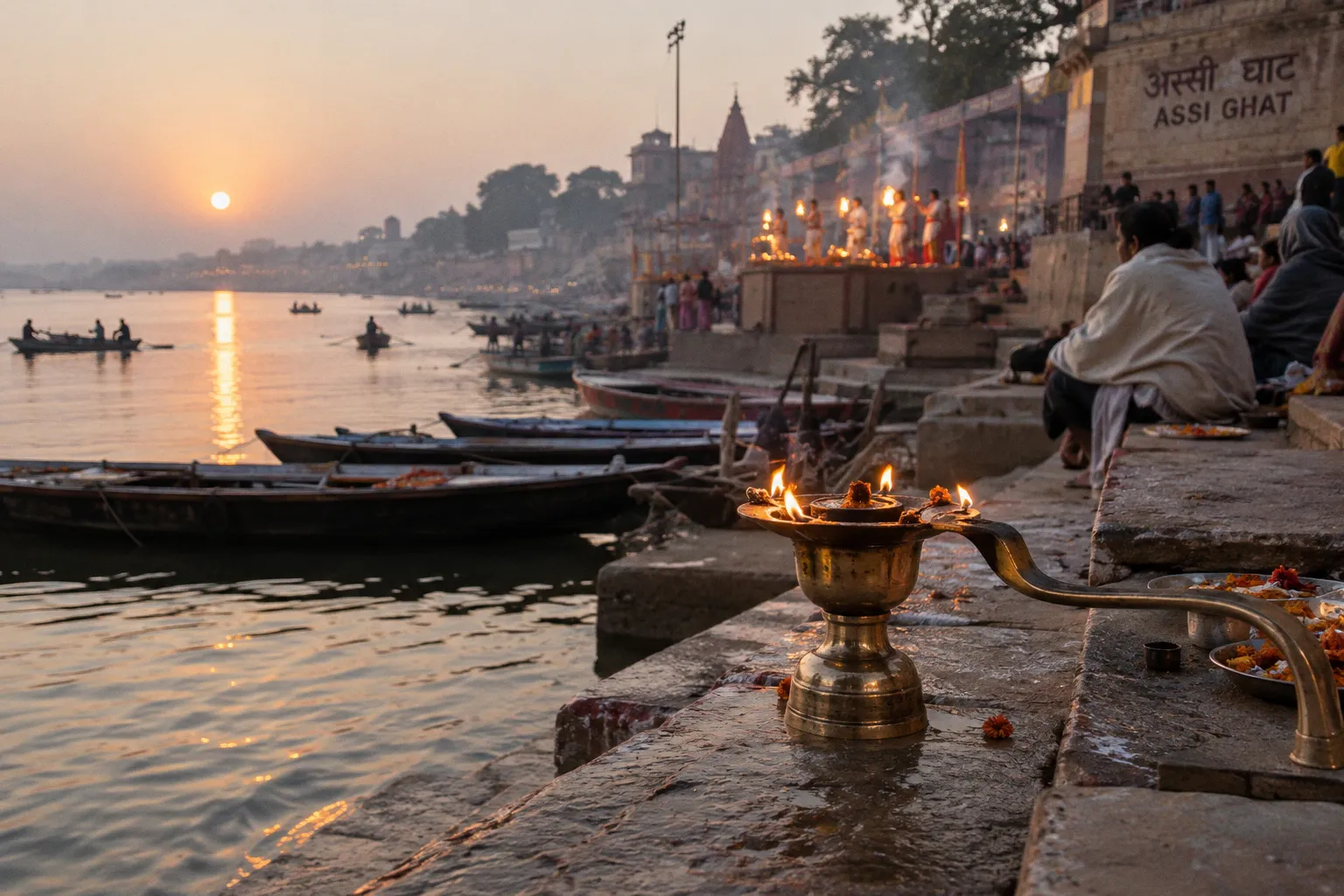
Choosing between Dashashwamedh Ghat and Assi Ghat is not a minor detail. These are two different operating environments: one is a tightly packed evening spectacle built around synchronized movement and maximum visibility; the other gives you a slower morning program, a smaller evening ritual, and more room to control your position.
Pick the wrong one and the ceremony becomes a bottleneck of bodies, vendors, steps, and late arrivals. Pick the right one and the timing, vantage point, and atmosphere work in your favor. For most visitors, the decision comes down to one question: do you want the grandest version of Ganga Aarti, or the least stressful way to experience it?
Dashashwamedh delivers scale. Assi gives you control. Do not confuse the two.
Dashashwamedh Ghat: the main evening spectacle
If your priority is the most recognizable Ganga Aarti in Varanasi, start with Dashashwamedh Ghat. The main evening ceremony is performed every day by seven synchronized Brahmin priests on raised platforms. They use brass lamps, conch shells, incense, and coordinated movements, creating a formal production with a clear visual center.
This is the version most visitors have in mind when they search for the best place to watch Ganga Aarti in Varanasi. It is large, public, and built for impact. The priests operate in formation. The platforms give the ritual height. The riverfront steps and boats create several viewing layers, but they also concentrate people in a very limited area.
The ceremony lasts approximately 40 to 45 minutes. It begins after sunset, with the schedule shifting through the year:
- In winter, the start is generally around 5:30 PM to 6:00 PM.
- In summer, it is generally around 6:45 PM to 7:00 PM.
- The exact time is not fixed year-round because it follows local sunset conditions.
Treat those ranges as operating windows, not guaranteed departure times. If you are building a boat ride, dinner, hotel transfer, or train connection around the ceremony, leave margin. A fixed-minute schedule is the wrong assumption here.
What the Dashashwamedh experience is actually like
Dashashwamedh works best when you accept its density instead of trying to bypass it completely. The crowd is part of the viewing problem, but it is also what gives the ceremony its scale. Visitors gather on the steps, in adjacent lanes, on balconies where available, and in boats facing the ghat.
The main advantages are straightforward:
1. The ritual has the strongest visual impact. Seven priests work simultaneously on raised platforms, so the action remains visible even when the steps are crowded.
2. The ceremony is easy to identify. You do not need to search for a small gathering or wonder whether you have arrived at the correct location.
3. The riverfront creates multiple viewing options. You can watch from the steps, an adjacent ghat, or a boat positioned across the water.
4. The timing is predictable in broad terms. The evening program is linked to sunset and lasts less than an hour.
The drawbacks are just as clear:
- The steps fill well before the ceremony begins.
- Movement becomes difficult once the main viewing area is saturated.
- Late arrivals may spend the ceremony standing behind taller visitors or moving through the outer edge of the crowd.
- Leaving immediately afterward can be slower than expected because the same lanes that brought you in are now carrying everyone out.
For a good position on the main Dashashwamedh steps, arrive at least 45 to 60 minutes before sunset. That is not excessive. It is the practical buffer required to move through the approach lanes, identify an acceptable viewing point, and settle before the ceremony starts.
If the central steps are already too dense, move toward Rajendra Prasad Ghat. It is immediately adjacent and commonly used as an alternative viewing position. The crowd there can be slightly lighter while preserving a direct connection to the main ritual. You will not get the same central proximity, but you may gain a more workable sightline and a cleaner exit.
Assi Ghat: better for control, not scale
Assi Ghat operates on a different rhythm. It hosts the pre-dawn Subah-e-Banaras program and a separate evening Ganga Aarti. Both can be useful, but they solve different visitor problems.
The morning program usually begins around 5:00 AM to 5:30 AM. It combines Vedic recitation, classical devotional music, Aarti, and a public yoga session. This is not a smaller copy of Dashashwamedh’s evening ceremony. It is a broader morning program with several linked elements and a less compressed atmosphere.
If you want the Assi Ghat morning Aarti experience, treat the early start seriously. Reaching the ghat at the beginning of the program gives you the best chance of choosing a usable place on the steps before the movement and seating patterns settle. You do not need the same 60-minute buffer used for Dashashwamedh, but arriving 30 to 45 minutes early remains the safer operating choice.
Assi also holds an evening Ganga Aarti:
- Around 6:00 PM in winter.
- Around 7:00 PM in summer.
- With the same seasonal caveat: the schedule can shift with sunset.
The evening ritual at Assi is smaller and significantly less crowded than the main Dashashwamedh ceremony. That makes it the more efficient choice for visitors who want to sit, move, take photographs without constant obstruction, or leave without being absorbed into a dense pedestrian flow.
Do not call Assi the quiet alternative and stop there. It is quieter relative to Dashashwamedh, not empty. The ghat still functions as a major riverfront destination, and the morning program attracts visitors who have deliberately chosen an earlier, more structured start.
When Assi is the optimal choice
Choose Assi Ghat when one or more of these conditions apply:
- You dislike dense crowds and do not need the largest version of the ceremony.
- You want a morning program that includes music, recitation, Aarti, and yoga.
- You are travelling with children, older visitors, or anyone who finds packed steps difficult.
- You want a simpler exit after the ceremony.
- You prefer a less compressed riverfront setting for observing rather than competing for position.
- You want to combine the ritual with an early riverfront walk.
Assi is also a useful bypass when your schedule cannot absorb a long pre-event wait at Dashashwamedh. The ceremony itself may be less visually overwhelming, but the total experience is often easier to manage.
Dashashwamedh versus Assi Ghat: the practical comparison
The right choice becomes clearer when the two locations are treated as logistics rather than as abstract atmosphere.
| Parameter | Dashashwamedh Ghat | Assi Ghat |
|---|---|---|
| Main experience | Grand evening Ganga Aarti | Pre-dawn Subah-e-Banaras and smaller evening Aarti |
| Evening scale | Large, synchronized ceremony with seven priests | Smaller and less crowded evening ritual |
| Typical seasonal start | About 5:30–6:00 PM in winter; 6:45–7:00 PM in summer | About 6:00 PM in winter; around 7:00 PM in summer |
| Morning option | Not the main format associated with the ghat | Subah-e-Banaras around 5:00–5:30 AM |
| Recommended early arrival | 45–60 minutes before sunset | 30–45 minutes before the program |
| Crowd pressure | High, especially near the central steps | Lower, though not empty |
| Best for | First-time visitors seeking the iconic spectacle | Visitors prioritizing space, control, and a broader morning program |
| Exit difficulty | Higher after the evening ceremony | Usually easier to manage |
| Boat-viewing value | Strongest for the large evening formation | Useful for a calmer riverfront view |
This table should not push you toward one universal winner. It shows why the best Ganga Aarti viewing spots depend on the kind of friction you are willing to accept.
Dashashwamedh charges you in waiting time and crowd density. Assi charges you in spectacle. Decide which cost matters less.
The efficient choice is not the most famous ghat. It is the ghat whose bottleneck matches your tolerance.
Arrival strategy: remove the avoidable problems
Most poor viewing experiences begin before the ceremony. Visitors arrive late, enter the wrong lane, stop at the first available space, and then try to improve their position after the crowd has closed around them. That plan fails at Dashashwamedh and is unnecessary at Assi.
Use a simple sequence.
1. Set the ceremony time first
Do not plan around a fixed online schedule without checking the seasonal window. The evening Aarti follows sunset, so the start shifts between winter and summer. If your accommodation, transport, or meal reservation is time-sensitive, build in a buffer after the ceremony rather than assuming you will be walking away at the exact listed start time plus 45 minutes.
2. Arrive before the approach becomes the bottleneck
At Dashashwamedh, arrive 45 to 60 minutes before sunset. This gives you time to navigate the approach, assess the steps, and choose between the central ghat and Rajendra Prasad Ghat.
At Assi, arrive 30 to 45 minutes early. For the morning program, that means getting there before the 5:00–5:30 AM start window. The early hour is not decorative. It is the reason the program remains manageable.
3. Pick your exit before you sit down
This is basic riverfront navigation, but visitors ignore it. At Dashashwamedh, do not push into the densest central point without knowing which lane you will use afterward. If you are on the steps, note the nearest practical route back toward the wider approach.
At Assi, the lower crowd pressure gives you more flexibility, but the same rule applies. Do not block your own exit with bags, footwear, or a group spread across the steps.
4. Negotiate before boarding a boat
Boat pricing is not a universal fixed figure. It varies by boat type, group size, season, timing, and negotiation. Shared evening Ganga Aarti boat tours are commonly quoted in the range of ₹300–₹600 per person, but that should be treated as a typical range rather than a guaranteed tariff.
Confirm the following before you board:
- Whether the price is per person or for the entire boat.
- Whether the ride includes only the ceremony or additional riverfront cruising.
- How long the boat will remain positioned near the ghat.
- Whether the quoted amount changes after dark or when demand rises.
- Where the boat will pick you up and return you.
Do not negotiate only the headline price. Negotiate the complete operating arrangement. A cheaper boat that leaves too early, blocks your view, or returns to a difficult landing point is not the optimal deal.
Boat versus shore: choose the correct vantage point
The boat-versus-shore decision is not simply about comfort. It changes the geometry of the ceremony.
From the shore, you face the priests directly and remain close to the platforms. The raised ritual area is easier to read as a coordinated sequence. You also experience the crowd as part of the event, for better or worse. The trade-off is obvious: prime shore positions disappear early, especially at Dashashwamedh.
From the river, you gain distance and a wider field of view. The seven priests, lamps, smoke, steps, and surrounding riverfront can be seen as one composition. This is often the stronger choice if your priority is understanding the full formation rather than standing close to one platform.
Shore viewing works better when:
- You want proximity to the priests and ritual objects.
- You are willing to arrive early.
- You prefer not to negotiate with boat operators.
- You need a stable position for the full 40–45-minute ceremony.
- You want to leave immediately once the ritual ends.
Boat viewing works better when:
- You want the entire ghat face in view.
- You are comfortable negotiating price and duration.
- The shore crowd is already beyond your tolerance.
- You are travelling as a small group and can agree on one boat arrangement.
- You want to combine the Aarti with a short Ganga river ride.
A boat is not automatically a premium experience. It can be the wrong choice if the operator positions the boat too far away, places you behind another vessel, or keeps the engine running through the ceremony. Ask where the boat will sit and how long it will remain there before agreeing.
At Dashashwamedh, boat viewing has the strongest visual advantage because the evening ceremony is organized for a broad riverfront audience. At Assi, the lower shore density reduces the need to use a boat merely as a crowd bypass. Take one there because you want the river angle, not because the steps are impossible.
How to build the day around each ghat
The two locations fit different itineraries.
A Dashashwamedh evening plan
Start moving toward the ghat at least 60 minutes before the expected sunset-linked start. Do not schedule a tight dinner reservation immediately afterward. The ceremony lasts approximately 40 to 45 minutes, but the exit can extend beyond that once the steps and lanes fill.
If the central viewing area is already saturated, bypass the worst concentration and assess Rajendra Prasad Ghat. It is close enough to preserve the connection to the main ceremony while offering a potentially more workable position.
If you have booked a boat, arrive at the boarding point with enough time to settle before the priests begin. Do not treat the boat as a last-minute rescue. The best river positions are also subject to demand, and late boarding can produce the same bottleneck you were trying to avoid on shore.
An Assi morning plan
For Subah-e-Banaras, work backward from the 5:00–5:30 AM start window. Allow time to reach the ghat without rushing and arrive 30 to 45 minutes early if you want a reliable place on the steps.
The program includes more than the Aarti itself: Vedic recitation, classical devotional music, and public yoga. Do not arrive expecting a compressed evening-style spectacle. The value lies in the sequence and the manageable early-morning setting.
The evening Assi program is simpler to schedule for visitors who do not want a pre-dawn start. Use the same 30 to 45-minute arrival buffer. You can still watch a riverfront Aarti without accepting Dashashwamedh-level crowd pressure.
The ceremony to choose by traveller profile
There is no need to manufacture a universal ranking. Match the ghat to the actual operating requirement.
Choose Dashashwamedh if you want:
- The most iconic and visually expansive evening ceremony.
- Seven priests performing in synchronized formation.
- A high-energy riverfront crowd.
- The strongest first-visit version of the evening Ganga Aarti.
- The option to view the ceremony from a boat facing the main platforms.
Choose Assi if you want:
- More space on the steps.
- A smaller evening ritual.
- The Subah-e-Banaras morning program.
- A lower-pressure arrival and exit.
- A ceremony that can fit visitors who dislike dense crowds or prolonged waiting.
Choose both if your schedule allows
Seeing both ghats is not redundant because the formats differ. Use Assi in the morning for Subah-e-Banaras, then Dashashwamedh in the evening for the large synchronized ceremony. That gives you the contrast directly: structured early program versus crowded sunset spectacle.
If you only have one opportunity, do not try to split the evening between both ghats. Travel time, arrival buffers, and crowd movement make that plan inefficient. Pick one and secure the experience properly.
Final rule for choosing your Ganga Aarti viewing spot
Use Dashashwamedh when scale is the priority and you can absorb a 45–60-minute early arrival plus a difficult exit. Use Assi when control, space, and a lower crowd level matter more—or when you want the pre-dawn Subah-e-Banaras program rather than another packed evening event.
For the clearest comparison, remember the operating rule: Dashashwamedh is the spectacle; Assi is the manageable format. Choose the one that solves your actual bottleneck, arrive before the crowd does, and negotiate every boat arrangement before you step aboard.