Kal Bhairav Temple: daily ritual schedule and visitor guide
Many visitors arrive in Varanasi expecting the city’s most important temple visit to begin at Kashi Vishwanath.
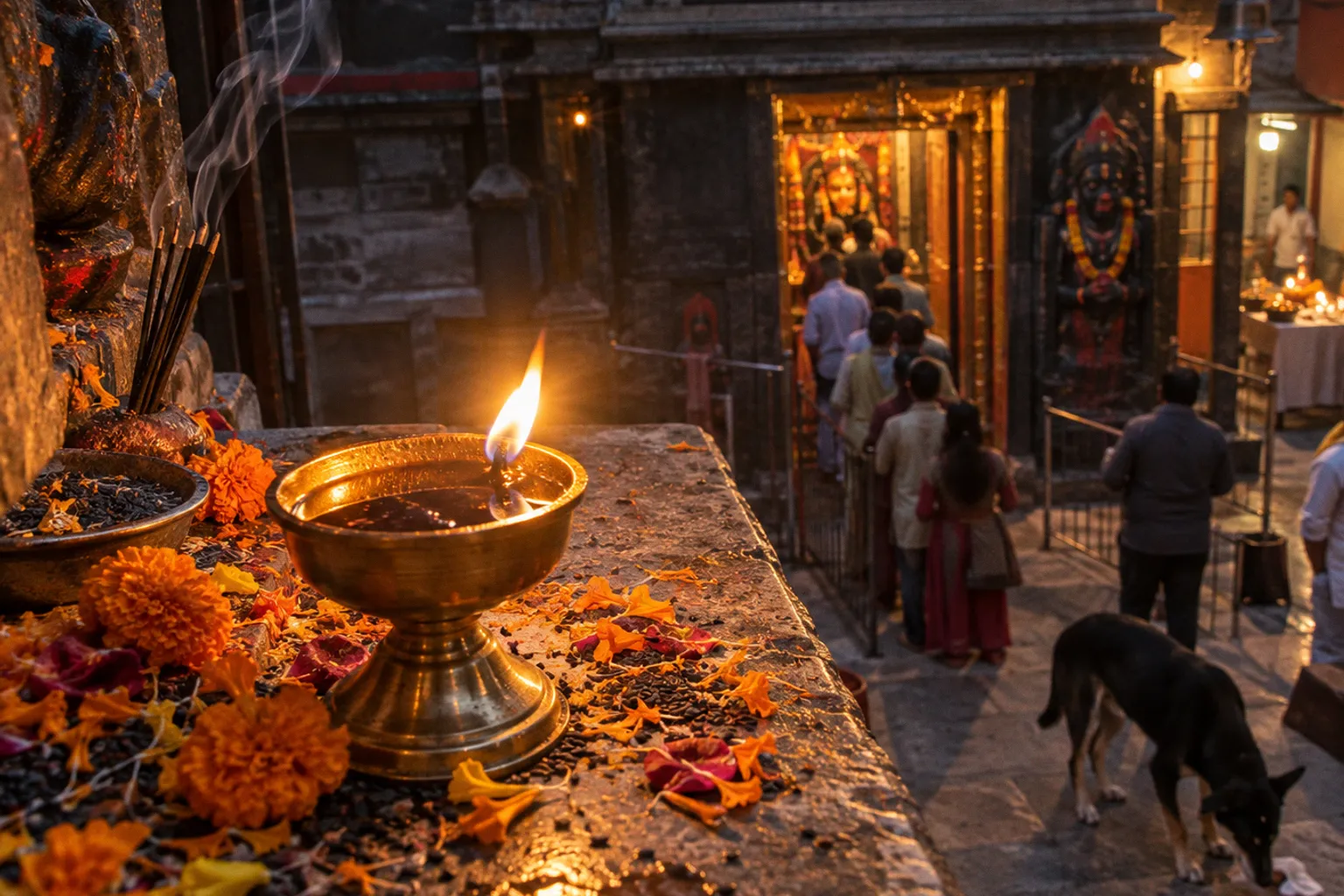
In the ritual geography of Kashi, however, another shrine often comes first: the Kal Bhairav Temple, where Lord Shiva appears as the guardian officer, or Kotwal, of the city. The traditional understanding is not that a pilgrim simply enters Varanasi as a tourist, but that one first seeks the protection and permission of Kal Bhairav before beginning a longer religious observance.
This is the significance of the shrine. Kal Bhairav is not only a fierce form of Shiva represented through iconography and myth; he also occupies a civic and ritual position within Kashi’s sacred lineage. Devotees come to request permission to remain in the city, to begin a pilgrimage, or to proceed toward other temples and ghats with the correct sense of etiquette. If you are planning your visit around the kal bhairav temple darshan timings and rituals, the most useful approach is to understand both the public opening hours and the rhythm of worship that gives those hours their meaning.
The role of the Kotwal: why pilgrims seek permission first
The name Bhairava is associated with a formidable manifestation of Shiva, while Kala refers to time and, in many religious interpretations, to the force that brings worldly forms toward their limit. At Kal Bhairav Temple, this power is not presented as an abstract idea. It is given a specific responsibility: guarding Kashi and overseeing those who enter its sacred domain.
The title Kotwal traditionally refers to a city officer responsible for order and protection. When devotees call Kal Bhairav the Kotwal of Kashi, they are describing a relationship of guardianship, discipline, and permission. This is why the customary sequence for many pilgrims begins with Kal Bhairav before moving toward other principal shrines. The visit establishes an observance: you acknowledge the guardian of the city before asking to participate in its sacred landscape.
We should be careful not to reduce this custom to a simple superstition or an item to tick off a pilgrimage list. Ritual sequence carries social and theological significance. It tells you how a tradition understands belonging. The visitor does not arrive as an owner of the city’s sacred spaces, but as someone asking to enter respectfully.
The temple’s mythology reinforces this position. In the narrative associated with the Kashi Khand section of the Skanda Purana, Kal Bhairav severed Brahma’s fifth head and carried the consequence of that act until entering Kashi at Kapalmochan Tirtha, where he was released from the sin of Brahmahatya, the killing of a Brahmin. The story is not simply an account of violence. It explores responsibility, transgression, purification, and the exceptional status of Kashi as a place where a severe spiritual burden can be transformed.
For pilgrims, the practical result is clear: Kal Bhairav is approached as an authority. You may hear people describe their visit as asking for permission to stay in Varanasi, to undertake a pilgrimage, or to proceed to another shrine. The wording differs from one family or guide to another, but the underlying gesture remains the same.
A visit to Kal Bhairav is not only a request for blessing; it is an acknowledgment that pilgrimage begins with permission.
Kal Bhairav Temple darshan timings: planning the day
The temple generally follows two broad public visiting periods:
| Visiting period | General public darshan |
|---|---|
| Morning | 5:00 AM to 1:30 PM |
| Afternoon and evening | 3:30 PM to 10:00 PM or 11:00 PM, depending on seasonal schedule |
| Early morning special worship | Mangala Aarti, around 4:00 AM |
| Midday worship | Bhog Aarti, around 12:00 PM or 1:00 PM |
| Evening worship | Sandhya Aarti, around 7:00 PM to 8:00 PM |
| Late-night worship | Shayan Aarti, around 11:00 PM to 12:30 AM |
These timings should be treated as a ritual framework rather than a railway timetable. Public darshan usually follows the general morning and evening slots, while aarti timings may shift according to the temple’s observance, season, crowd conditions, or the specific day. If you are travelling for a particular aarti, confirm the schedule locally before setting out, especially during major festivals and auspicious tithis, the lunar dates used in the Hindu calendar.
The best time to visit Kal Bhairav Varanasi depends on what you want from the experience.
For a quieter darshan
The first public morning period is often the most suitable choice for visitors who want to approach the temple with patience and fewer competing demands from the rest of the day. Early morning also aligns naturally with the city’s devotional rhythm, when pilgrims are beginning their observances rather than arriving after a full day of sightseeing.
You do not need to force yourself into the Mangala Aarti if your travel arrangements make a 4:00 AM visit impractical. Mangala Aarti is a particularly significant early worship, but attendance at it is not the only valid form of darshan. A calm visit during the regular morning opening can be more respectful than arriving exhausted, rushed, or unable to follow the shrine’s instructions.
For the atmosphere of evening worship
The evening period brings a different rhythm. Sandhya Aarti, performed around 7:00 PM to 8:00 PM, marks the transition from day into night and draws devotees who wish to participate in the temple’s evening observance. Crowds can be more concentrated at this time, and public access during the aarti itself may not follow the same pattern as ordinary darshan.
Do not assume that arriving just before the aarti guarantees entry into every part of the ritual space. The inner sanctum, or garbha griha, may be subject to crowd management and local arrangements, particularly during peak worship. The appropriate approach is to follow the instructions given at the temple rather than treating an online schedule as a promise of unrestricted access.
For late-night worship
Shayan Aarti, the late-night worship associated with the deity’s repose, is generally held between around 11:00 PM and 12:30 AM. This is a distinct observance, not simply a late opening for sightseeing. If you plan to attend, arrange your transport and return route in advance, remain attentive to local directions, and be prepared for conditions that are different from a daytime visit.
The temple’s standard public hours are commonly given as 5:00 AM to 1:30 PM and 3:30 PM to 10:00 PM or 11:00 PM. Aarti timings sit within a more complex devotional schedule. This is why the most reliable plan is to choose a broad visiting window and then confirm the precise ritual timing on the day.
The four daily aartis and what they signify
The aarti cycle gives structure to the temple day. Aarti is a ceremony in which light is offered before the deity, accompanied by prayer, bells, chanting, and other ritual actions. Each aarti occupies a particular position in the daily sequence, and the names indicate the changing phase of the day.
Mangala Aarti: the early morning opening
Mangala Aarti takes place around 4:00 AM, before the regular public morning darshan period. The term mangala carries the sense of auspiciousness, and the ritual opens the day’s worship in an atmosphere of preparation and reverence.
For a pilgrim, attending Mangala Aarti can be meaningful because it places you at the beginning of the temple’s daily observance rather than in the middle of a tourist itinerary. Yet the significance of the ritual does not mean that every visitor must attend it. If you are unfamiliar with the shrine, a regular morning darshan may offer a more manageable introduction to the etiquette of the space.
Bhog Aarti: the offering of food
Bhog Aarti is associated with the offering of food, known as bhog, and is generally held around noon or early afternoon, often at approximately 12:00 PM or 1:00 PM. Food offerings are not simply decorative objects in Hindu worship. They represent hospitality, reciprocity, and the recognition that the deity is being approached as a living presence within the ritual relationship.
If you visit around midday, allow for the possibility that the pace of public access may change as the temple conducts its observance. A temple’s daily schedule is not organised solely around visitor convenience. When an offering is being prepared or presented, the visitor’s role is to wait, listen, and accept the rhythm of the shrine.
Sandhya Aarti: the evening transition
Sandhya Aarti is generally held around 7:00 PM to 8:00 PM. Sandhya refers to the transitional period between day and night, a time that holds particular importance in Hindu observance. At Kal Bhairav Temple, the evening aarti provides an opportunity to encounter the shrine when the day’s public movement gathers around a more concentrated act of worship.
This is often the period when visitors notice the strongest contrast between ordinary darshan and formal ritual. The soundscape becomes more prominent, the congregation may grow denser, and movement may be directed more carefully. You can participate through attentive presence without attempting to stand at the centre of the ritual action.
Shayan Aarti: the closing observance
Shayan Aarti takes place late at night, usually around 11:00 PM to 12:30 AM. The word shayan refers to rest or repose, and the ritual closes the temple’s daily cycle.
For visitors, the main point is not to treat this as a dramatic after-hours attraction. It is a closing observance with its own etiquette. If access is limited or the arrangement differs from the public schedule, that is part of the temple’s ritual order rather than a failure of visitor service. We participate respectfully by accepting that a sacred institution does not owe every part of its daily life to public viewing.
Offerings, Bhairav Raksha Sutra, and the etiquette of darshan
Offerings at Kal Bhairav Temple commonly include flowers, oil, and black sesame seeds. Devotees may also purchase a black thread known as Bhairav Raksha Sutra. Raksha means protection, while sutra means thread or connecting cord. When tied around the wrist, it is understood as a protective ritual object associated with Kal Bhairav’s guardianship.
The thread should not be treated as a souvenir in the ordinary commercial sense. Its significance comes from the act of receiving and wearing it within a devotional context. If you choose to accept one, do so because you understand the observance, not because it appears to be a required souvenir for completing a temple visit.
Dogs also have an important association with Bhairav iconography, as the dog is traditionally regarded as his vehicle, or vahana. Offerings of white barfi to dogs are part of the devotional landscape around the shrine. Visitors should follow local guidance about where and how such offerings are made, since feeding animals in a crowded urban lane has practical consequences as well as ritual meaning.
A considerate visit usually involves a few simple habits:
- Wear clothing that allows you to enter a devotional environment without drawing attention away from the observance.
- Keep your movements measured in crowded areas, particularly near the entrance and inner worship spaces.
- Follow instructions from temple staff, priests, and local volunteers even when the arrangement differs from what you expected.
- Ask before photographing people, ritual actions, offerings, or the interior of the shrine.
- Keep your phone and other belongings secure, and avoid bringing unnecessary items into a busy temple lane.
- Do not assume that a particular offering, thread, or ritual service is compulsory unless the temple’s authorised personnel state otherwise.
- If you are uncertain about the sequence of worship, watch what other devotees are doing and ask quietly rather than interrupting the ritual.
There is no need to perform a gesture that you do not understand. A respectful bow, a moment of silence, or a sincere offering is preferable to imitating a practice without knowing its purpose. The temple is not an examination in religious fluency. It is a place where your conduct should show attention.
Auspicious days: Tuesdays, Sundays, Ashtami, and Chaturdashi
Tuesdays and Sundays are widely regarded as especially auspicious for worship at Kal Bhairav Temple. The lunar dates Ashtami and Chaturdashi are also associated with particular devotional significance. These dates can bring larger crowds and a more concentrated atmosphere of observance.
The most prominent annual occasion is Bhairav Ashtami, also known as Bhairava Jayanti, observed on Margashirsha Krishna Ashtami. The date changes according to the lunar calendar, so visitors should check the relevant year’s calendar rather than relying on a fixed date.
Auspicious timing is valuable for pilgrims who want their visit to align with a specific religious intention, but it also changes the practical conditions of darshan. On a busy day:
1. Allow more time than the ordinary temple schedule seems to require, because the queue and approach through the lanes may move slowly.
2. Avoid planning a tightly connected itinerary immediately afterward; ritual timing and crowd movement are not always predictable.
3. Expect more offerings, more devotional activity, and greater density around the shrine.
4. Keep your group together without blocking the path of local devotees.
5. Accept that you may see less of the inner ritual than you imagined and still have completed a meaningful darshan.
The significance of an auspicious day lies in the intention and observance it supports. It does not turn the temple into a performance staged for visitors. The shrine remains a functioning place of worship for local families, pilgrims, priests, and returning devotees.
On a crowded sacred day, patience is not an inconvenience added to the pilgrimage; it is part of the pilgrimage’s etiquette.
Understanding the traditional circumambulation
Some scriptural traditions associate Kal Bhairav worship with eight circumambulations, or parikrama. A parikrama is the practice of walking around a sacred image or shrine in a clockwise direction, keeping the deity at the centre of one’s movement. The number eight carries a connection to the traditional forms and directions associated with Bhairava.
This should be approached with care. A textual or customary recommendation does not mean that every visitor should force a fixed number of circuits through a crowded space. The practical possibility of circumambulation depends on the temple’s arrangement, crowd control, and instructions on the day. If the path is open and devotees are undertaking the practice, you may follow it respectfully. If movement is restricted, do not create a second route or attempt to bypass a queue in order to complete a number.
The principle is more important than mechanical repetition: remain aware of the shrine as the centre of the observance, keep the movement clockwise where appropriate, and avoid turning a devotional practice into a hurried photographic exercise.
How to fit Kal Bhairav into a Varanasi pilgrimage
Many visitors combine the temple with a wider journey through Kashi’s sacred sites, including Kashi Vishwanath, the ghats along the Ganga, Sankat Mochan Hanuman Temple, Durga Kund Temple, or the temples and institutions connected with Banaras Hindu University. The order may vary according to family tradition, travel time, and the purpose of the visit, but the Kal Bhairav shrine is often placed near the beginning because of its role as the guardian of Kashi.
If you are visiting the temple before Kashi Vishwanath, leave enough time between the two rather than attempting to move through both as if they were adjacent stops in a museum itinerary. The significance of the sequence is not measured by how quickly you complete it.
A practical day might look like this:
- Begin with a morning visit during the general darshan period if you want a calmer introduction.
- Offer flowers, oil, or black sesame according to your intention and the temple’s local practice.
- Receive a Bhairav Raksha Sutra only if you understand its devotional purpose.
- Continue to other shrines or the riverfront after allowing time for the lanes and queues.
- Return in the evening only if you specifically wish to attend Sandhya Aarti or experience the later devotional rhythm.
- On a festival or auspicious lunar date, keep the rest of the day flexible.
Transport arrangements deserve particular attention. The temple is reached through the dense urban fabric of Varanasi, where the final approach may involve narrow lanes and substantial pedestrian movement. A vehicle cannot always take you directly to the entrance, and a driver’s estimate of travel time may not account for the final walk or festival congestion. Wear practical footwear, keep valuables close, and carry only what you need.
The shrine is part of a living neighbourhood, not an isolated monument. Shopkeepers, residents, priests, pilgrims, and visitors share the same lanes. Your conduct outside the temple therefore forms part of the visit: do not obstruct entrances, photograph private domestic spaces without permission, or treat devotional commerce as a spectacle.
What visitors should and should not assume
The standard general darshan is understood to be available without a paid entry ticket. That does not mean every special ritual arrangement is automatically open to everyone, nor does it guarantee access to the inner sanctum during peak aarti. Special passes, close access, or arrangements connected with particular worship may follow procedures that change over time.
For this reason, be cautious with online claims that present one fixed entry rule as universal. The most reliable guidance is the instruction provided at the temple on the day of your visit. In particular, do not assume that a general visiting hour gives you unrestricted access during Mangala, Sandhya, or Shayan Aarti.
You may also encounter varied descriptions of offerings, including claims about alcohol and Bhairav worship. The shrine’s ritual traditions are complex, and private devotional practices should not be casually presented as official general prasad distributed by temple authorities. Follow the actual instructions of the temple and avoid buying an offering simply because a tout or informal guide tells you that it is compulsory.
The same care applies to the age of the temple. The existing structure is generally associated with construction in the mid-seventeenth century, with later reconstruction or expansion linked to the eighteenth century and the patronage of Rani Ahilyabai Holkar. The sacred presence of Kal Bhairav is understood through a much older religious lineage, but the precise ancient origin of the current shrine should not be confused with the age of the tradition itself.
A respectful way to complete your visit
Before entering, decide what you are asking from the visit. It may be permission to begin a pilgrimage, protection for your time in Kashi, remembrance of a family tradition, or simply the opportunity to stand before a shrine whose significance has shaped the city’s sacred geography.
Then allow the ritual to be what it is. Offer what you can offer without anxiety. Listen to instructions. Move with the crowd rather than against it. If you do not understand a Sanskrit or Hindi term, ask for an explanation rather than pretending familiarity. If a ritual space closes temporarily, wait or return later rather than pressing forward.
The kal bhairav temple darshan timings and rituals are useful for planning, but the schedule alone cannot explain why the temple matters. Kal Bhairav’s position as the Kotwal of Kashi gives the visit its distinctive character: you are not only seeking a blessing from a form of Shiva, but recognising the authority of the guardian who stands within the city’s ritual lineage.
Plan around the general hours of 5:00 AM to 1:30 PM and 3:30 PM to 10:00 PM or 11:00 PM, confirm aarti timings locally, and leave room for the shrine’s own rhythm. The most respectful participation is neither hurried nor theatrical. It is attentive, informed, and willing to begin in the manner Kashi’s traditions prescribe: by asking permission to enter.