Banarasi silk saree: identifying authentic handloom weaves
A Banarasi silk saree is not authenticated by weight, shine, or a familiar floral pattern alone.
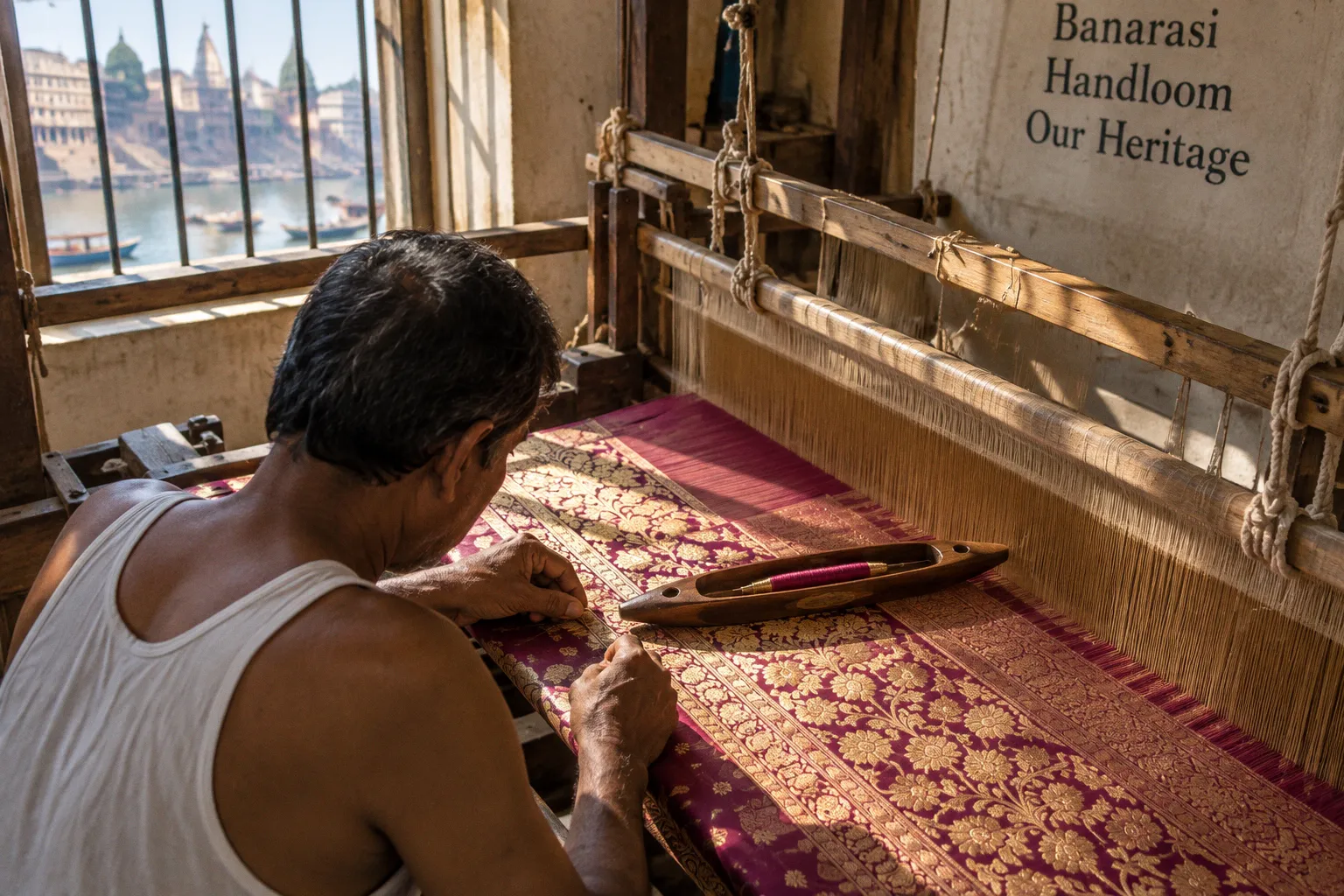
These qualities can appear in powerloom copies as easily as in handwoven cloth, which is why the most useful approach combines documentation with close observation of the weave itself.
The phrase Banarasi silk carries both cultural significance and legal meaning. Since 2009, Banarasi brocades and sarees have held Geographical Indication, or GI, status in India. This protection applies to textiles woven in Varanasi and five adjoining districts—Mirzapur, Chandauli, Bhadohi, Jaunpur, and Azamgarh. Yet a GI label is only one part of the conversation. To understand what you are buying, we need to look at the saree’s lineage, the evidence of its construction, and the relationship between its material, price, and certification.
Authenticity is not a question of how much a saree sparkles; it is a question of where, how, and from what the cloth was made.
Start with the GI tag and Silk Mark
The first distinction to make is between geographical origin and fiber composition. A GI tag concerns the protected identity of the textile: it indicates that the Banarasi brocade or saree belongs to the recognized production region. It does not, by itself, tell you that the saree is made entirely from pure silk, nor does it prove that every visible thread was woven by hand.
That is where the Silk Mark becomes useful.
The Silk Mark label is issued by the Silk Mark Organisation of India under the Central Silk Board. It certifies that the yarn used in the saree is 100% natural pure silk. The label includes identifying features such as a serial number, QR code, and tamper-proof hologram. When you are comparing several sarees described as silk, this certification gives you a more specific piece of information than the broad word Banarasi alone.
A careful buyer should read the two forms of identification as answering different questions:
| What you are checking | What it tells you | What it does not establish by itself |
|---|---|---|
| GI tag | The saree belongs to the legally recognized Banarasi production identity and region | That the fabric is 100% pure silk or entirely handwoven |
| Silk Mark label | The yarn used is certified as 100% natural pure silk | That every part of the saree, including zari, has the same composition |
| Reverse-side weave | Whether the cloth displays physical signs associated with handloom construction | A complete legal certification of origin |
| Selvedge and loom marks | Whether the edge carries traces of traditional loom tensioning | That an unmarked saree is automatically counterfeit |
| Seller’s description | The seller’s stated material, technique, and provenance | Independent proof of those claims |
The labels should be examined physically rather than accepted as decoration. Look for the serial number, QR code, and hologram on the Silk Mark label, and ask whether the seller can explain how the label corresponds to the particular saree. A printed card placed beside a saree is not the same thing as a certification label attached to that textile.
At the same time, do not turn certification into a blunt instrument. Small artisanal sellers and individual weavers may not issue formal GI or Silk Mark documentation with every direct sale, particularly when they are working outside large retail systems. The absence of a tag means that the saree requires closer examination; it does not automatically establish that it is fake.
Read the reverse side before admiring the front
The front of a Banarasi saree is designed to command attention. Brocade motifs, metallic zari, floral butis, patterned borders, and a controlled sheen can make it difficult to think analytically. The reverse side is less theatrical and often more revealing because it shows how the motifs were built into the cloth.
In a handwoven Banarasi saree, the back may show floating threads between motifs. You may also see tied-off knots where the weaver changed colours, along with slight variations in the handling of the threads. These irregularities are not necessarily flaws. They can be traces of the human and mechanical decisions involved in traditional loom work.
A powerloom copy often presents a different kind of neatness. Its reverse finish may appear mechanically uniform, with short clipped threads rather than longer floating threads and tied-off transitions. The surface can look too consistent in the wrong way: not carefully resolved by hand, but processed according to a repeated machine pattern.
When identifying handloom Banarasi silk, turn the saree over in good light and inspect several different areas rather than judging one motif. Examine the pallu, the border, and a section of the body. A single clean or untidy patch does not tell the whole story, especially when the saree contains more than one weaving technique or has been finished after leaving the loom.
You are looking for a pattern of evidence:
1. Floating threads between motifs can indicate the way supplementary pattern threads were carried across the reverse side.
2. Tied-off knots at colour changes suggest that the transition was handled during weaving rather than produced as a completely uniform machine finish.
3. Slight variations in the weave may reflect handloom construction and should not be confused automatically with poor workmanship.
4. Clipped, uniformly short threads across the back may point toward a powerloom imitation, particularly when combined with an excessively regular reverse surface.
5. A perfectly tidy reverse is not enough to prove machine production, but it should encourage you to inspect the selvedge, labels, and material claims more carefully.
Traditional silk weaving techniques in Varanasi have always involved technical discipline. Handwoven does not mean careless, and machine-made does not mean visually unattractive. A powerloom saree may reproduce a Banarasi pattern with considerable precision. The question is not whether the copy is beautiful; the question is whether it is being sold honestly as a handloom silk saree.
The selvedge keeps a record of tension
The selvedge is the unpatterned edge that runs along the length of the saree. It is easy to overlook because the decorative border is usually more prominent, but this narrow margin can preserve evidence of the loom on which the cloth was made.
Handloom sarees may carry faint pin marks along the selvedge. These marks are associated with the traditional tension pins used to hold the fabric steady during weaving. They may not be dramatic, and they should not be expected to appear as a bold line of identical punctures. Look for subtle traces in more than one section of the edge.
Powerlooms use different mechanized tensioning systems. Their selvedges may show mechanical track lines or may lack the manual pin marks associated with traditional handloom tensioning. Again, no single feature should be treated as an absolute verdict. The selvedge is strongest as evidence when it agrees with what you have already seen on the reverse side.
This is one reason rushed shopping can work against you. A saree folded into several layers may conceal the very edges that would help you understand its construction. Ask to see a length of the selvedge and the reverse, and take time to examine them without allowing the presentation to remain focused only on the front pattern.
The terminology also matters. A seller may use handloom, handwoven, silk, Banarasi, and zari as though they were interchangeable descriptions. They are not.
- Handloom describes the type of loom and the method of production.
- Silk describes the fiber, but the word should be connected to a specific composition rather than assumed from shine.
- Banarasi refers to a protected regional textile identity, though the market also contains imitations using Banarasi-inspired designs.
- Zari refers to metallic thread used in decorative weaving, and its quality depends on the material and construction of that thread.
- Powerloom refers to mechanized production and does not mean the saree has no value; it means the saree should not be represented as an authentic handloom piece.
The reverse and the selvedge are not hidden secrets; they are the parts of the saree where its production history is most legible.
Separate silk from shine
High gloss is one of the least dependable authenticity markers. Synthetic polyester can have a strong artificial shine, while pure silk usually presents a more restrained sheen that changes as the fabric moves. A bright surface may be attractive, but it cannot establish fiber composition.
Weight is equally unreliable. A saree with dense zari or heavy embellishment may weigh more than a plain silk saree, while a lighter silk textile may contain less metallic work. You should not use heaviness as shorthand for purity.
When a seller claims that a saree is pure silk, the Silk Mark label is the clearest non-destructive form of confirmation available within the information provided by the certification system. If a label is absent, ask what the fabric composition is and whether the seller is describing pure silk, a silk blend, art silk, or synthetic fiber. A precise answer is more useful than a general assurance that the saree has a traditional appearance.
There is also a traditional burn test for distinguishing pure silk from synthetic imitation. Pure silk burns slowly, smells like burning hair, and leaves black, powdery ash. Polyester burns quickly, smells like plastic, and forms a hard melted bead. But this test is destructive. It should never be performed casually on a finished saree, particularly one with a decorative border, zari, dyeing, or value that could be damaged. If a test is considered at all, it belongs to a controlled textile assessment or to a loose yarn sample supplied for that purpose—not to an impulsive experiment with the edge of a treasured garment.
The same caution applies to examining zari.
Examine the zari without confusing decoration for proof
Genuine zari consists of fine silver or gold plating wrapped around a silk core yarn. When a small section of genuine zari is scratched, the underlying core may appear red or white silk. Synthetic zari, by contrast, may use plastic or dull metal coatings.
This distinction can be useful, but scratching a finished saree is not an acceptable way to inspect it in a shop. The test damages the thread and may leave a visible mark in a border or motif. Ask whether the seller can show you an unused thread sample, a cut end, or documentation describing the zari. If no such evidence is available, treat the zari claim with caution rather than creating damage in the name of certainty.
The appearance of metallic thread also changes according to age, storage, oxidation, and the density of the weave. A saree that does not look brilliantly gold is not necessarily made with inferior zari, and a highly reflective surface is not necessarily evidence of precious-metal plating. Authenticity is built from several related observations, not from the loudest visual feature.
When considering a saree for ceremonial use, its tactile and visual character can still matter. The way the border falls, the softness of the silk, and the relationship between the body and the pallu help you understand the garment’s design lineage. They are meaningful aesthetic observations, but they should remain separate from technical claims about fiber and handloom status.
Understand the price gap between a copy and a handloom saree
Price is not a perfect authentication tool, yet an implausible price should make you slow down. Synthetic powerloom imitations marketed as Banarasi may appear in the lower range of approximately Rs 500 to Rs 1,000. An authentic handloom silk Banarasi saree carrying GI and Silk Mark tags is generally expected to begin above Rs 10,000, depending on its weaving, zari, design, and other details.
These figures should not be turned into a rigid price chart. A low price does not prove that a saree is counterfeit, and a high price does not prove that it is handwoven. Sellers can mislabel products in both directions, while small weavers and direct artisan channels may operate outside formal certification systems. The significance of the price lies in how it relates to the claim being made.
If a saree is presented as pure silk, handwoven, and richly worked, yet priced in the range normally associated with synthetic powerloom copies, ask what has been omitted from the description. It may be a synthetic textile, a blend, a machine-made imitation, or a saree with a simpler construction than the seller suggests. The honest answer may still lead to a useful purchase, but only if the object is described accurately.
A practical comparison can be made by recording the seller’s answers under four headings:
- Fiber: Is it 100% natural silk, a blend, or synthetic?
- Technique: Is it handloom or powerloom?
- Origin: Was it woven within the GI-protected Banarasi production region?
- Documentation: Does it carry a GI-related identification and a Silk Mark label with verifiable features?
The more expensive saree is not automatically the more authentic one. A buyer should be paying for a clearly described textile rather than for the atmosphere of exclusivity surrounding it.
A respectful way to make the final decision
When you are selecting a Banarasi silk saree in Varanasi, the most considerate approach is also the most practical: ask direct questions, request to see the reverse and selvedge, and allow the seller to explain the cloth before you begin handling it extensively. Textile shops may have carefully folded sarees arranged according to colour, occasion, and price, so we should avoid pulling apart a stack without guidance.
A simple sequence keeps the inspection focused:
1. Read the description before touching the decoration. Establish whether the seller is claiming pure silk, handloom production, GI identity, or some combination of these.
2. Inspect the labels. Look for the Silk Mark serial number, QR code, and tamper-proof hologram, and distinguish a proper label from a general product card.
3. Turn the saree over. Examine floating threads, tied-off knots, and the overall regularity of the reverse side.
4. Find the selvedge. Look for faint traditional pin marks, while remembering that the absence of one feature is not conclusive.
5. Discuss the zari. Ask what the metallic thread contains and whether the seller can show a sample without damaging the saree.
6. Compare the price with the claim. A low price may be entirely reasonable for a powerloom copy, but it should not be paired with an unqualified handloom promise.
7. Keep the uncertainty visible. If there is no formal certification, describe the saree to yourself as unverified rather than forcing it into the category of either genuine or fake.
This last point is part of textile etiquette. A saree made on a powerloom is not culturally meaningless, and a saree without a visible tag is not automatically fraudulent. What matters is that the lineage of the object is not concealed. A powerloom textile can be an accessible interpretation of Banarasi design; a handwoven silk saree carries a different technical, economic, and cultural significance. Both can be appreciated, but they should not be sold under the same description.
The meaning of an informed purchase
Identifying a Banarasi silk saree is not about discovering one secret mark that settles every question. The GI tag, Silk Mark label, reverse-side floats, selvedge pin marks, fiber evidence, zari construction, and price all contribute to a more reliable understanding. Each one has limits, and those limits are part of the knowledge.
When we approach the saree in this way, we respect more than the buyer’s budget. We acknowledge the weaver’s labour, the regional lineage protected by the GI designation, the technical vocabulary of the loom, and the difference between a handwoven textile and a machine-made imitation. The most responsible purchase is therefore not simply the one that looks beautiful under shop lights. It is the one whose material, method, origin, and price have been described with enough clarity for you to participate in the tradition without mistaking its surface for its history.