Chunar Fort day trips: avoiding common tourist traps
Chunar Fort is approximately 40 kilometres from Varanasi, but the distance alone does not determine the cost or difficulty of the excursion. The principal problems are logistical.
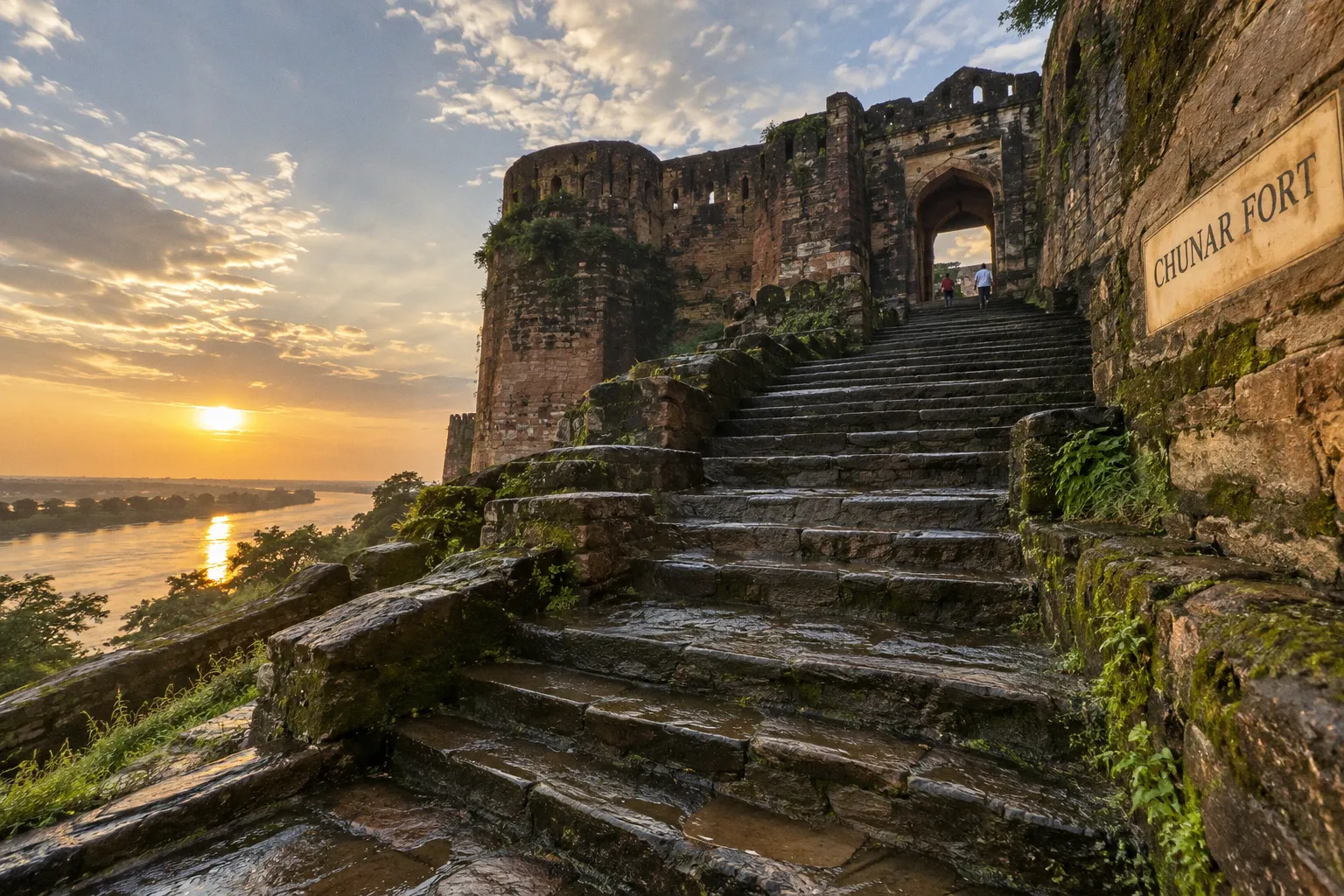
Tour packages may exclude monument entry, camera charges, food, drinks, gratuities, and transfers from locations outside the standard city area. A low advertised price can therefore become a substantially different expense by the time the visitor reaches the fort.
The journey is manageable as a day trip. Train travel from Kashi or Varanasi to Chunar takes about 45 minutes, while a private cab provides more control over departure and return times. The fort itself requires two to three hours for a meaningful visit. The practical objective is not simply to reach Chunar. It is to establish the total route, the actual inclusions, and the sequence of movement between station, town, entrance, and ramparts before departure.
Navigating the 40-kilometre route: train versus private cab
Chunar Fort stands on the Ganges in Mirzapur district, southeast of Varanasi. Its position is geographically straightforward but operationally divided into separate stages:
2. Arrival in Chunar.
3. Local movement from the railway station or road drop-off point to the fort.
4. Entry processing.
5. Internal exploration across the fort complex.
6. Return to Chunar station or the vehicle waiting point.
Most avoidable costs occur between the second and third stages. A train ticket does not normally solve the final connection to the fort, and a private cab quote may not include every transfer requested by the traveller.
Train travel from Kashi or Varanasi
Indian Railways operates services from Kashi or Varanasi towards Chunar station. The journey takes around 45 minutes. Reported fares range from approximately ₹120 to ₹950, depending on the coach class and the specific service. This is the lowest-cost intercity option when the timetable aligns with the intended visit.
The train has two limitations. First, the schedule determines the day’s structure. A visitor arriving too late reduces the available time inside the fort, particularly because the site generally operates from 9:00 AM to 5:00 PM. Some entrance gates have been reported to open around 8:00 AM, but that earlier access should not be treated as a universal operating rule.
Second, Chunar station is not the fort entrance. The visitor still needs local transport to reach the ramparts. The exact standardized fare for an auto-rickshaw directly from Chunar Railway Station to the fort is not consistently documented. That uncertainty makes it preferable to agree on the fare before departure rather than negotiate after luggage has been unloaded.
A rail-based itinerary works best for travellers who are comfortable with a less controlled schedule and who have already considered the last local connection. It is less suitable when the group includes children, elderly visitors, extensive luggage, or anyone requiring a fixed return time.
Private cab from Varanasi
A private cab removes the dependence on the rail timetable and allows an earlier departure. It also permits a direct return to Varanasi after the fort visit. For a day trip, that flexibility has practical value: the fort can be approached before the strongest daytime heat, and the return journey does not depend on finding local transport at a particular hour.
The cab option is more vulnerable to unclear inclusions. A quotation may cover the vehicle and driver but exclude monument tickets, waiting charges, meals, camera charges, or pick-up and drop-off beyond the operator’s normal city limits. Airport transfers from Lal Bahadur Shastri Airport and transfers from Mughalsarai, now Pt. Deen Dayal Upadhyaya station, may attract additional charges.
A serious quote should define the following points in writing:
- Whether the quoted amount is for the vehicle or per passenger.
- Whether the return journey is included.
- The permitted waiting period at Chunar Fort.
- Whether parking, tolls, and driver expenses are included.
- Whether airport or railway-station pick-up carries a surcharge.
- Whether the driver will take the vehicle to the fort entrance or only to Chunar town.
- Whether the vehicle remains available during the full two- to three-hour visit.
The distinction between a transfer and a day-hire vehicle is significant. A transfer may deliver the visitor to Chunar and end there. A day-hire arrangement should keep the vehicle available for the return, but the duration and waiting conditions must still be established.
| Transport option | Main advantage | Main risk | Most suitable for |
|---|---|---|---|
| Train from Kashi or Varanasi | Lower direct travel cost and approximately 45-minute journey | Timetable dependency and separate local transfer to the fort | Independent travellers with flexible schedules |
| Private cab | Direct route, controlled departure, and easier return | Excluded charges, waiting conditions, and out-of-bound pick-up fees | Families, small groups, and visitors requiring schedule control |
| Unspecified tour package | Convenience through a single booking | Entry fees, food, camera charges, gratuities, and transfers may be excluded | Only travellers who have verified the full inclusion list |
The cheapest route to Chunar is not necessarily the lowest-cost day trip. The final local transfer and excluded charges determine the actual price.
Official entry fees and the surcharge problem
Chunar Fort is not a universally free monument. Adult visitors should expect an official entry charge. Reported fees range from ₹20 to ₹25 for Indian nationals and from ₹200 to ₹300 for foreign nationals. Children under 15 are reported to enter free.
The range is more useful than a single advertised figure because ticketing can vary by category and administrative practice. Visitors should carry enough small-denomination cash for the entrance process and should not assume that a tour operator’s quotation includes the fee. The same applies to photography. Camera charges may be collected separately, depending on the equipment and the applicable local rules.
The common tourist trap is not necessarily an inflated official ticket. It is the presentation of a package total that appears comprehensive but covers only transport. The additional expenses then appear individually at the site or during the return journey.
A package should be treated as incomplete until it answers four basic questions:
- Is the Chunar Fort monument ticket included?
- Are camera or photography charges included?
- Are food, drinks, and gratuities excluded?
- Does the quoted transport cover the full return route?
If the answer is unclear, the correct assumption is that the item is payable separately. This does not imply misconduct by every operator. It reflects a normal division between transport services, monument administration, and local vendors. The problem begins when the division is not disclosed before payment.
How guide charges become unclear
Unofficial local guides may offer their services near the entrance. Uniform pricing for these guides is not consistently documented. A visitor should therefore establish the total fee before the tour begins, including:
- The duration of the guiding service.
- Whether the guide covers the full accessible complex or only the principal ramparts.
- Whether the quoted amount is for one person or the whole group.
- Whether the guide is independent or connected to the transport operator.
- Whether the service includes historical explanation or only route assistance.
A guide who asks for additional payment at the end has created an avoidable dispute if the initial arrangement was not defined. The safest approach is a short, explicit agreement before walking inside. No elaborate contract is required. The scope, duration, and total amount should simply be clear.
Visitors should also distinguish between a guide and a driver. A driver may know the approach road and waiting area but may not provide a reliable historical account. Conversely, an entrance guide may explain selected structures but have no responsibility for the return journey. Combining both roles without clarification is a frequent source of confusion.
Timing the visit for light, heat, and usable exploration
The standard visiting window is approximately 9:00 AM to 5:00 PM. Some gates have been noted as opening around 8:00 AM, but access conditions should be confirmed locally rather than assumed. The two-hour minimum is not excessive. Chunar Fort is a large historic enclosure with layered defensive and administrative spaces, and a short stop may cover only the most accessible section.
An early arrival has three practical advantages. It leaves more time for the internal route, reduces the pressure created by the 5:00 PM closing period, and offers more controlled light for photography. Late afternoon can also produce useful side lighting across masonry surfaces, but a late start leaves less margin if the approach or ticketing process takes longer than expected.
Photography should be organized around the site’s geometry rather than around a generic claim that one hour is always best. The fort’s walls, elevated positions, and river-facing orientation create changing contrast during the day. In direct overhead light, details in stonework may flatten and exposed surfaces become more demanding to navigate. Morning and late afternoon generally provide more manageable conditions for architectural images, but the visitor should give priority to safe footing and site instructions over a preferred frame.
A practical schedule is:
1. Arrive in Chunar with sufficient time for the local transfer.
2. Reach the fort early in the operating window.
3. Complete the exposed rampart and river-facing sections before the middle of the day.
4. Reserve the second half of the visit for enclosed, lower, or more detailed areas.
5. Begin the return journey with enough time for local transport and the onward connection.
The fort should not be treated as a brief photographic stop between other attractions. A two- to three-hour exploration period allows the visitor to understand its spatial layout and historical layering. Less time may still be worthwhile, but it changes the visit from a site examination into a short viewpoint stop.
Local transport, ramparts, and movement inside the complex
The physical route does not end at the entrance. Chunar Fort occupies a defensive position above the Ganges, and the visitor’s experience is determined by changes in elevation, wall alignment, open surfaces, and the condition of accessible paths. Comfortable footwear is more useful than formal clothing. Water should be carried, particularly during the hotter part of the day, but waste must not be left inside the monument grounds.
Local transport from Chunar station is the least standardized part of the journey. There is no consistently published fare schedule for an auto-rickshaw directly to the fort ramparts. The visitor should ask for the complete fare before entering the vehicle and should state whether the requirement is a one-way trip, a return, or waiting during the visit.
These are different services:
- A one-way drop-off ends at the fort.
- A return arrangement requires the driver to wait or return at a specified time.
- A vehicle hired for several hours may be priced differently from both.
- A transfer to Chunar town may not include the final approach to the monument.
A driver who agrees to wait should be given a realistic return time. A two- to three-hour fort visit is longer than a routine station transfer. If the driver does not wish to wait, the visitor should arrange the return before entering the site rather than attempting to negotiate it after closing.
The same principle applies to private cars. A driver may describe the trip as a full-day hire while imposing a separate charge for extended waiting. That condition should be settled before departure from Varanasi.
Basic safety in a historic defensive site
Chunar Fort is an active heritage site rather than a controlled museum interior. Surfaces, edges, steps, and exposed viewpoints require ordinary caution. Visitors should remain on accessible paths, avoid climbing on walls or restricted structures, and keep children within direct reach near elevated areas. The presence of a guide does not remove the need for personal attention.
The infrastructure of an old fort rarely conforms to the continuous, level circulation expected in a modern attraction. There may be uneven transitions between sections. The route should therefore be paced according to the least mobile member of the group, not the fastest walker.
Visitors should also account for the return journey. Carrying a charged phone, keeping the driver’s number available, and retaining enough cash for local transport are simple measures with high practical value. They are particularly relevant when the day is organized around a train rather than a continuously available cab.
Historical layers: from Vikramaditya to the East India Company
The fort’s historical value lies in its repeated strategic use. Its chronology is not a single founding story. It is a sequence of political occupations and military recoveries connected to the geography of the Ganges and the wider Mirzapur region.
Traditional accounts attribute the original commissioning of the fort to Maharaja Vikramaditya in 56 BC. This date should be understood as a traditional attribution rather than as a complete archaeological explanation of the visible structure. The present fort complex reflects later construction, adaptation, and military modification across different periods.
Sher Shah Suri took control of Chunar Fort in 1532 CE. The occupation placed the fort within the political contest of the sixteenth century, when control of river routes and fortified elevations had direct military value. The fort was later recaptured by Akbar in 1575 AD, adding another stage to its imperial chronology.
The East India Company captured Chunar Fort in 1772 AD. British control introduced another administrative and military phase. The site’s significance therefore cannot be reduced to one dynasty or one architectural style. Its spatial layout records a succession of uses: fortified position, political stronghold, administrative asset, and later heritage monument.
This chronology matters during the visit because different structures should not be read as if they belonged to the same construction campaign. Visitors looking for a single, visually uniform monument will misunderstand the site. The more accurate approach is to observe how defensive walls, elevated positions, access routes, and internal spaces were retained or altered as control changed.
Chunar Fort is best understood as a layered military landscape, not as a monument with one fixed date and one architectural identity.
The practical cost of a Chunar Fort day trip
A day trip budget has at least five separate components:
1. Intercity transport.
Train fares from Kashi or Varanasi to Chunar are reported at approximately ₹120 to ₹950, depending on coach class and service. A private cab will be priced separately by the operator and should be assessed by vehicle, route, and duration rather than by a headline per-person figure.
2. Local connection.
The journey from Chunar station or town to the fort is an additional movement. Its fare is not governed by a consistently published standardized schedule.
3. Monument admission.
Indian nationals should expect approximately ₹20 to ₹25 per adult. Foreign nationals should expect approximately ₹200 to ₹300 per adult. Children under 15 are reported to enter free.
4. Photography and guide services.
Camera charges may apply separately. Local guide fees are not uniformly documented and should be agreed before the service begins.
5. Food, drinks, and gratuities.
These are often excluded from tour packages. They should not be treated as incidental inclusions unless the operator states otherwise.
The correct comparison is therefore not between a train fare and a cab quotation. It is between complete itineraries. A train plus local transport, entry fee, return connection, food, and possible guide cost may produce a different total from a cab that appears expensive at first glance. A cab may be better value for a group if it eliminates multiple transfers. A train may remain preferable for a solo traveller who accepts the additional planning.
Signs of an unreliable package
A package deserves scrutiny when it uses a single low figure without defining the service. Particular warning signs include:
- A price that does not state whether it is per person or per vehicle.
- No description of the return journey.
- A claim of all-inclusive service without mentioning entry, camera, food, and gratuity charges.
- Extra fees for airport or Mughalsarai pick-up revealed only after booking.
- A driver who cannot confirm the waiting period at Chunar.
- A guide fee left open until the end of the visit.
- A promise of a fort visit without a stated duration inside the monument.
These conditions do not automatically make the operator fraudulent. They indicate that the service has not been defined with enough precision for a reliable comparison.
Building a reliable itinerary from Varanasi
The most stable plan begins with the fort’s operating window, not with the transport advertisement. The visitor should work backwards from the desired arrival time and allow space for the final local transfer.
For a train-based trip, the itinerary should include the selected service, the arrival at Chunar station, the local vehicle arrangement, the two- to three-hour fort visit, and the return connection. The return train should not be scheduled so tightly that a delay inside the monument or at the local transfer point creates a missed departure.
For a cab-based trip, the booking should specify a direct return to Varanasi, the total vehicle availability, and any surcharge for airport or out-of-city collection. If the cab begins at Lal Bahadur Shastri Airport or Pt. Deen Dayal Upadhyaya station, the operator should state whether that location falls outside the standard service area.
The fort can be visited independently, but independent travel does not mean unplanned travel. The useful distinction is between paying for convenience and paying for ambiguity. A defined cab service may justify a higher price. An undefined package does not.
Preservation and the present visitor experience
Chunar Fort remains a major historical structure in a region where heritage is distributed across riverfront architecture, temple districts, Buddhist sites, colonial buildings, and fortified settlements. Its preservation challenge is therefore partly architectural and partly infrastructural. The monument must be accessible enough for visitors while retaining the irregular spatial conditions that reveal its defensive history.
For the visitor, preservation is visible in the management of access, the protection of masonry and elevated structures, and the separation between permitted routes and restricted areas. The responsible response is straightforward: use designated access, do not climb or alter historic fabric, remove waste, and avoid treating fragile surfaces as viewpoints or seating.
The fort’s long chronology also places limits on simplified restoration narratives. A successful visit does not require every wall to appear newly repaired. Restoration should preserve evidence of construction phases and use, not erase them in pursuit of visual uniformity. The value of Chunar lies partly in the fact that its infrastructure records successive political systems.
A well-planned Chunar Fort day trip is consequently a modest logistical exercise with a clear historical return. The distance from Varanasi is manageable, the rail journey can take about 45 minutes, and official entry fees are relatively low. The main risks are avoidable: unclear package inclusions, unplanned local transport, undeclared camera or guide charges, and insufficient time inside the fort.
The reliable method is precise. Establish the route. Separate transport from admission. Confirm the return. Treat the published operating window as the controlling limit. Then read the fort through its spatial layout and chronology, from the traditional Vikramaditya attribution to the captures by Sher Shah Suri, Akbar, and the East India Company. That approach produces a more accurate visit and prevents the small expenses of a day trip from becoming its defining feature.