Baba Kinaram Sthal: visitor etiquette and dress code
There is a hesitation that settles over many first-time visitors to Ravindrapuri well before they reach the gates of Baba Kinaram Sthal, and it is worth naming openly.
The word Aghor, carried by whispered travel tales and a few sensational photographs, often arrives wrapped in a frame that makes a respectful visitor wonder whether a working ashram is really the right setting for an ordinary day of darshan.
It is. Baba Kinaram Sthal, also written as Baba Keenaram Sthal and home to the sacred Krim Kund, functions as the spiritual headquarters of a long-standing lineage of Shaiva sadhakas. The etiquette of the place is not a puzzle, even if the official dress-code policy is unconfirmed. The safest approach is the familiar one for a functioning sacred complex: cover your shoulders and knees, remove your footwear, keep your voice low, and understand what kind of space you are entering. The rest is attention rather than ceremony. You do not need to perform devotion, but you do need to avoid turning someone else’s place of practice into a backdrop for your own itinerary.
Understanding the Spiritual Significance of Krim Kund
To move through Baba Kinaram Sthal with the right bearing, it helps to know what the grounds are for, because the customs you observe make far more sense once the underlying purpose is clear. The Sthal sits in the Ravindrapuri and Bhelupur area of the city, a residential pocket that feels several steps removed from the riverfront crowds of Dashashwamedh and Assi. That quieter setting is part of the character of the visit. You are not approaching a monumental riverfront temple designed to absorb a constant stream of tourists. You are entering an ashram whose primary life is devotional and residential.
The complex is anchored by Krim Kund, also written as Kreem Kund, a sacred water tank associated with the convergence of older streams of Shaiva practice, including the Kailashi and Girnari lineages. Baba Keenaram, the ascetic after whom the Sthal is named, established the site as a seat of the Aghor tradition. The kund is both a ritual water body and a focal point around which the daily observances of the ashram are organized.
That distinction matters. Krim Kund is not simply one more interesting location to add between a walk through Bhelupur and a visit to the ghats. Its importance is not primarily architectural, and the experience is not built around explaining every object to an arriving visitor. The atmosphere depends on the presence of people who come to pray, sit, conduct ritual, or continue an established discipline. A traveler may be welcome without being the center of attention. In fact, the best visit usually begins when you stop expecting the site to stage itself for you.
The word Aghor is often the source of the misunderstanding. In its usage within the tradition, it points to a path that takes nothing in the phenomenal world as finally impure. That is a philosophical and spiritual position, not a public spectacle. The sadhakas who carry this lineage observe disciplined forms of meditation, mantra, and ritual engagement with the sacred. The presence of cremation imagery in some Aghor iconography belongs to a contemplative vocabulary about impermanence; it is not a license for conduct that would disturb a visitor or the surrounding community.
What you encounter at Baba Kinaram Sthal is a working ashram: priests conducting daily puja, devotees coming for darshan of the shrine and the kund, students and renunciates moving between structures, and visitors trying to understand how to be present without intruding. The practical rules are therefore best read as expressions of the place’s purpose. Modest clothing reduces distraction. Removing footwear marks the transition into a sacred precinct. A quiet voice protects the concentration of others. Asking before photographing recognizes that not every moment in an ashram is available for public display.
Krim Kund is not a curiosity to be photographed at the edge; it is the ritual heart of the ashram, and your behavior around it should reflect that centrality.
Knowing this changes how you plan your visit. You are not entering a museum of an exotic sect. You are entering the working headquarters of a Shaiva tradition, and the etiquette that applies is the familiar temple-and-ashram etiquette of Banaras, applied with more attentiveness to silence, modesty, and personal space than you might bring to a crowded public shrine.
Modesty Standards and Footwear Protocols for Visitors
This is the part of a visit that travelers most often want pinned down in advance, and rightly so. Getting it right before you leave your guesthouse saves the awkwardness of improvising at the entrance.
The official dress-code policy at Baba Kinaram Sthal is unconfirmed. That does not leave a visitor without useful guidance. The established practical advice is straightforward: wear clothing that covers your shoulders and knees, choose fabric that is not transparent, and avoid an outfit that looks designed for a beach, gym, nightclub, or photo shoot rather than a sacred site. When in doubt, choose the more covered option. A light shawl, dupatta, or scarf takes up little space in a day bag and can make an otherwise borderline outfit more appropriate.
For men, a shirt or kurta with sleeves paired with trousers, jeans, or a dhoti that falls below the knee is the sensible choice. Shorts, sleeveless tops, athletic wear, and clothing carrying loud graphics or slogans are better left at your lodging. For women, a kurta or sleeved top paired with a long skirt, loose trousers, salwar, or saree works well. If a top has short sleeves, a shawl or dupatta can provide additional coverage around the shoulders.
The point is not to impose a costume or to make visitors imitate a renunciant. It is to avoid drawing attention to the body in a setting where people may be praying, meditating, or participating in ritual. Visitors who are trying to work out how to check visitor etiquette and dress code before arriving should treat shoulder and knee coverage as the clearest baseline, because the precise official policy has not been confirmed publicly.
| Garment Element | Sensible Practice | Best Avoided |
|---|---|---|
| Shoulders | Sleeved shirt, kurta, blouse, or a shawl or dupatta covering the shoulders | Sleeveless tops, tank tops, cropped tops |
| Lower body for men | Full-length trousers, jeans, or a dhoti below the knee | Shorts, very short three-quarter pants, athletic wear |
| Lower body for women | Long skirt, salwar, loose trousers, or saree | Shorts, short skirts, or leggings without a covering top |
| Fabric | Opaque, comfortable material that allows easy movement | Sheer fabric or clothing that requires constant adjustment |
| Footwear | Sandals or slip-on shoes that are easy to remove | Heavy lace-up footwear that slows you at every threshold |
| Extra layer | A shawl, scarf, or dupatta kept in your day bag | Arriving without a covering option when your outfit is borderline |
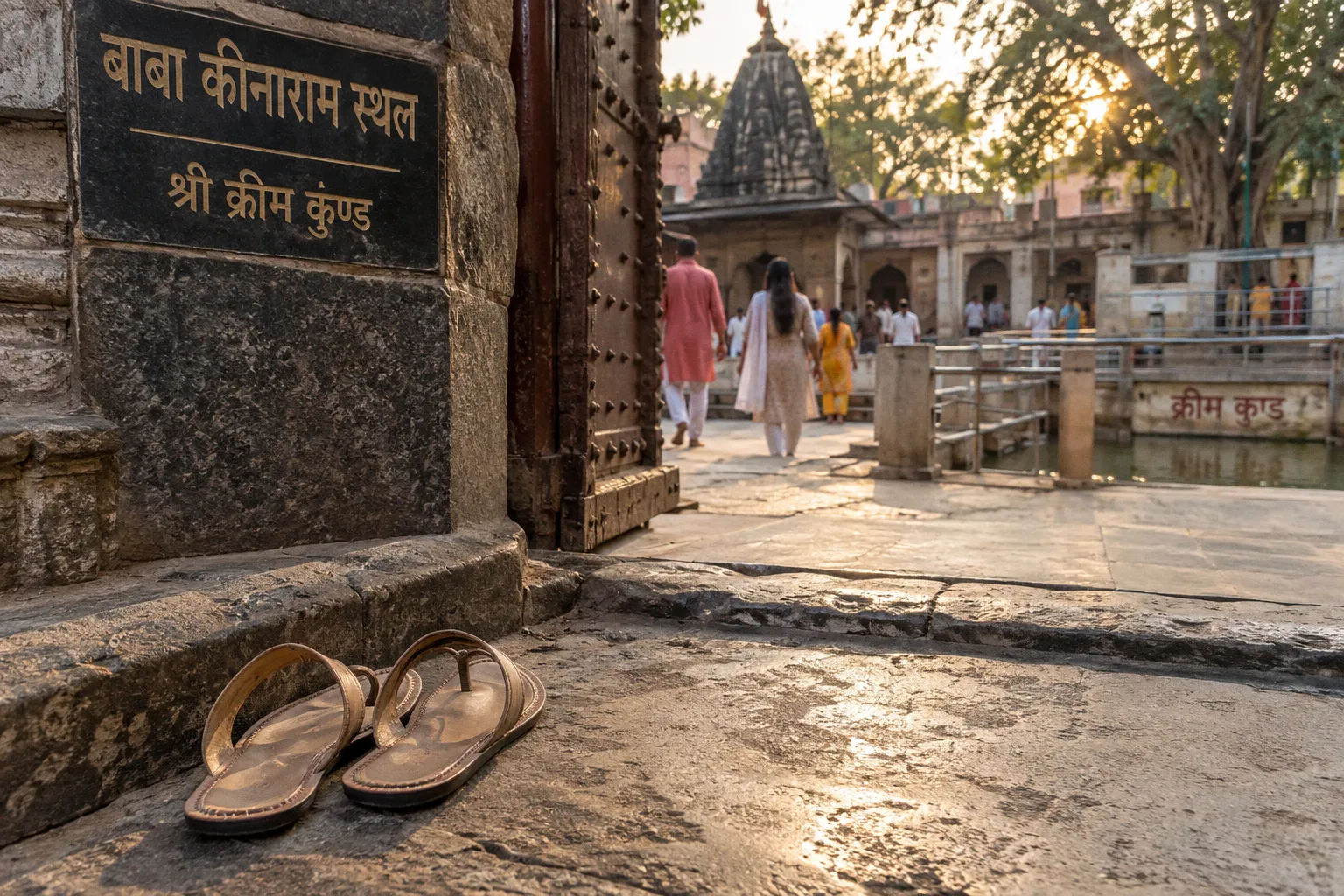
Footwear is its own small ritual at every temple in Kashi, and Baba Kinaram Sthal is no exception. Remove your shoes before entering the relevant inner precincts and leave them at the designated rack or deposit point where instructed. Slip-on sandals are practical for this and for the rest of a Banaras itinerary, because footwear comes off repeatedly throughout the day. Lace-up shoes are perfectly serviceable on the street but become inconvenient when you are moving between several sacred sites.
Whether you remain barefoot or use socks depends on the conditions and on the customs of the area you are entering. The important point is not to carry footwear into a space where it should have been removed. Keep your shoes together rather than leaving them in the middle of a passage, and avoid treating the removal as an inconvenience to be rushed through. At a busy shrine, a few seconds of attention prevents confusion for everyone behind you.
A few related decisions belong in the same category. Keep bags small and light. A large backpack is awkward in inner spaces and may need to remain at the entrance. Put your phone on silent before you enter. If you need to take a call, step outside the shrine area rather than speaking inside, even in a low voice. A phone that remains in your bag is often the simplest way to avoid both accidental photography and the temptation to check messages during darshan.
Offerings should also be modest. Flowers, fruit, milk, or incense may be appropriate depending on the practice of the day and the guidance available on site. Avoid arriving with a large, elaborate package that needs to be unpacked in the middle of a queue. If you are unsure whether an offering is suitable, ask before placing it near the kund or shrine. A visitor does not demonstrate respect by guessing confidently.
Navigating Daily Darshan Hours and Peak Observances
Knowing when to arrive changes the texture of your visit more than almost any other decision. Baba Kinaram Sthal operates on a schedule that is broader than many smaller shrines in the city but more contained than the round-the-clock flow associated with Kashi Vishwanath. The published timings provide a useful frame for planning.
On Monday, Wednesday, Thursday, Friday, and Saturday, the complex is open approximately from 5:30 AM to 7:00 PM. On Tuesday and Sunday, the hours extend approximately from 5:00 AM to 9:00 PM. These timings should shape your itinerary, but they should not be treated as a guarantee that every part of the complex will feel the same throughout the day. Ritual activity, devotional traffic, and access to particular areas can change the experience even within the general opening period.
The early-morning window, especially the first hour after opening, is usually the most suitable period for visitors who want a calmer and more contemplative experience. The city is still gathering momentum, the lanes around the ashram are less congested, and there is less pressure to move quickly through the precincts. If you are visiting as part of a larger Varanasi itinerary, early arrival also gives you room to remain for a while rather than treating darshan as a hurried stop between two fixed appointments.
By mid-morning, the space begins to fill with local devotees, pilgrims passing through Varanasi, and people who have come specifically to sit near the kund for personal practice. That can be a rewarding time to visit if you want to see the ashram in its active daily rhythm, but it requires more awareness of movement and personal space. Do not stop in a doorway to study your map, and do not allow a group to spread across a narrow passage.
Late afternoon, particularly during the hour or two before closing on standard days, can bring a different kind of devotional concentration. Visitors may be preparing for evening worship, and the atmosphere can become less suitable for casual conversation or extended sightseeing. If you arrive at that point, allow the religious activity to set the pace. You may not be able to see or approach every area in the way you expected, and that is not necessarily a problem to be solved.
Two annual observances can reshape the rhythm of the Sthal considerably. Maha Shivaratri, the great night of Shiva, brings a substantial influx of devotees and sadhakas. Queues lengthen, inner spaces become crowded, and the kund becomes a focal point for extended ritual activity through the night. Lolark Shashti, a festival associated with the sun and with particular family observances, also draws large numbers, and the surrounding lanes in Ravindrapuri can become densely packed.
Neither festival is a bad time to visit, but both require a different mindset from an ordinary day. Build in extra time, avoid rigid plans, and expect movement to be slower. Keep valuables secure, stay aware of companions, and do not push toward the front of a gathering simply to obtain a clearer view. In a dense religious crowd, patience is not passive; it is a practical form of respect.
Plan your visit around the rhythm of the Sthal, not around the rhythm of your hotel breakfast; the place is at its best when you arrive with time to spare rather than minutes to spare.
The expanded hours on Tuesdays and Sundays can be useful, but they may also coincide with heavier devotional traffic. If you find dense crowds difficult, an early visit on a quieter weekday may offer a more comfortable introduction. If your schedule permits only a busier day, go with realistic expectations: you may spend less time near the kund, and your visit may consist of a shorter darshan followed by a quiet pause at the edge of the grounds.
A final timing principle is worth keeping in mind. Do not arrive immediately before a separate appointment across the city. Varanasi traffic is unpredictable, and a sacred visit becomes needlessly tense when you are watching the clock. The best way to check visitor etiquette and dress code is not only to read the rules before leaving; it is also to give yourself enough time to notice what is happening once you arrive.
Behavioral Expectations Within the Aghor Ashram Grounds
If dress and footwear are the visible parts of etiquette, behavior is what gives a sacred space its actual atmosphere. At an Aghor ashram, the unspoken expectations are not mysterious, but they are more consequential than some visitors expect.
The first principle is silence, or at least a voice held well below conversational volume. The kund may be used for personal meditation by practitioners who sit near it for long periods. The inner shrine has its own rhythm, shaped by priests conducting puja and repeating mantras. A conversation that feels quiet outside may still be intrusive within that setting. Speak only when necessary, and allow pauses to remain pauses.
The second principle is direction. In many Hindu sacred spaces, circumambulation follows an established pattern. Around a shrine or sacred center, the conventional pradakshina is clockwise, keeping the sacred object to your right. If you are unsure what to do at Baba Kinaram Sthal, watch the movement of devotees for a moment before joining it. There is no need to force your way into a group or to imitate a ritual you do not understand. Observe first, then move carefully.
Photography is the area where visitors most often make decisions they later regret. Treat the inner shrine areas and the immediate precincts of the kund as places where photography should be avoided unless clear permission is given. Devotees and sadhakas may not wish to be photographed, and a ritual moment is not made more meaningful by placing a camera between yourself and the people conducting it.
The outer courtyards and architectural elements may offer more flexibility, but the considerate approach is still to ask when there is any doubt. Do not photograph a person who is praying, meditating, bathing, receiving instruction, or participating in a ritual without permission. Avoid using a flash. Do not place a phone or camera above the heads of other devotees to obtain a better angle. In a crowded sacred space, the camera can become a physical obstruction even before it becomes a question of privacy.
Our standing guidance is simple: keep your phone in your bag through the most sacred parts of the visit, take photographs only in areas where they are clearly acceptable, and return your attention to the place itself. You did not travel to Varanasi merely to prove that you were present.
Interaction with sadhakas and priests is another part of the visit that deserves care. If a sadhu or priest initiates conversation, a brief and courteous exchange is appropriate. Listen more than you speak. Do not assume that an ascetic is available to explain the tradition, pose for a photograph, or answer a sequence of questions about Aghor practice. A greeting does not automatically constitute an invitation to an interview.
If you see a ritual or practice you do not recognize, observe quietly and resist the urge to comment audibly. The site is meant to be inhabited, not annotated. The cremation-ground associations that sometimes surface in conversations about Aghor practice belong to a contemplative vocabulary about impermanence. They are not a reason to expect a public performance of something dramatic or unfamiliar. If you are genuinely uncertain about what you are seeing, ask a member of the on-site staff at an appropriate moment and accept a brief answer.
Do not touch people, ritual objects, offerings, or structures simply because they appear accessible. Sacred spaces often contain boundaries that are understood through practice rather than explained in large signs. If other devotees are waiting, follow their lead. If an area appears closed or reserved for worship, do not cross into it for a better view.
Offerings and donations require the same restraint. General entry should not be approached as a commercial transaction, and donations are voluntary. If you wish to contribute, use the designated donation box or office rather than handing money informally to individuals. If you want to offer milk, flowers, or a small lamp for the kund, ask about the appropriate procedure before placing anything. An offering is not improved by being elaborate, expensive, or publicly displayed.
The same applies to food and drink. Keep water in a closed bottle where permitted, but do not eat inside the shrine areas unless you have been told that it is acceptable. Dispose of packaging properly and avoid bringing plastic or unnecessary waste into the grounds. A sacred site is also a lived environment, and the people who maintain it should not have to clear away the remains of a visitor’s convenience.
Children can visit, but they need a clear explanation before entering: voices stay low, shoes come off, people are not touched without permission, and the kund is not a place for leaning over, splashing, or play. The same instruction applies to adults who have mistaken a religious site for an informal attraction. Curiosity is welcome; carelessness is not.
Step in with the calm of a guest rather than the urgency of a tourist, and the Sthal will meet you with the openness it has offered sincere visitors for generations.
The honest summary is this. Baba Kinaram Sthal is a working Aghor ashram in a residential corner of south Varanasi, and the etiquette it asks of you is neither exotic nor burdensome. The official dress-code policy is unconfirmed, but the practical standard is clear enough for planning: cover your shoulders and knees, remove your footwear before entering the relevant sacred precincts, and choose modest clothing that allows you to move without constant adjustment.
Arrive with time to spare. Keep your phone silent and your camera away unless photography is clearly permitted. Watch the movement of devotees, speak quietly, and do not treat the kund, the shrine, or the sadhakas as scenery. If you are unsure, pause and observe before acting.
That is how to check visitor etiquette and dress code in the only way that ultimately matters at a living sacred site: prepare before you arrive, then let the place teach you the finer points once you are there. What you carry away will be shaped less by what you photographed than by how quietly and attentively you were willing to be present.