Durga Kund Temple: optimal visit times and access routes
A visit to Durga Kund Temple is easiest when you separate two different questions: when the shrine is open, and when the experience of darshan—the act of viewing and presenting oneself before the deity—is most manageable.
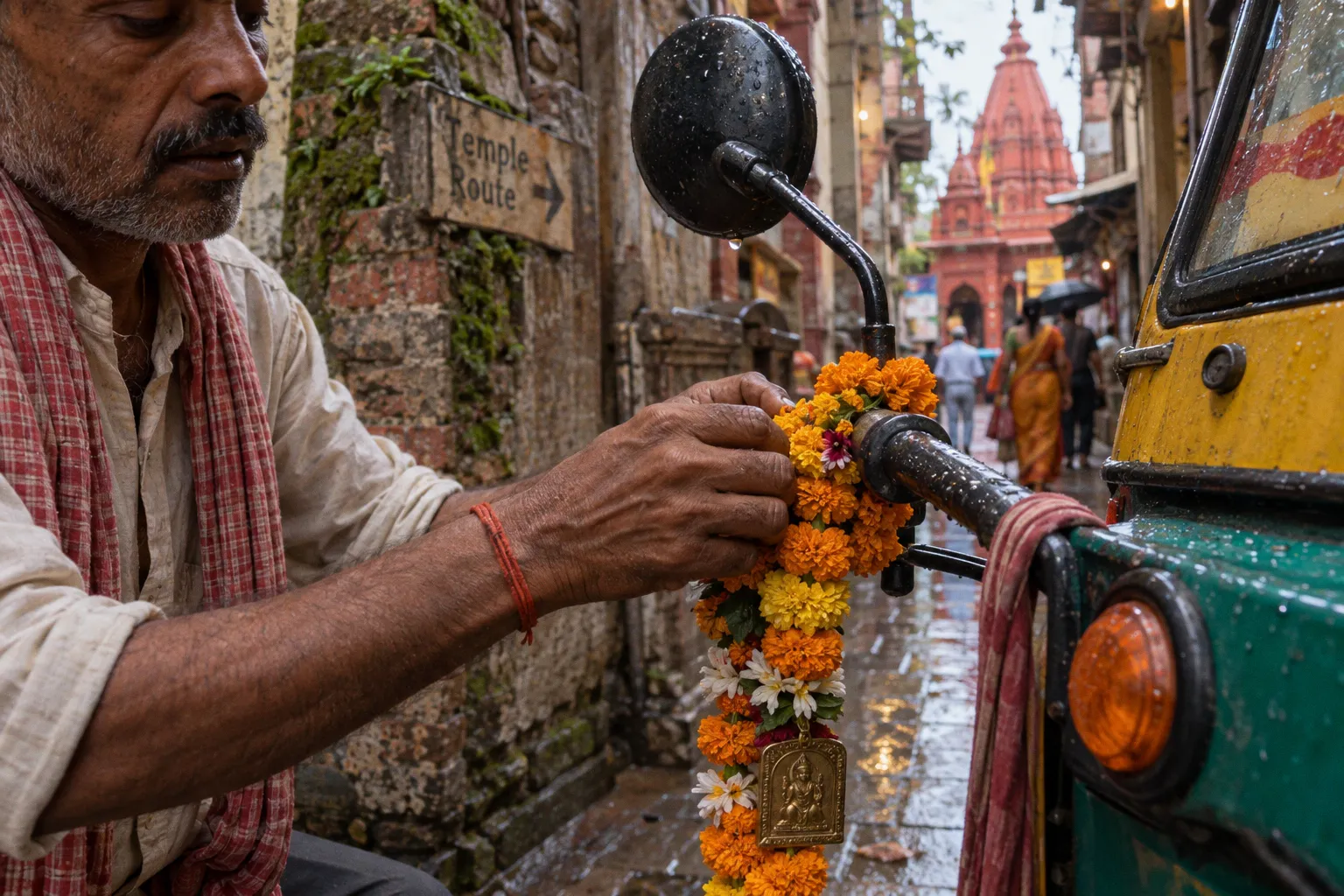
The temple generally opens between 4:00 and 5:00 AM and closes between 8:00 and 9:00 PM, but those broad hours do not tell you when the approach will be calm, when aarti will shape the visit, or when festival crowds may make an otherwise short journey considerably slower.
Durga Kund Temple, also called Durga Mandir or Lal Mandir, stands on Durgakund Road in Anandbagh, Bhelupur, inland from the Ganges and close to the Durga Kund pond. It is an 18th-century shrine built in red stone in the North Indian Nagara style by Rani Bhabani of Natore in Bengal. Its location makes it particularly practical for a southern Varanasi itinerary: Tulsi Manas Temple is approximately 500 metres away, while Banaras Hindu University lies about 2 kilometres from the temple.
The best approach is therefore not simply to arrive at the earliest possible hour, but to match your timing with your purpose—quiet darshan, participation in aarti, a combined temple route, or a visit during Navratri and Durga Puja.
The best time for Durga Kund Temple darshan
For most visitors, the most reliable window is early morning, after the temple opens and around the morning aarti, or later in the afternoon before the evening observance begins. Morning hours are generally more comfortable for those who prefer a less congested approach, while the evening has a stronger ritual rhythm but may also bring more devotees.
The usual pattern is:
| Visit purpose | Suggested time | What to expect |
|---|---|---|
| Quiet darshan | Early morning, shortly after opening | Cooler conditions and a more focused temple visit |
| Morning aarti | Around 5:30 AM | A formal devotional observance; timings may shift |
| General daytime visit | Morning to late afternoon | The broadest practical window, though conditions vary |
| Evening darshan | Before the evening aarti | More activity around the shrine and surrounding road |
| Evening aarti | Around 7:00 PM | A devotional gathering, usually busier than a quiet midday visit |
| Festival visit | Flexible, with extra time | Larger crowds, slower access, and less predictable queues |
These times should be treated as working guidance rather than a fixed public timetable. The temple’s reported daily schedule varies from approximately 4:00 or 5:00 AM until 8:00 or 9:00 PM, and aarti is commonly associated with around 5:30 AM in the morning and 7:00 PM in the evening. Local observance, festival arrangements, and temple administration can alter the practical rhythm on a particular day.
If your priority is an unhurried first darshan, arriving soon after opening is usually more suitable than arriving just before an aarti. If your priority is witnessing the observance itself, arrive with enough time to find the approach, understand where devotees are gathering, and accept that the temple may not move at the same pace as a sightseeing stop.
The best time for Durga Kund Temple darshan is not only the hour with the fewest people; it is the hour that allows you to participate without turning worship into a rushed photo stop.
Morning darshan and the significance of aarti
Aarti is a ritual offering of light, performed as part of worship. At Durga Kund Temple, the morning aarti is generally associated with approximately 5:30 AM, although visitors should confirm the current timing locally rather than building an entire day around the minute.
An early visit has several practical advantages. The air is usually more comfortable than later in the day, the road approach may feel less pressured, and you have more flexibility if the visit takes longer than expected. This matters particularly if you are travelling with older family members, children, or anyone who finds the combination of traffic, standing, and temple access tiring.
There is also a difference between entering for darshan and attending aarti. During a brief darshan, you may have only a limited moment before the flow of worshippers moves onward. During aarti, the emphasis is on observance rather than on moving efficiently through the shrine. You should therefore avoid treating the ritual as a performance arranged for visitors. Stand where devotees are standing, follow the movement of the gathering, and allow space for worshippers who have come with a longstanding personal or family practice.
Evening darshan and the 7:00 PM aarti
The evening aarti is generally associated with around 7:00 PM and may be the more convenient option for visitors following a daytime route through Bhelupur, Tulsi Manas Temple, or the area around BHU. The light is also more favourable for appreciating the temple’s red-stone exterior, whose Nagara architectural form is part of the shrine’s visual significance.
The trade-off is that evening visits can be busier. A visitor arriving shortly before aarti may encounter a concentration of devotees rather than a calm queue, and the surrounding road may be less straightforward for a vehicle to approach or leave. If you want to attend the evening observance, arrive before the expected start rather than attempting to reach the entrance at the last minute.
For a quieter evening darshan, consider coming after the main gathering has dispersed, while remaining within the temple’s operating hours. This is not a guarantee of low crowd levels, and closing arrangements may begin before the outer published time, but it can be more manageable than arriving at the peak of the observance.
How to reach Durga Kund Temple
Durga Kund Temple is located at 27, Durgakund Road, Anandbagh, in the Bhelupur area of Varanasi. The most useful landmark for planning is not the riverfront but the cluster of nearby religious and educational sites: Tulsi Manas Temple is approximately 500 metres away, and BHU is about 2 kilometres away.
The best way to reach Durga Kund Temple depends on where your journey begins and how much walking your group can comfortably manage. Taxi, auto-rickshaw, and cycle rickshaw are the principal practical options cited for reaching the shrine. Each has a different advantage: a taxi offers greater enclosure and ease for luggage, an auto-rickshaw is often more adaptable for short city movements, and a cycle rickshaw may be useful for the final local approach when road conditions and traffic make a larger vehicle inconvenient.
From Varanasi Junction railway station
Varanasi Junction, identified as BSB, is approximately 5 to 7 kilometres from Durga Kund Temple. The distance is not extreme, but the time required can vary with traffic, road conditions, and the point at which a driver can bring you close to the temple.
For a direct journey, ask for Durga Kund Road, Anandbagh, or Durga Mandir in Bhelupur, rather than describing the shrine only as a temple near the river. Durga Kund is inland, and confusing it with a riverfront destination can lead to an unnecessary detour.
A practical station-to-temple plan looks like this:
1. Choose a direct vehicle if you are carrying luggage or travelling with an older person. A taxi or auto-rickshaw reduces the need to change vehicles and makes the journey easier to manage after a train arrival.
2. Use the full landmark description. Give the driver the temple name together with Durgakund Road and Bhelupur, since several religious landmarks in Varanasi share familiar names.
3. Allow more time around aarti. The nominal distance of 5 to 7 kilometres does not predict the actual duration of a morning or evening journey.
4. Expect a final approach on foot if necessary. The vehicle may not stop exactly at the point you imagine, especially when traffic or local access arrangements are busy.
5. Keep the first visit simple. If you arrive with bags, do not assume that the temple precinct will function like a conventional tourist attraction with extensive storage or visitor facilities.
For travellers arriving before dawn, the early opening can make a direct visit possible, but the practical availability of transport at that hour may not be identical to daytime conditions. Arrange the journey with your accommodation or driver in advance rather than assuming that the first vehicle you find will know the temple’s morning rhythm.
From Lal Bahadur Shastri International Airport
The airport is approximately 25 to 30 kilometres from Durga Kund Temple. This is a city transfer rather than a short local ride, so it is sensible to treat the temple as part of your arrival itinerary only if you have enough time, light luggage, and a clear plan for the rest of the day.
A taxi is generally the most straightforward choice from the airport, particularly for first-time visitors and families. Auto-rickshaws may be useful for local travel after you have reached the city, but a longer airport transfer is easier when the vehicle, luggage space, and destination are settled in advance.
If you are going directly from the airport to the temple:
- Confirm that the destination is Durga Kund Temple in Bhelupur, not a different Durga shrine.
- Keep your arrival time separate from the expected darshan time, since the 25 to 30 kilometre distance can take longer than the map distance suggests.
- Avoid scheduling the visit immediately before a flight or train connection.
- If you are travelling during Navratri or Durga Puja, build in additional time for congestion and a slower temple approach.
- Consider whether the visit will be comfortable with luggage; a sacred site is not always the most convenient first stop after a flight.
The temple’s location is especially useful for visitors staying in or exploring southern Varanasi, but it is not directly on the Ganges riverbank. That distinction matters when planning a walking route: a visit to Durga Kund does not automatically place you beside the ghats.
Combining Durga Kund with Tulsi Manas Temple and BHU
Durga Kund Temple is well suited to a multi-site itinerary because of its proximity to Tulsi Manas Temple and BHU. Tulsi Manas Temple is approximately 500 metres away, making it the most natural companion visit. BHU is about 2 kilometres from the shrine and can be added when you want to extend the route beyond the immediate temple neighbourhood.
A sensible sequence depends on your priorities.
If darshan is the main purpose
Begin at Durga Kund Temple in the early morning, when the shrine opens and the conditions are generally more suitable for a focused visit. After darshan, continue to Tulsi Manas Temple, which is close enough to reach without arranging another long vehicle journey.
This order protects the purpose of the pilgrimage. You are not trying to squeeze the shrine between unrelated sightseeing stops, and you retain flexibility if the morning observance takes longer than expected.
If you are following an architectural and cultural route
Visit Durga Kund first, then Tulsi Manas Temple, and continue towards BHU if the group still has energy and time. The route brings together different layers of Varanasi’s sacred geography: the goddess shrine associated with Durga, the devotional and literary significance of Tulsi Manas, and the large educational landscape of BHU.
We should resist flattening these places into interchangeable attractions. Each has its own lineage, etiquette, and mode of attention. A temple visit is not improved simply by collecting more entrances in one morning. The quality of the observance depends on whether you have allowed enough time to understand where you are and how people are using the space.
If an older traveller is in the group
The 500-metre distance to Tulsi Manas Temple may be manageable for some visitors but tiring for others, particularly after an early start or in warm weather. For elderly travellers, the most comfortable plan may be to use a vehicle between sites rather than treating the proximity as a requirement to walk.
The same principle applies to BHU. At approximately 2 kilometres from Durga Kund Temple, it is nearby in itinerary terms, but not necessarily a comfortable walk for every traveller. Ask your driver to wait or arrange a clear meeting point rather than leaving the group to negotiate transport at the busiest part of the day.
Entry etiquette and access for pilgrims
The principal entry consideration at Durga Kund Temple is the distinction between the wider temple environment and the inner sanctum, or garbhagriha. A garbhagriha is the innermost shrine chamber where the principal deity is housed. At Durga Kund Temple, only Hindus are permitted to enter the main sanctum sanctorum.
This is not a detail to discover at the doorway after planning the entire visit around interior access. Non-Hindu visitors should approach the temple with clarity about what participation means in this setting: observing the exterior architecture, understanding the site’s ritual significance, and respecting the boundaries established around the inner shrine.
For Hindu pilgrims, access may still be shaped by the day’s worship, crowd movement, and local instructions. Entry is not necessarily a single uninterrupted line from road to sanctum. During aarti or festival observance, the flow may change, and visitors may be directed to stand, wait, or move in a particular way.
A respectful visit usually involves the following:
- Dress in a manner suitable for a Hindu place of worship.
- Follow signs, barriers, and instructions from temple personnel or local attendants.
- Keep phones and cameras discreet, and do not assume that every part of the temple is available for photography.
- Do not press forward during aarti or attempt to create a private viewing position.
- Keep the entrance and circulation areas clear for worshippers.
- Ask before arranging a private puja or offering through a priest, since ritual services and their costs may vary.
- Leave time for footwear and personal belongings, rather than arriving at the threshold already rushed.
There is no need to perform unfamiliar gestures theatrically. If you do not know the expected sequence, watch the worshippers around you and follow the local rhythm without interrupting it. Etiquette is often less about displaying knowledge than about making room for the people who have come to pray.
At Durga Kund, respectful access begins with knowing which spaces are open to you—and accepting that a boundary is part of the temple’s observance, not an inconvenience to negotiate away.
Managing crowds during Navratri and Durga Puja
Navratri and Durga Puja are peak pilgrimage and festival periods for Durga Kund Temple. The shrine’s connection with the goddess Durga gives these observances particular significance, and the atmosphere during a festival should not be evaluated by the same standard as an ordinary weekday darshan.
Crowd management begins with realistic planning. Exact live queue times are not fixed, and they can change substantially according to the festival day, time of arrival, local arrangements, and the number of worshippers attending. It is therefore better to think in terms of flexible arrival windows than to rely on a promised waiting time.
During a busy period:
1. Arrive earlier than your preferred ritual time. If you want to attend aarti, reach the area with enough margin to locate the approach and join the gathering without pushing through.
2. Avoid stacking several appointments immediately afterward. A temple visit during Navratri may take longer than the same visit on an ordinary day.
3. Travel light. Bags make movement through a dense crowd more difficult and can complicate security or storage arrangements.
4. Keep the group together before entering the busiest area. Establish a meeting point in case family members are separated.
5. Do not mistake a short road distance for a short access time. The final approach can be the slowest part of the journey.
6. Accept that darshan may be brief. A large gathering changes the rhythm of individual viewing, and the purpose is participation rather than extended personal access.
7. Follow festival-specific instructions. Local arrangements may take precedence over the ordinary visitor pattern.
For elderly visitors, people with mobility limitations, or anyone unable to stand for a prolonged period, a non-festival visit is usually the more practical choice. The temple’s spiritual significance does not depend on choosing the most crowded day, and a quieter observance may allow a more attentive encounter with the shrine.
A practical day plan for visiting Durga Kund Temple
For a first visit, the following patterns are usually easier to manage than an unstructured arrival.
Early-morning plan
- Travel directly to Durga Kund Temple shortly before or after opening.
- Allow time for the morning aarti if you intend to attend it, generally around 5:30 AM.
- Complete darshan without rushing into a second site.
- Continue to Tulsi Manas Temple, approximately 500 metres away, if the group is comfortable.
- Add BHU later, using a vehicle if walking would be tiring.
This plan is best for visitors who want cooler conditions, a focused start, and more flexibility later in the day.
Late-afternoon and evening plan
- Reach the Bhelupur area with time to spare before the expected evening aarti.
- Visit Durga Kund Temple first rather than arriving at the last moment.
- Attend the evening observance, generally around 7:00 PM, if that is your purpose.
- Continue to a nearby destination only if the group is comfortable with the crowd and the remaining travel time.
This plan works well when Durga Kund is part of a southern Varanasi itinerary, but it requires more patience around the aarti period.
A quieter daytime plan
- Visit between the main morning and evening observances.
- Use the time to look closely at the temple’s red-stone Nagara architecture and the relationship between the shrine, road, and Durga Kund pond.
- Continue to Tulsi Manas Temple or BHU without trying to force the visit into a ceremonial schedule.
The middle of the day may be less attractive in warmer conditions, but it can suit travellers who want to avoid the concentrated movement of aarti. The exact crowd level remains variable, so this is a preference, not a guarantee.
What to confirm before leaving for the temple
The temple’s general opening pattern is widely described as approximately 4:00 or 5:00 AM to 8:00 or 9:00 PM, with a morning aarti around 5:30 AM and an evening aarti around 7:00 PM. These are useful planning markers, not a substitute for local confirmation on the day of your visit.
Before setting out, confirm:
- Whether the temple is following its usual opening hours.
- The current aarti timing.
- Whether festival arrangements have changed the ordinary entry route.
- Where your vehicle can reasonably stop.
- Whether anyone in your group needs a shorter walking approach.
- Which parts of the temple are open to your party, particularly in relation to the garbhagriha.
- Whether you have left enough time for the next destination.
The practical question is not simply how to reach Durga Kund Temple, but how to arrive in a state that permits respectful participation. A taxi can bring you to Bhelupur; it cannot remove the need for patience, appropriate conduct, or attention to local boundaries.
Final guidance for a respectful visit
Durga Kund Temple is one of the more accessible sacred landmarks in southern Varanasi, especially when combined with Tulsi Manas Temple and, with additional planning, BHU. Its location on Durgakund Road makes it reachable by taxi, auto-rickshaw, or cycle rickshaw from Varanasi Junction, approximately 5 to 7 kilometres away, and from Lal Bahadur Shastri International Airport, approximately 25 to 30 kilometres away.
For the best balance of comfort and observance, choose early morning or late afternoon, and arrive before—not at the exact moment of—the aarti you wish to attend. During Navratri and Durga Puja, set aside additional time and expect the temple to function as an active place of pilgrimage rather than a quick sightseeing stop. If you are travelling with elderly family members, prioritise a direct vehicle, minimise unnecessary walking, and avoid the most crowded festival windows when possible.
Most of all, let the temple’s own rhythm guide the visit. Durga Kund is not merely a red-stone monument on a city route; it is a living shrine with a lineage of worship, defined entry boundaries, and daily observances that continue whether or not a visitor has managed to see every nearby landmark. When we plan around that reality, the journey becomes both easier and more respectful.