Kashi Vishwanath Temple entry: Godowlia versus Manikarnika gates
Two distinct doors open onto the same Jyotirlinga, and the choice between them shapes the entire texture of a Kashi Vishwanath darshan.
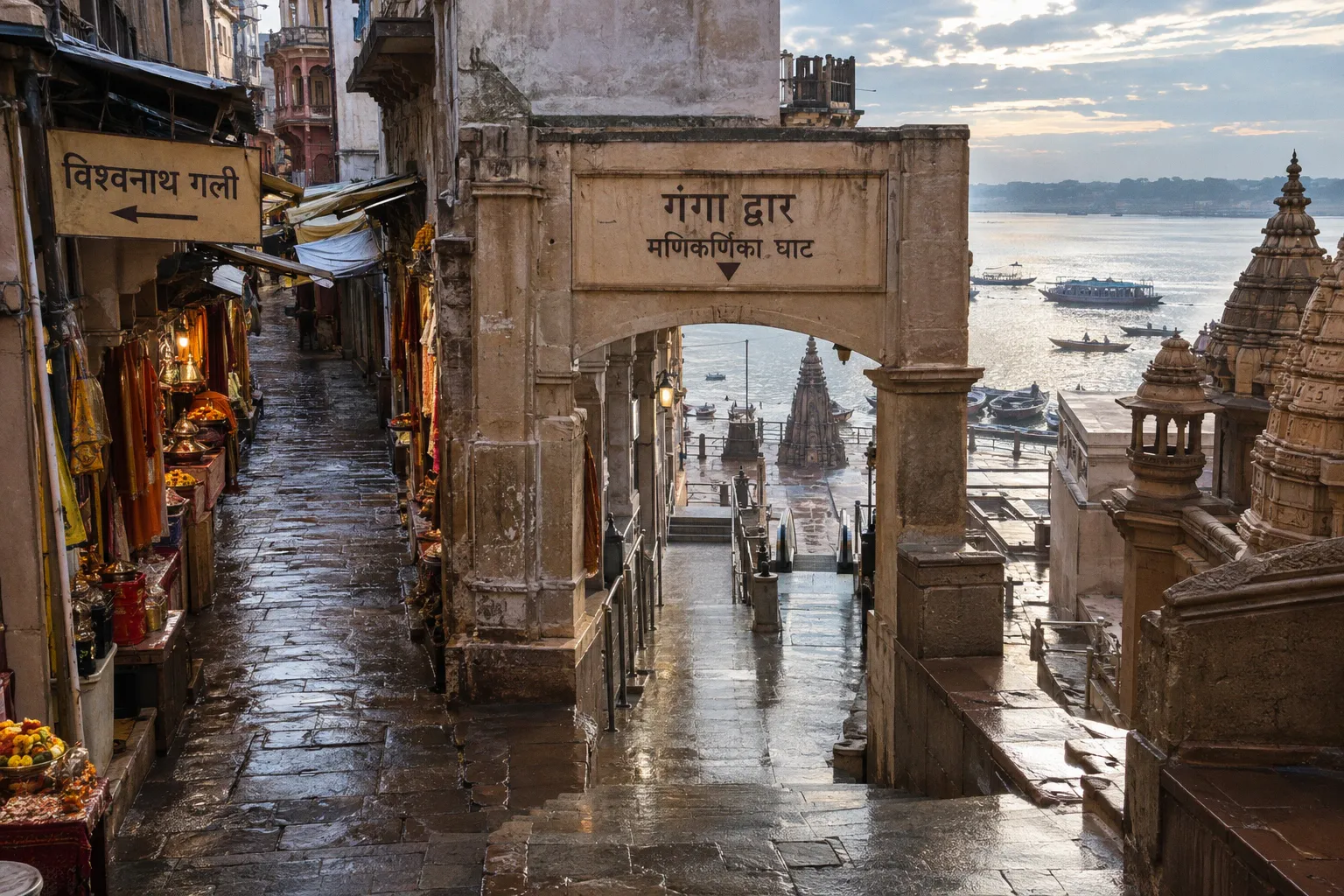
Two Doors, One Sanctum: Choosing Your Kashi Vishwanath Entry
Many pilgrims arrive in the city believing that the only authentic approach is the crowded street-side climb from Godowlia through Vishwanath Gali — the narrow lane that has historically funnelled devotees toward the temple since the eighteenth-century reconstruction by Ahilyabai Holkar. Others assume the riverfront Ganga Dwar is a modern convenience that sidesteps the living tradition of the old city. Neither framing quite captures what is actually on the ground. The Godowlia approach and the Manikarnika-side Ganga Dwar each carry their own etiquette, their own pace, and their own practical consequences, and we want to walk you through them carefully so that your route reflects your intention rather than an inherited assumption.
The Godowlia Street-Side Approach: Heritage Lanes and Honest Crowds
When you approach from the southern side of the city, almost every road eventually funnels you toward Godowlia Chowk. This is the great roundabout where the legend of Kashi compresses itself into a single intersection, and from here the rules of the road change abruptly. Private vehicles and auto-rickshaws are restricted past the chowk itself, so whether you have come by cab from the airport, by shared auto from Lanka, or by hired car from Cantonment, your wheels will give out somewhere around Godowlia. From that drop-off point, the temple is still ten to fifteen minutes away on foot, and those minutes take you through Vishwanath Gali and its neighbouring alleys — lanes that are simultaneously a market, a processional way, and a living museum of Banarasi commerce.
Three gates are typically associated with this street-side approach. Gate 4, sometimes marked as the Chhatrapati Shivaji Maharaj Gate and historically linked to the Gyanvapi route, is the principal pedestrian entry from the Godowlia and Bansphatak direction, and it is where you will find the official help desks and Sugam Darshan (literally "easy darshan," a paid expedited-entry ticket) facilitation services. Gate 1 (Dhundhiraj Gali) and Gate 2 (Saraswati Phatak) are the older, narrower bazaar alleys that have served as informal entries for generations; they remain in use, but during peak hours they compress into the kind of bottleneck that turns a fifteen-minute walk into a much longer negotiation with the crowd. The lineage of this approach is what many devotees come specifically seeking — the feeling of arriving the way their parents and grandparents arrived, by foot, through the bazaar, with the temple revealing itself gradually rather than all at once. That significance is real, and it is worth honouring. But it is also worth knowing that this same heritage lane can become impassable during Shravan Mondays, major festival days, or the late-afternoon aarti rush, when the queue for general darshan (Jhanki Darshan, the free standard entry that offers a brief viewing of the deity) can stretch back into Vishwanath Gali itself.
The Godowlia approach is not the only authentic way in, and the riverfront is not a shortcut — they are two grammars of the same devotion.
The Ganga Dwar: Riverfront Access and Corridor Infrastructure
If the Godowlia entry is the temple approached through the city, the Ganga Dwar is the temple approached through the river. The entrance sits on the Manikarnika and Lalita Ghat side of the riverfront, and it connects directly to the Kashi Vishwanath Dham — the Corridor complex inaugurated in December 2021, which spans roughly five hundred thousand square feet paved in Chunar sandstone and links the sanctum to the ghats in a continuous processional way. From a pilgrim's perspective, this changes the geometry of arrival entirely. You are no longer threading through market lanes; you are stepping off the ghats themselves, often after a holy dip in the Ganges, and walking into the temple through an open, paved precinct designed for movement at scale.
For elderly pilgrims, families with small children, or anyone whose mobility makes the Godowlia climb difficult, the Ganga Dwar carries a quiet but significant advantage: escalators now connect the ghat level to the corridor level, and the route from riverboat to darshan can be made without ever entering the congested interior bazaars. Boat operators along the ghats between Dashashwamedh and Lalita/Manikarnika will know the drop-off points; fares vary by operator and season, so it is reasonable to confirm the rate before boarding. Once on the steps, the riverfront entry leads into security, ticket verification, and the corridor proper without the narrowing, bottle-necked turns that characterise the older lanes. This is not a bypass of tradition so much as a layering of it — the Ganga has always been the temple's eastern flank, and approaching from the water is, if anything, the older gesture of arrival for those who came to Kashi by boat.
| Parameter | Godowlia Street-Side (Gate 4 / Gate 1 / Gate 2) | Ganga Dwar (Lalita / Manikarnika Ghat) |
|---|---|---|
| Approach surface | Narrow bazaar lanes, pedestrian-only past Godowlia Chowk | Open ghat steps and paved corridor plaza |
| Vehicle access | Restricted at Godowlia Chowk; 10–15 min walk from drop-off | Boats land at the steps; no city traffic involved |
| Crowd profile | Compressed, denser during peak hours and Mondays | Generally more dispersed; corridor helps spread flow |
| Mobility suitability | Difficult for those with limited walking capacity | Escalators available; gentler gradient |
| Help desks / Sugam Darshan | Concentrated near Gate 4 on the Godowlia side | Available inside the corridor after entry |
| Ritual context | Heritage bazaar approach, centuries-old procession route | Riverfront arrival, holy-dip then darshan sequence |
Queue Management and Sugam Darshan Logistics
The darshan queue is where most of the practical disappointment of a Kashi visit is born, so let us be specific. General darshan, the free Jhanki Darshan, typically involves a wait somewhere between an hour and a half and four hours depending on the day, the season, and the time you join the line. Sugam Darshan, the paid expedited queue, runs at three hundred rupees per person on regular days and five hundred rupees on Mondays and during major festivals, and it is available not only at the help desks near Gate 4 but also through the temple trust's official online portal — a detail worth knowing if you want to lock in your slot before arriving in the city. Online booking does not exempt you from security screening, but it does remove the secondary queue for purchasing tickets on the day.
The question of which gate manages queues better has no single answer, because the queue geometry is fluid and depends on operational decisions made hour by hour. What we can say with confidence is that the corridor infrastructure on the Ganga Dwar side was specifically designed to absorb and redistribute flow that the older lanes simply could not contain, and on heavy days you will often find the riverfront entrance moving with a steadier rhythm even when the Godowlia side has stalled at the chowk. Conversely, on quieter weekdays outside festival windows, the difference narrows considerably, and the heritage of arriving through Vishwanath Gali becomes an asset rather than an obstacle.
Sugam Darshan is a courtesy of time, not a guarantee of solitude — the corridor will still be full, but you will not have spent four hours of your pilgrimage standing still.
Strategic Planning: Peak Hours, Mobility, and Intention
The temple operates daily from roughly 3:00 AM to 11:00 PM, with extended windows during festivals, but the rhythm of crowds does not respect the official hours so much as cluster around them. The heaviest pressure typically falls in the morning Mangala Aarti window, the late-afternoon period leading into the evening Sandhya Aarti, and on Mondays, which carry particular significance for Shiva devotees and draw pilgrims from across the region. If your intention is to attend a specific aarti or to combine a Ganga snan (ritual bath) with darshan, the riverfront approach often serves you better because it allows you to sequence the bath and the darshan within a single continuous movement. If your intention is to walk the traditional route through the bazaars, perhaps to pause at smaller shrines along Vishwanath Gali or to take parshad (sanctified offering) from a particular priest's lineage, then the Godowlia entry remains the right grammar for that pilgrimage.
For those with elderly companions, the choice is largely made for them by the body itself. The ten-to-fifteen-minute walk from the Godowlia drop-off through crowded lanes is genuinely taxing in the Banarasi heat, and the escalator-equipped riverfront route is not a luxury in such cases but an act of care. Recent access guidelines issued between 2024 and 2026 have also introduced dedicated arrangements for local residents of the Kashi Vishwanath Dham precinct, which means visitors should expect to encounter slightly more stratified entry lanes than older accounts describe — another reason to confirm current procedures through the temple trust before you travel.
Security Protocols and What to Carry, What to Leave
Both entry points are subject to the same underlying security framework, and what you bring with you matters as much as which door you choose. Mobile phones are permitted inside the corridor but generally restricted within the inner sanctum area; lockers or deposit counters are available near both entries, and the riverfront side in particular has invested in cloakroom-style facilities within the Dham complex. Leather items, large bags, and outside food are typically declined at screening; small cloth pouches for offerings are welcomed. Dress modestly — covered shoulders and knees are the practical baseline for respectful observance in this tradition, regardless of which gate you enter through.
Security checks at the Ganga Dwar tend to be more spread out because of the corridor's open design, while the Godowlia checks compress into the lane width itself. Neither is more rigorous than the other; they are simply shaped by their architecture. Allow an extra ten to fifteen minutes for screening and ticket verification whichever route you take, and remember that the corridor has its own internal wayfinding — signage in Hindi and English now guides you from the ghat steps through the ancillary shrines to the main darshan hall, which is itself a useful orientation if it is your first visit.
Choosing with Intention
The Godowlia approach offers lineage and immersion; the Ganga Dwar offers dignity of movement and the older river-to-shrine gesture. Neither is more authentic than the other, and neither is a shortcut. What we would gently suggest is that you choose before you arrive rather than letting the city choose for you at the chowk. If you are coming with elders, with children, with limited walking capacity, or with a desire to combine the river bath with darshan in a single unhurried sequence, plan to enter through Ganga Dwar at Lalita or Manikarnika Ghat. If you are coming to walk the traditional lane, to linger at the smaller shrines, and to experience the bazaar's living devotion as part of your pilgrimage, plan to enter through Gate 4 on the Godowlia side and arrive early enough to give yourself the full ten-to-fifteen-minute walk without rushing.
The temple does not change with the door you choose; your experience of arriving at it does. In Kashi, the manner of approach is itself a form of observance, and choosing it deliberately — rather than by default — is one of the quiet courtesies the city extends to those who take the trouble to learn its grammar before they step into its lanes.