Sankat Mochan Temple access: main gate versus side entrance
The most important fact about Sankat Mochan Hanuman Temple access routes is also the one most likely to be misunderstood: for ordinary visitors, the temple is organized around one primary public entry point, not a choice of several interchangeable gates.
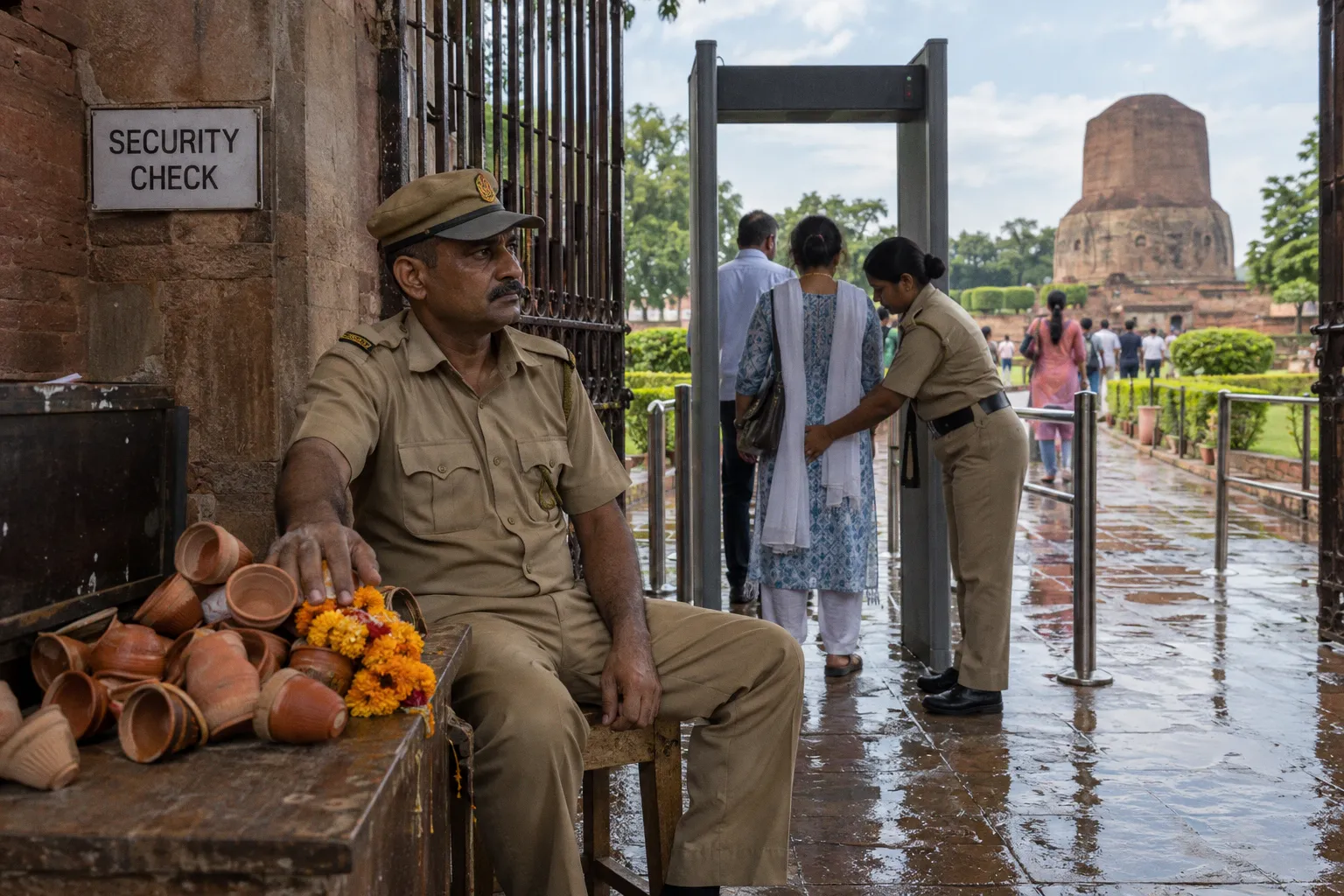
You may hear references to a side entrance, a quieter approach, or an alternative way around the building, but the available visitor guidance does not establish a separate public side gate that bypasses the main security process.
That distinction matters because Sankat Mochan is not a monument where you can simply walk around the perimeter until you find a less crowded doorway. The public approach is controlled, visitors pass through metal detectors, and security guards carry out mandatory frisking before entry. The practical question is therefore not how to defeat the queue by finding an unofficial entrance, but how to reach the designated checkpoint with the right belongings, at a suitable hour, and with enough patience for the day’s ritual rhythm.
Main gate versus side entrance: what visitors can actually expect
For general pilgrims, the main access point is the reliable route. It leads to the security checkpoint through which visitors are screened before entering the temple grounds. The checkpoint is equipped with metal detectors, and guard inspection is part of the ordinary observance of visiting Sankat Mochan, not an exceptional procedure reserved for unusually busy days.
A side entrance, in the sense of a second public gate that allows visitors to avoid screening or join the temple from another direction, should not be treated as an established option. The available information describes a single primary public access route controlled by security. It does not confirm a separate visitor entrance with different rules, nor does it support the assumption that a side route will be open when the main approach is crowded.
| Question | Main public entry point | Supposed side entrance |
|---|---|---|
| Is it an established route for general visitors? | Yes, this is the designated public access route | Not confirmed as a separate public access point |
| Security screening | Metal detector and mandatory frisking | Do not assume screening can be avoided |
| Electronic devices | Mobile phones and cameras are prohibited | No basis for assuming different rules |
| Bags and luggage | Handbags, luggage, wallets, and plastic bags are prohibited | No confirmed exception |
| Best use | Plan your arrival around the checkpoint and queue | Treat informal directions cautiously |
| Crowd strategy | Choose timing and arrive prepared | Do not rely on a gate that may not exist for pilgrims |
The significance of this arrangement is both practical and institutional. Sankat Mochan is an active place of worship, and its access system reflects the temple’s responsibility to protect worshippers while maintaining an orderly environment for darshan, the act of seeing and being seen by the deity. Security is therefore part of the visitor’s path, not an inconvenience added outside the religious experience.
At Sankat Mochan, the efficient route is not the hidden route; it is the designated route approached with the right timing and nothing that security will ask you to surrender.
Why the temple has a controlled access system
The permanent police chowki, or police post, on the temple grounds was established after the bomb blast of March 7, 2006. That date remains part of the modern security lineage of the site, because it explains why access is managed with a degree of vigilance that may feel stricter than at some other temples in Varanasi.
You should expect the checkpoint to be active even if the temple appears quiet from the outside. Security personnel may inspect visitors before entry, and vehicle searches can also be conducted at the discretion of security staff. The presence of a police post is not a sign that an ordinary visit is impossible or unusually formal; it is a permanent part of the temple’s contemporary infrastructure.
This is where respectful etiquette becomes practical. If you arrive carrying a phone, camera, large bag, or outside food, you are not merely risking a delay. You may need to step away from the queue, find a place to leave your belongings, or abandon the visit if secure storage is not available. The most considerate approach is to decide what you will carry before leaving your hotel, guesthouse, university campus, or transport.
The rules reported for the main checkpoint prohibit:
- mobile phones and cameras;
- handbags, luggage, wallets, and plastic bags;
- outside food and beverages;
- liquor and smoking items;
- leather articles.
The prohibition on electronic devices deserves particular attention. Visitors should not assume that a smaller phone, concealed camera, or alternate doorway will be accepted. There is no reliable basis for treating a side route as an exception to the electronic-device restrictions, and the visitor guidance specifically cautions against assuming that phones or cameras can be carried through another entrance.
What to do before reaching Sankat Mochan
The cleanest visit begins before you arrive at the temple road. Since there is no confirmed general-purpose side entrance for bypassing the main checkpoint, preparation has a direct effect on how smoothly you move through the pilgrim path to Sankat Mochan.
A useful approach is to reduce your visit to what you actually need for worship and navigation. Carry identification only if your wider travel plans require it, and do not bring a wallet, plastic bag, camera, or phone into the temple approach. If you are travelling with companions, agree in advance on where you will regroup after the visit, because entering without mobile phones makes casual coordination more difficult.
You should also separate the temple visit from shopping, meals, and sightseeing when planning your day. Outside food and beverages are prohibited at the entrance, so the person carrying water, snacks, or purchases from an earlier stop may need to reorganize before joining the queue. This is especially relevant for visitors coming from the Banaras Hindu University area or from a longer city itinerary, when the temple is one stop among several rather than the only destination.
For many travellers, the most efficient sequence is:
1. Leave prohibited belongings at your accommodation or with a secure, prearranged storage option rather than carrying them to the gate.
2. Arrive at the designated public checkpoint, allowing time for metal detection and frisking.
3. Follow the instructions of security personnel instead of searching for an unofficial side path.
4. Keep the visit focused on the temple’s observance, particularly during busy periods when the queue moves according to security and worship conditions.
5. Rejoin your group at a previously agreed location outside, since phones cannot be relied upon during the visit.
This is not a checklist to rush through the temple. It is a way of removing avoidable friction so that the significance of the visit is not overshadowed by a preventable argument over a bag or device.
Peak hours: Tuesday and Saturday are a different proposition
The best time to visit Sankat Mochan depends on what you mean by best. If your priority is the longest possible visiting window, Tuesday and Saturday have an advantage: the temple extends its hours up to midnight on those days. If your priority is a calmer approach through security and a less compressed experience of the grounds, the same days may require more careful timing because they are important devotional days and can draw heavier attendance.
The available access information identifies Tuesday and Saturday as peak days, with hours extending later than on standard days. This creates a familiar pilgrimage compromise: the days with the strongest devotional significance may also bring the most pressure to the access system.
On regular days, the temple generally opens around 4:30 or 5:00 in the morning, closes for an afternoon interval beginning around noon, and reopens later in the day. The afternoon closure is reported as lasting until approximately 3:00 or 4:00 PM, while standard closing is described as around 10:00 or 10:30 PM. On Tuesdays and Saturdays, closing may extend to midnight.
Because these times are presented in ranges rather than as one unchanging timetable, you should treat the day’s operating rhythm as more important than a minute-by-minute promise. A planned arrival just before the afternoon closure can create an unnecessarily difficult experience: you may reach the security checkpoint only to discover that entry is no longer proceeding as expected. For that reason, build a margin into your schedule rather than aiming for the final minutes before the temple pauses or closes.
A practical timing comparison
| Visit objective | More suitable approach | What to keep in mind |
|---|---|---|
| Experience the widest opening window | Tuesday or Saturday | These days may remain open until midnight, but attendance can be stronger |
| Avoid arriving during the afternoon pause | Visit in the morning or after reopening | The closure window is generally around noon to 3:00 or 4:00 PM |
| Reduce the risk of a late-night arrival becoming impractical | Choose a regular day and arrive well before closing | Standard closing is generally around 10:00–10:30 PM |
| Keep the visit simple and unhurried | Arrive with no prohibited belongings and time for screening | A side entrance should not be assumed |
| Combine the temple with another city visit | Plan the temple as a distinct stop | Food, shopping bags, phones, and cameras may interfere with entry |
There is no universally perfect hour. Early morning can align well with the temple’s opening rhythm, while a later visit may suit travellers whose city plans begin elsewhere. What matters most is that your chosen time respects both the daily observance and the security process, rather than treating the temple as a stop that can be fitted into an arbitrary gap.
Crowd management is about behaviour as much as numbers
When visitors search for Sankat Mochan temple entry points, they are often trying to solve a crowd problem: where to stand, which lane to join, and whether another gate will provide relief. At Sankat Mochan, crowd management begins with the fact that the public flow is concentrated through a controlled entry point. This can make the approach feel slower during peak periods, but it also gives the temple a clear method for screening visitors.
You can help the process by avoiding several common mistakes:
- Do not join a group at the gate before confirming that you have removed all prohibited items.
- Do not interpret a security queue as evidence that a hidden public entrance must be available.
- Do not bring a camera or phone on the assumption that you can leave it with a guard.
- Do not block the approach while reorganizing bags, food, or transport documents.
- Do not press for a different route when security personnel are directing visitors through the established checkpoint.
These are matters of etiquette because the queue is shared by worshippers, local families, students, visitors from other parts of India, and international travellers who may not yet understand the temple’s access conventions. A visitor who arrives prepared does more than save personal time; they reduce interruptions for everyone moving toward the shrine.
The temple’s access rules also have a different meaning from the entrance procedures at a museum or ticketed monument. There is no confirmed fee-based fast-track arrangement for ordinary entry in the information available here. The visit is not structured around purchasing a shortcut through a separate public door. Queue movement and security control remain the ordinary framework.
Reaching Sankat Mochan from BHU and the wider city
For visitors searching for the best route to Sankat Mochan from BHU, the question of access begins only after you have reached the temple area. The temple is approximately 6–8 kilometres from Varanasi Junction Railway Station and around 26 kilometres from Lal Bahadur Shastri International Airport, so many travellers will approach it as part of a broader city transfer rather than a short walk from the central ghats.
From the Banaras Hindu University side, it is sensible to plan the final approach with enough time to account for traffic, the vehicle drop-off, and the walk toward the security checkpoint. The precise route can vary with the day’s traffic and local road conditions, but the destination logic remains stable: reach the designated public approach, not an imagined alternate gate.
If you are travelling by car or hired vehicle, paid parking is available on a first-come, first-served basis. Availability is therefore not guaranteed simply because parking exists, and vehicle searches may be carried out at security’s discretion. During crowded Tuesday and Saturday periods, this can make a drop-off strategy more practical than assuming you will find a space immediately beside the temple.
A sensible arrival plan from the city has three separate stages:
1. The city transfer: allow time for the distance from your starting point, especially when coming from the railway station or airport.
2. The final approach: account for the distance between vehicle drop-off or parking and the temple’s security-controlled entry.
3. The temple procedure: reserve time for metal detection, frisking, and any adjustment required because of prohibited belongings.
This separation helps prevent a common planning error: calculating only the driving time and forgetting that a temple visit has its own threshold, where transport ends and observance begins.
The temple’s foundation and the meaning of a present-day visit
Sankat Mochan is commonly associated with Goswami Tulsidas, whose foundation of the temple is placed in the 16th century. That lineage gives the site a particular place within Varanasi’s devotional geography, but it should not be reduced to a historical label placed beside a modern security system. The temple continues to function as a living place of worship, and its present-day rules are part of how that worship is protected.
For a visitor, this means that the checkpoint is not an accidental barrier between the city and an old building. It is part of the contemporary relationship between public access, collective safety, and religious observance. The restrictions on devices, bags, outside food, and leather items shape the experience before darshan begins, and accepting them without argument is one of the simplest forms of participation available to an outsider.
We also need to distinguish between access and entitlement. A visitor may arrive with genuine devotion, academic interest, or a desire to understand Varanasi’s sacred landscape, but those intentions do not create a separate entry protocol. The same public security expectations apply. That equality can be reassuring: you do not need specialist status or a secret route to approach the temple respectfully.
The most respectful pilgrim path is the one that accepts the temple’s conditions before reaching its gate.
So, is there a better entrance?
For general visitors, the answer is straightforward: use the main designated entry point and do not plan your visit around a side entrance. No confirmed public side route has been established as a way to avoid the metal detector, frisking, or restrictions on belongings. If someone suggests that phones, cameras, or bags can be taken through a different gate, treat that advice cautiously unless temple security itself directs you otherwise.
The better strategy is to choose your day and hour with care. Tuesday and Saturday offer extended visiting hours, potentially until midnight, but may also bring more pressure to the access system. Regular days generally provide a shorter operating window, with an afternoon closure and closing around 10:00–10:30 PM. Early arrival or a well-planned post-reopening visit can be more useful than searching for an unofficial entrance.
Before you leave, remove mobile phones, cameras, handbags, luggage, wallets, plastic bags, outside food, beverages, liquor, smoking items, and leather articles from your plan. Arrange transport with the possibility of first-come parking and vehicle inspection in mind, particularly if you are coming from BHU, the railway station, or another part of the city.
Sankat Mochan Temple access is therefore less a comparison between two gates than a comparison between two approaches: one based on rumours of a shortcut, and one based on the temple’s actual system. The second approach is the one that works. Arrive through the established checkpoint, accept the security observance, allow time for the day’s rhythm, and you will enter with fewer surprises and a clearer understanding of the place you have come to visit.