Dhamek Stupa walking route: a self-guided heritage trail
Ten kilometers northeast of Varanasi's built-up riverfront, a 1.5 square kilometer tract of land compresses roughly 2,250 years of South Asian history into a walking distance of under two kilometers.
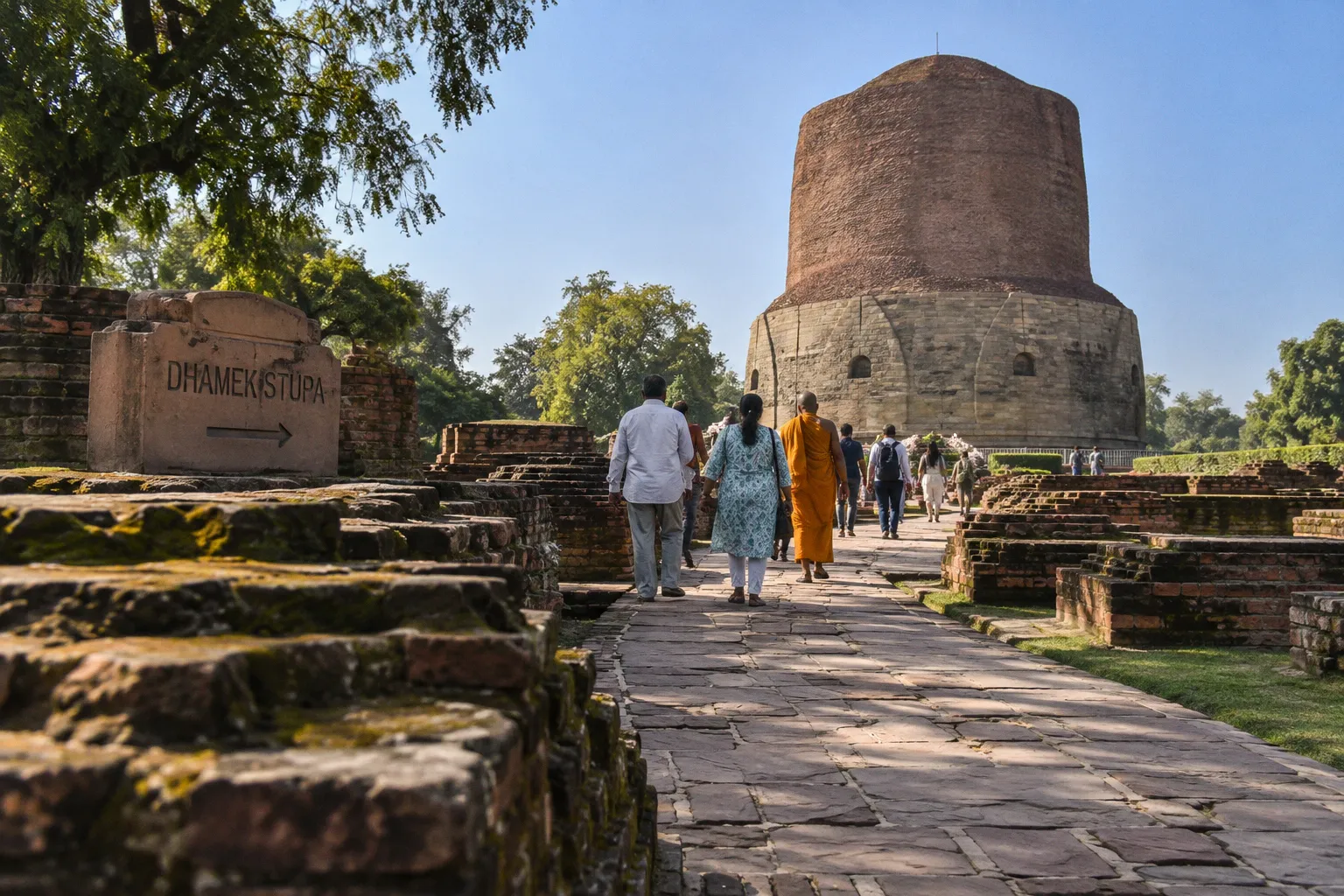
Sarnath — the deer park (mrigadava) where Gautama Buddha is recorded to have delivered his first sermon — accommodates five major heritage nodes inside this tight perimeter: Chaukhandi Stupa, the Dhamek Stupa archaeological complex, the Sarnath Archaeological Museum, the open excavations of monastery ruins, and Mulagandha Kuti Vihar. A heritage walker following the established circuit covers the entire sequence in three to four hours, depending on museum dwell time and photo stops. The spatial logic of the site, more than any single monument, is what defines the visit.
Sarnath delivers 2,250 years of architectural history within a 1.5 kilometer radius — the most compressed heritage footprint in the Varanasi district.
Starting at Chaukhandi: the Mughal-Gupta gateway
The logical entry point for a self-guided heritage walk is the Chaukhandi Stupa, located at the southwestern edge of the protected archaeological zone near the main site entrance off the Varanasi–Gorakhpur highway. The structure presents a clear two-phase chronology that orients the visitor before they move deeper into the complex.
The lower mound is an ancient red-brick stupa dating to the Gupta period, between the 4th and 6th centuries CE. Its mass represents a transitional architectural form in the long evolution from the hemispherical Maurya-era stupas (such as the original 3rd-century BCE foundation beneath Dhamek Stupa, commissioned by Ashoka around 249 BCE) to the taller, cylindrical Gupta-era forms that dominate the Varanasi region today. The upper component is an octagonal brick tower added in 1588 CE, constructed by one Govardhan to commemorate a visit by the Mughal emperor Humayun. This Mughal-era crown — functionally a commemorative gateway rather than a religious superstructure — gives Chaukhandi its hybridized silhouette and signals to the walker that Sarnath's heritage spans Mauryan foundations, Gupta superstructure, and Mughal commemoration in a single object.
Chaukhandi's 1588 CE Mughal crown converts a 4th-century Gupta brick mound into a single object spanning twelve centuries.
Practical note for the walker: ascending the Chaukhandi mound and its tower is prohibited under current Archaeological Survey of India regulations, both for visitor safety and for the preservation of the brick fabric. The structure is observed at ground level only.
From Chaukhandi, the path turns east-northeast into the main archaeological complex. The distance from the Chaukhandi entrance to the Dhamek Stupa enclosure is approximately 400 meters along paved pathways, passing through a landscaped parkland section maintained by the Archaeological Survey of India.
Navigating the archaeological complex and Dhamek Stupa
The Dhamek Stupa dominates the central node of the Sarnath circuit. The standing monument — a massive cylindrical brick-and-stone structure — measures 43.6 meters (128 feet) in height and 28 meters in diameter. It is not the original structure built at the site: the earliest foundation here was commissioned under Ashoka around 249 BCE, and it was substantially rebuilt and enlarged during the Gupta period around 500 CE to its current dimensions.
The defining visual feature of the stupa is the band of intricate carved stonework running along the lower portion of the cylindrical drum. These are Gupta-period carvings — geometric medallions, floral motifs, and figural panels depicting scenes from the Buddha's life, including a famous relief of a horseman and a panel interpreted as representing the First Sermon itself. The carvings are executed in the characteristic sandstone of the region and represent some of the finest surviving examples of 5th-century CE Buddhist relief work in northern India.
The visitor pathway circumnavigates the stupa at ground level. Buddhist custom dictates clockwise circumambulation (pradakshina); visitors observe this convention as a matter of local etiquette, though the site itself is administered as a heritage monument rather than an active place of worship in the Hindu temple sense. The base diameter of 28 meters means a single full circuit measures approximately 88 meters — a short loop easily integrated into the broader walk.
Adjacent to the Dhamek Stupa enclosure, the open archaeological excavations expose the remains of monastic structures (vihara walls) and a smaller secondary stupa. These excavated foundations date primarily to the Gupta and post-Gupta periods and provide the spatial context for how the monastic community was arranged around the central reliquary monument in antiquity. The excavation trenches are fenced and visible from the perimeter walkway; visitors do not enter the trenches themselves.
The Ashoka Pillar and the museum's national treasures
Northwest of the Dhamek Stupa, a short covered walkway connects the archaeological complex to the Sarnath Archaeological Museum, administered by the Archaeological Survey of India. The museum is the destination for visitors seeking the site's most singular artifact: the Lion Capital of Ashoka, originally erected as a pillar capital at Sarnath around 250 BCE and now serving as the official national emblem of India.
The original capital — a polished sandstone column crowning piece depicting four Asiatic lions seated back-to-back on a circular abacus, with the Ashokan edicts inscribed below — is housed in the museum's main gallery. The artifact on display is the surviving original; a replica stands on the capital base at the original pillar site near the museum entrance. A standard heritage walk treats the museum visit as a discrete 45- to 60-minute block, followed by a return to the outdoor circuit.
Museum operating parameters
| Parameter | Detail |
|---|---|
| Days closed | Fridays, plus designated government holidays |
| Typical visit duration | 45–60 minutes |
| Located | Within the protected archaeological zone, walking distance from Dhamek Stupa |
| Signature artifact | Lion Capital of Ashoka (250 BCE), national emblem of India |
Beyond the Lion Capital, the museum's collection includes Mauryan and Gupta-period sculptures, excavated architectural fragments from the monastic complex, and a sequence of standing Buddha images in various regional stylistic traditions. The collection is dense, well-labeled, and small enough to be absorbed in a single morning visit.
Mulagandha Kuti Vihar and the Deer Park
Exiting the museum zone to the east, the walking circuit continues toward Mulagandha Kuti Vihar, located roughly 800 meters from the Dhamek Stupa complex. This section of the walk passes through the landscaped grounds that constitute the modern Deer Park (mrigadava) — a designated green space referencing the original parkland setting of the Buddha's first sermon.
Mulagandha Kuti Vihar itself is a 20th-century construction, not an archaeological monument. The temple was built in 1931 by the Maha Bodhi Society of Sri Lanka and follows a hybrid architectural vocabulary drawn from late-Gupta Buddhist precedents. The interior houses a sequence of murals painted by the Japanese artist Kosetsu Nosu depicting scenes from the Buddha's life; these murals are the building's primary artistic feature. An adjacent modern Buddha statue and a relic chamber containing purported bone fragments of the Buddha (a long-standing tradition at major Buddhist pilgrimage sites) complete the interior program.
The building is an active place of worship, and visitors are expected to remove footwear before entering the main shrine hall. Photography of the Nosu murals is generally prohibited.
The Thai Temple complex and its standing Giant Buddha statue — an 86-foot (approximately 26-meter) bronze-and-concrete figure — stands a short distance east of Mulagandha Kuti Vihar and is a frequent addition to the walking circuit for visitors with an additional hour to spare. The statue was a gift from the Thai Buddhist community and was consecrated in the latter half of the 20th century. The height figure of 86 feet is the standard cited dimension for the standing figure; precise construction dates vary across sources and should be confirmed on the ground plaque.
Practical logistics for a three-hour heritage walk
The Sarnath walking circuit operates within a constrained spatial envelope and a tight daily schedule. A self-guided walk optimized for first-time visitors follows the sequence below.
Suggested walking sequence (total circuit: approximately 1.5–2 km, 3–4 hours)
1. Chaukhandi Stupa — entry node, Mughal-Gupta chronology orientation. 20 minutes.
2. Path to Dhamek Stupa — 400 meters east-northeast through parkland. 10 minutes walking.
3. Dhamek Stupa enclosure — circumambulation and Gupta stone carving observation. 30–40 minutes.
4. Open monastery excavations — adjacent to Dhamek Stupa. 15 minutes.
5. Sarnath Archaeological Museum — Lion Capital and full collection. 45–60 minutes. Verify open-day status before departure from Varanasi.
6. Path to Mulagandha Kuti Vihar — 800 meters east through the Deer Park grounds. 15 minutes walking.
7. Mulagandha Kuti Vihar — interior visit, mural observation. 20–30 minutes.
8. Optional extension: Thai Temple and Giant Buddha statue — 86-foot standing figure. 30 minutes round trip.
Access and movement
| Parameter | Detail |
|---|---|
| Distance from Varanasi | 10 km (northeast, along the Varanasi–Gorakhpur road corridor) |
| Recommended transport | Auto-rickshaw or taxi from Varanasi (40–60 minutes depending on river crossing and traffic) |
| Walking surface | Paved pathways, partial compacted earth; flat terrain throughout |
| On-site signage | Multilingual (English, Hindi); major monuments are individually labeled with ASI interpretive plaques |
| Best walking window | Early morning (site opens at approximately sunrise) to midday, before peak heat |
Preservation and infrastructure constraints
The site's tight footprint creates specific operational constraints. The Archaeological Survey of India maintains fencing around the most sensitive excavation zones, prohibiting direct access to the monastery trench interiors. Visitor flow along the main pathway is unidirectional in places during peak pilgrimage periods, particularly around full-moon Buddhist holy days when arrival volumes spike significantly relative to baseline traffic. The museum's Friday closure, combined with periodic government-declared holidays, means the indoor collection is occasionally unavailable on what would otherwise be a workable visiting day — visitors should confirm open-day status before committing to the round trip from Varanasi.
Assessment: a compressed heritage footprint under active management
The Sarnath walking circuit succeeds as a heritage experience because of its spatial compression, not despite it. Five major heritage nodes — three of them anchored to structures or collections of national significance — sit within a perimeter that an average walker crosses in under two kilometers. The chronological span from the 3rd-century BCE Mauryan foundation commissioned by Ashoka around 249 BCE, through the 500 CE Gupta rebuilding of Dhamek Stupa, the 1588 CE Mughal commemorative tower at Chaukhandi, and the 1931 CE construction of Mulagandha Kuti Vihar, is unusually dense for a single walking route anywhere in the South Asian heritage network.
The principal management challenge going forward is balance: the site serves simultaneously as a protected archaeological zone under the Archaeological Survey of India, an active Buddhist pilgrimage destination with attendant devotional traffic, and a heritage tourism node for international day visitors from Varanasi. Current infrastructure — paved pathways, multilingual signage, controlled-access museum galleries, perimeter fencing on the excavation zones — accommodates all three uses at current volumes. The conservation question, rather than access, is the long-term one: how the Gupta-period carved stonework at Dhamek Stupa and the exposed monastery foundations withstand continued exposure, visitor contact, and the regional climate.
For the self-guided walker arriving from Varanasi, the route is straightforward, the monuments are well-marked, and the entire heritage footprint is legible in a single morning.