Ramnagar Fort museum access: choosing your best tour route
Ramnagar Fort stands on the eastern bank of the Ganges, opposite Varanasi, approximately 15 kilometres from Varanasi Junction and about 30 kilometres from Lal Bahadur Shastri International Airport. The distance is not the principal difficulty.
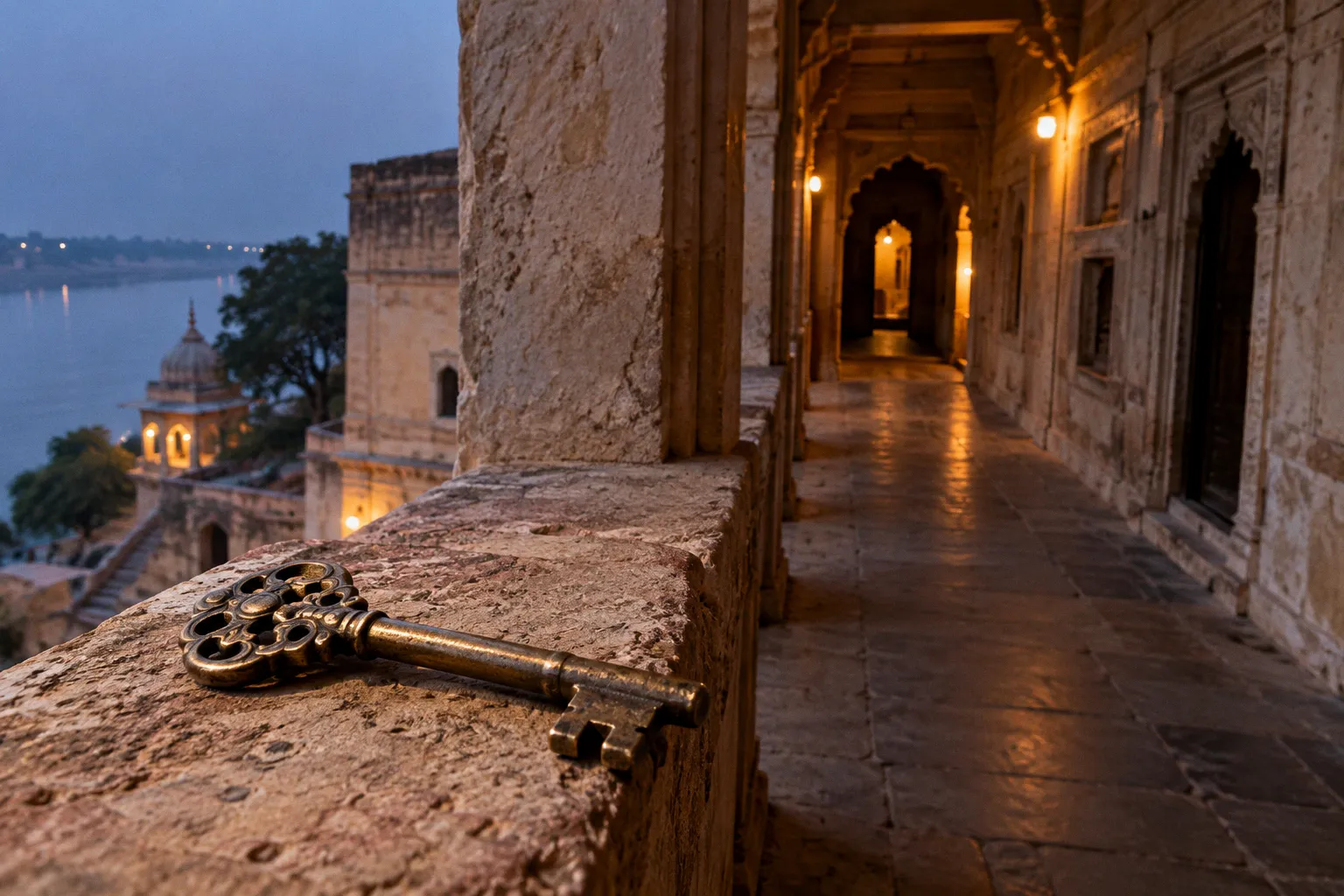
The problem is spatial orientation: the fort, the museum, the riverfront passage, and the restricted residential areas do not function as one fully accessible tourist circuit.
The practical visit is therefore a route-selection exercise. Most visitors enter through the museum, move through the collection galleries, continue toward the river, and finish at the Veda Vyasa Temple. The fort was built in 1750 from creamy Chunar sandstone by Kashi Naresh Raja Balwant Singh. Its present visitor experience combines an 18th-century royal complex with a museum established in 1964 and a riverfront section that remains separate from the private quarters of the Banaras royal family.
Navigating the 1750 Chunar sandstone citadel
Ramnagar Fort occupies the eastern bank of the Ganges, across the river from the main Varanasi urban core. This position determines both the approach and the character of the visit. The fort is not embedded in the dense central alley system of Kashi. It is a destination across the river, reached through the broader road network of Ramnagar rather than through the pedestrian routes around the principal ghats.
The construction date is significant. Raja Balwant Singh commissioned the fort in 1750, during a period when regional political authority was being consolidated through fortified residences, river access, and court institutions. The use of Chunar sandstone connects the complex with a wider architectural geography of the Ganges plain. Chunar, located downstream in the Mirzapur district, was a major source of durable sandstone used in forts, temples, public buildings, and colonial structures across the region.
The building should not be read as a single monumental block with unrestricted access. The tourist route is narrower than the full historical footprint of the royal residence. Some parts of the complex remain associated with the living royal household and are not open to visitors. This distinction matters when planning a private tour or promising a comprehensive fort exploration.
The visitor route is best understood in three spatial stages:
1. Arrival at the fort complex. The approach ends at the public visitor area rather than at every internal section of the residence.
2. Museum galleries. The principal public collection is housed in the Maharaja Banaras Vidya Mandir Trust Museum, also known as Saraswati Bhawan.
3. Riverward passage. After the museum, a designated route leads toward the edge of the Ganges and the Veda Vyasa Temple.
This sequence is more reliable than attempting to improvise a circuit around the outer walls. The fort is not laid out as an open archaeological site with a continuous perimeter walk. The museum and riverfront passage provide the clearest structure for an independent visit.
Ramnagar Fort is not one unrestricted monument. It is a public museum route within a larger royal complex.
The strongest historical reading begins before entering the galleries. From the exterior, the Chunar sandstone construction establishes the fort’s material identity. Inside, the collection shifts the emphasis from defensive architecture to courtly administration, transport, clothing, weaponry, and scientific instruments. The chronology is therefore layered: the building dates from 1750, the museum institution from 1964, and several objects belong to later phases of royal and colonial-era material culture.
Inside the Maharaja Banaras Vidya Mandir Trust Museum
The Maharaja Banaras Vidya Mandir Trust Museum was established in 1964 by Maharaja Kashi Naresh Vibhuti Narain Singh. It is commonly identified as Saraswati Bhawan. The museum is the principal organized visitor attraction inside the fort and should be treated as the core of the tour rather than as an incidental room sequence.
Its collections document the operational life of the court. They include vintage American cars, gold and silver brocaded palanquins, Kimkhwa silk garments, ivory work, rare armaments, and objects associated with royal ceremony and transport. The collection is valuable because it preserves systems of use rather than presenting only isolated decorative objects. A palanquin records movement and court protocol. A motorcar records technological adoption. Kimkhwa textiles record elite production and ceremonial display. Weapons indicate military connections and the changing material culture of the court.
The armoury is particularly broad in geographic reference. It includes swords and firearms from Burma, Japan, and Africa, alongside other weapons associated with the royal collection. These objects should not automatically be interpreted as evidence of local manufacture. A court collection can be international even when the building itself is rooted in a specific regional political tradition. The geographic origin of an object and the architectural origin of the fort are separate questions.
A useful museum route moves from large objects to smaller ones:
- Begin with vehicles and palanquins. They establish scale and explain how the court moved through the city and beyond it.
- Continue to textiles and ivory work. These sections show the relationship between material production, status, and ceremonial use.
- Allow additional time for the armoury. The mixture of regional and international objects makes it more than a display of weapons; it reflects the circulation of military technology and courtly goods.
- Finish with the astronomical clock. Its mechanism and information display provide a different category of evidence from the royal possessions surrounding it.
Photography and videography are strictly prohibited inside the museum galleries. This restriction changes the practical rhythm of the visit. Visitors cannot rely on photographs as a substitute for notes, and tour leaders should not build the itinerary around staged group images inside the collection rooms. A small written record of dates, object types, and gallery sequence is more useful.
The museum is also not equivalent to a fully restored palace interior. Restoration and access are selective. The public collection offers a concentrated view of the court, while private residential quarters remain outside the tourist route. This is not a defect in the itinerary. It is the actual access condition of the site.
The 1872 astronomical clock and royal collection highlights
The most technically distinctive object in the museum is the astronomical clock known as the Dharam Ghari. It was built by B. Mulchand in 1872. The clock displays the time, day, month, and year, as well as the astronomical positions of stars and planets.
Its importance lies in the information architecture. A conventional clock marks the passage of hours. The Dharam Ghari combines civil time with calendrical and astronomical reference. It therefore belongs to the same broad history of courtly instruments in which timekeeping, cosmology, administration, and public authority overlap.
The clock should be read alongside the rest of the museum rather than treated as an isolated curiosity. The fort’s collections present several different forms of control:
- Transport objects show how people and goods moved through the court.
- Textiles and ceremonial items show how rank was made visible.
- Arms show the military dimension of political authority.
- The clock shows the measurement and organization of time.
This arrangement makes the museum particularly useful for visitors interested in infrastructure and historical systems. The galleries are not only a catalogue of valuable objects. They reveal how a regional court maintained status, mobility, ceremony, and technical knowledge.
The chronology should remain clear. The fort was constructed in 1750. The astronomical clock dates to 1872, more than a century later. The museum was formally established in 1964. These dates represent three different phases of the site’s history:
| Date | Historical significance | What the visitor encounters |
|---|---|---|
| 1750 | Construction of Ramnagar Fort under Raja Balwant Singh | Chunar sandstone architecture and the royal residence complex |
| 1872 | Construction of the Dharam Ghari by B. Mulchand | A clock displaying civil, calendrical, and astronomical information |
| 1964 | Establishment of the Maharaja Banaras Vidya Mandir Trust Museum | The organized public museum route inside the fort |
A private guide can add value by explaining this chronology and separating established facts from interpretation. A group tour can be efficient, but it may compress the time available for the clock, armoury, and textile collections. The choice depends less on the size of the fort than on how much attention the visitor wants to give the objects.
Ramnagar Fort museum visiting hours and entry options
Published visiting information gives a general daily operating window between approximately 9:30 or 10:00 in the morning and 4:30 or 5:30 in the afternoon. The variation reflects differing listings and possible changes in the museum’s operating schedule. Visitors should not treat one online timetable as permanently authoritative, particularly when planning a same-day cross-city journey.
The museum may close on selected festival days, including Dussehra and Muharram. These are not minor calendar exceptions. Festival activity can alter road conditions, crowd movement, and access to the wider fort area. The best time to visit Ramnagar Fort Museum is therefore a regular weekday or non-festival day, with arrival near the opening period rather than near the final entry window.
Entry prices also vary between listings and categories. Reported figures range from approximately ₹15 to ₹80 per adult for Indian nationals and from approximately ₹150 to ₹200 for foreign visitors. The lower figures appear in older or differing fee listings, while more recent quotations may be higher. No single amount should be treated as universally fixed without confirmation at the counter.
The uncertainty has a practical consequence: carry a margin in both time and cash, and regard the fee as subject to revision. Direct official online advance booking for the private trust museum should not be assumed. The available information does not establish a single universal digital ticketing system.
The main access variables can be summarized as follows:
| Visitor concern | Most reliable planning position |
|---|---|
| Opening period | Expect a morning-to-late-afternoon schedule, with listings varying around 9:30–10:00 AM to 4:30–5:30 PM |
| Indian adult entry | Allow for a range of roughly ₹15–₹80 because older and updated listings differ |
| Foreign adult entry | Allow for a range of roughly ₹150–₹200 |
| Festival closures | Check locally before travel, especially around Dussehra and Muharram |
| Photography | Prohibited inside the museum galleries |
| Online tickets | Do not assume that official advance digital booking is available |
| Private areas | Royal residential quarters are not part of the unrestricted visitor route |
The most efficient visit model is a morning museum entry followed by the riverfront passage. Starting late creates two risks: reduced time inside the galleries and a less flexible return journey across the river. A visitor who wants only exterior architecture can make a shorter stop, but that approach omits the principal historical collection.
Transportation to Ramnagar Fort from Varanasi
The fort’s position opposite the central city makes transportation a planning issue rather than a simple distance calculation. From Varanasi Junction, the approximate road distance is 15 kilometres. From Lal Bahadur Shastri International Airport, it is approximately 30 kilometres. Actual travel time varies with traffic, bridge conditions, and the selected crossing.
The most practical choices are usually a hired car, taxi, or auto-rickshaw arranged for a return journey. A return arrangement reduces the risk of negotiating transport after the museum visit, particularly if the visitor continues to the riverfront section or combines Ramnagar with other heritage sites. App-based availability may vary across the eastern bank, so a confirmed return vehicle is preferable to an assumption that another car will be immediately available.
A local taxi or private car is the most controllable option for a focused heritage itinerary. It allows the visitor to set a departure time, wait during the museum visit, and continue to another destination if the schedule permits. It also reduces the need to combine several independent transport legs.
An auto-rickshaw can be practical for travellers already in the southern or eastern parts of the Varanasi urban area. The suitability depends on road conditions, luggage, heat, and the time of day. It is less predictable as a return solution if the visit extends beyond the main museum galleries.
Public transport may reduce cost but offers less control over the final approach and the return. Since the museum has a limited daily operating window and possible festival closures, a low-cost route that introduces several transfers can consume the time saved on the fare.
For a wider heritage itinerary, Ramnagar can be paired with sites on the Varanasi side only if the transport plan is arranged around the river crossing. It should not be inserted casually between tightly timed temple visits in the old city. The spatial layout is different, and the fort is not a short walk from the main ghat sequence.
A workable day structure is:
1. Depart Varanasi in the morning, allowing extra time for the approach to Ramnagar.
2. Enter the museum close to opening time.
3. Follow the galleries in sequence, reserving time for the armoury and the Dharam Ghari.
4. Continue through the designated passage toward the Ganges and the Veda Vyasa Temple.
5. Return to the arranged vehicle rather than relying on an unplanned departure.
6. Add further sites only after the return journey has been secured.
This is a route for visitors who want to see the fort as a heritage complex rather than collect a quick exterior photograph.
Choosing between a private and group tour
The question of a Ramnagar Fort private versus group tour is primarily a question of control. The museum itself is compact enough for a group visit, but the historical material rewards slower observation.
A group tour is efficient when the objective is to cover the main fort, museum, and riverfront route within a larger day itinerary. It usually provides transport coordination and a basic explanation of the royal collection. The limitations are predictable: fixed departure times, less flexibility around the astronomical clock, and reduced opportunity to examine the distinction between public museum space and private residential space.
A private tour is better suited to visitors with a specific interest in architecture, court administration, material culture, or restoration. The guide can organize the visit chronologically, explain the 1750 construction phase, identify the 1872 clock as a later technical object, and place the 1964 museum foundation in the modern history of heritage management. A private vehicle also makes the return journey less dependent on local availability.
The choice can be made through four practical questions:
- Does the itinerary include only Ramnagar, or several destinations on the same day?
- Is the visitor more interested in architecture or in the museum collection?
- Is additional time required for the armoury, textiles, vehicles, or clock?
- Has return transport been arranged in advance?
A group route is sufficient for orientation. A private route is preferable for analysis. Neither option provides access to the royal family’s private residential quarters, and no guide should imply otherwise.
The best tour route is the one that protects time inside the museum and secures the return across the river.
Visitor etiquette and restricted zones
The museum’s photography ban is the clearest operational rule. Cameras and phones should remain unused inside the galleries. Visitors should also avoid treating the interior as a general photo location, since the restriction applies to both photography and videography.
The distinction between museum, temple, and residential space should remain visible throughout the visit. The passage to the Veda Vyasa Temple is part of the visitor route, but it does not convert every adjoining section of the fort into public space. The royal residence continues to operate with restricted areas.
A disciplined visit follows a few simple principles:
- Keep the museum route clear for other visitors and organized groups.
- Follow staff instructions where access changes between gallery, passage, and riverfront sections.
- Do not enter closed doors, residential areas, or unmarked courtyards.
- Treat the Veda Vyasa Temple as an active religious site rather than as a museum room.
- Avoid assuming that a festival-day visit will follow the ordinary timetable.
- Carry sufficient time for the return journey instead of extending the visit until the final possible departure.
The fort’s preservation challenge is structural. It must maintain a living royal complex, protect a museum collection, manage a riverfront route, and regulate public access without presenting the entire site as an open heritage park. Restoration in such a setting is not simply a matter of repairing stone. It also involves defining boundaries, preserving objects, controlling visitor movement, and maintaining the separation between public interpretation and private use.
The most reliable route through Ramnagar Fort
For most visitors, the strongest itinerary is straightforward: arrive in the morning, enter the Maharaja Banaras Vidya Mandir Trust Museum, move through the royal collection, study the 1872 Dharam Ghari, continue toward the Ganges and Veda Vyasa Temple, and return by prearranged transport.
The route is historically coherent. It begins with the 1750 Chunar sandstone fort, moves through the court’s material culture, reaches the museum’s technical high point in the astronomical clock, and ends at the river edge. It also respects the site’s access boundaries. The museum is public. The royal residential quarters are not.
Opening hours, entry fees, and festival closures require local confirmation because published listings differ. That uncertainty should be incorporated into the plan rather than ignored. A visitor who allows time for transport, carries a fee margin, and avoids the final admission period will have a more reliable experience than one who treats the fort as a fixed-ticket monument with unrestricted access.
Ramnagar Fort remains valuable precisely because it is not a single frozen historical object. Its architecture begins in 1750, its collections extend into the 19th century, its museum institution was formalized in 1964, and its public route still operates inside a living complex. Current preservation depends on keeping those layers legible while limiting access where the building remains residential. That is the central condition of visiting the fort—and the reason the route matters as much as the destination.