Vindhyachal or Sitamarhi: choosing your heritage day trip
The choice between Vindhyachal and Sitamarhi is not a minor variation on the same excursion.
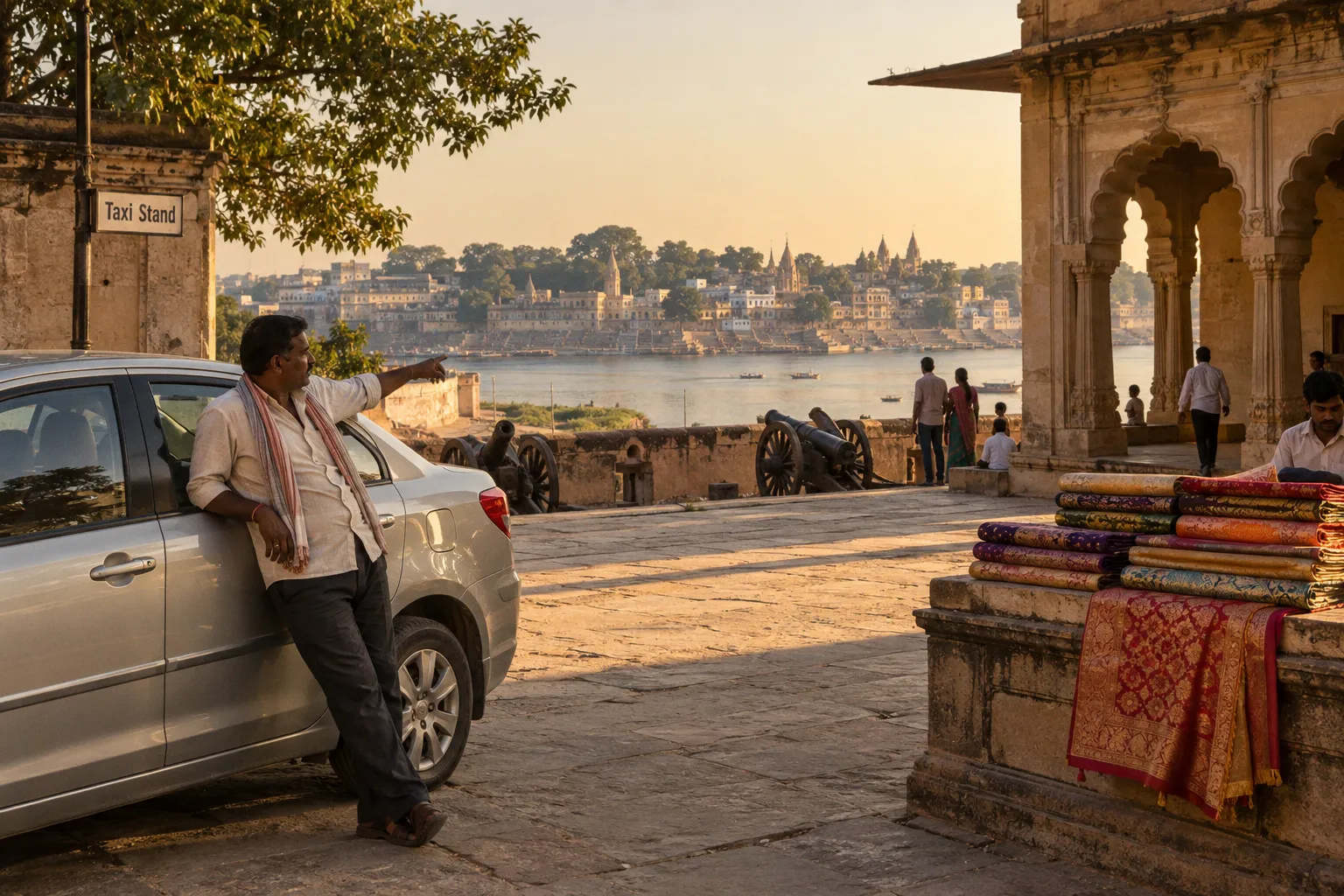
The two destinations represent different heritage structures, different spatial experiences, and different demands on a one-day itinerary from Varanasi.
Vindhyachal, in Mirzapur district, is approximately 65–70 km from Varanasi by road via NH35. Its primary heritage form is a connected pilgrimage circuit: Vindhyavasini Temple, Kali Khoh Temple and Ashtabhuja Devi Temple are linked by the Trikon Parikrama. Sitamarhi, in Bhadohi district, lies approximately 80–90 km from Varanasi and is centred on Sita Samahit Sthal, the location traditionally associated with Sita’s descent into the earth. Its most visible landmark is a modern Hanuman statue approximately 108–110 feet high.
The practical distinction is clear. Vindhyachal is a route with several active religious sites and a concentrated movement pattern. Sitamarhi is a single principal complex with a quieter riverside setting and a narrower mythological focus. The correct choice depends on whether the day is organised around movement between shrines or around one historical-religious landscape.
The Shaktipeeth circuit: navigating Vindhyachal
Vindhyachal is structured around the worship of Goddess Vindhyavasini and is recognised as a major Hindu Shaktipeeth. For visitors approaching from Varanasi, however, the important point is not only the status of the principal temple. It is the spatial layout of the wider circuit.
The Trikon Parikrama links three locations:
1. Vindhyavasini Temple sits at the centre of the circuit and normally forms the primary destination for visitors arriving in Vindhyachal.
2. Kali Khoh Temple is approximately 2 km from the main temple and occupies a cave-temple setting.
3. Ashtabhuja Devi Temple lies on the Vindhya hills and completes the triangular pilgrimage route.
This arrangement creates a different excursion from a visit to a single temple. The route requires coordination between separate stops, road movement and local access conditions. The distance between the sites is modest in geographical terms, but the practical time required depends on congestion, pedestrian activity and the sequence selected by the driver or local guide.
The circuit is therefore best understood as an infrastructure problem rather than a simple distance calculation. A taxi may cover the road from Varanasi efficiently and still lose time within Vindhyachal if the itinerary is not planned around the three points. The main temple, the cave site and the hill temple do not provide the same access conditions or the same spatial experience.
A chronological reading of the circuit
Vindhyachal’s importance is primarily religious and traditional rather than archaeological. The visitor is not moving through a sequence of preserved ancient structures with clearly documented construction dates. Instead, the heritage value lies in the continuity of the circuit and in the way the three sites operate together.
The movement from Vindhyavasini Temple to Kali Khoh and then to Ashtabhuja Devi creates a geographic chronology: riverine settlement and temple concentration give way to a cave site and then to the elevated landscape of the Vindhya hills. The route is not a museum itinerary. It remains an active pilgrimage system, with infrastructure shaped by daily worship, seasonal demand and local transport.
This distinction matters for travellers arriving from Varanasi. Those looking for carved façades, excavated remains or a tightly preserved historical complex may find Vindhyachal less legible than Sarnath or a fort museum. Its significance is instead found in the relationship between the sites and in the persistence of the Trikon Parikrama as a functioning spatial structure.
Vindhyachal is not one monument viewed from one entrance. It is a three-point circuit, and the quality of the visit depends on managing that movement.
The circuit also gives Vindhyachal a higher activity level than Sitamarhi. Visitors should expect more transitions during the day, more variation between locations and a stronger dependence on local circulation. That is an advantage for travellers who want a dense pilgrimage route. It is a disadvantage for anyone seeking a slow, low-complexity excursion.
Sitamarhi and the landscape of the Ramayana tradition
Sita Samahit Sthal, commonly referred to as Sitamarhi in travel planning, is located in Bhadohi district along the Ganga. It should not be confused with Sitamarhi district in Bihar. The destination near Varanasi is a heritage and pilgrimage site in Uttar Pradesh.
The site is associated with the episode in which Sita is believed to have descended into the earth while staying at Sage Valmiki’s ashram. The historical significance of Sitamarhi is therefore different from the circuit-based significance of Vindhyachal. Its identity depends on a specific narrative location rather than on a sequence of three connected temples.
The physical complex is dominated by a Hanuman statue approximately 108–110 feet high. This is the most immediate visual reference point for visitors and gives the site a strong contemporary landmark. The statue is not evidence of an ancient construction phase; it belongs to the modern presentation of the sacred landscape. The distinction between traditional association and modern built form should remain clear when assessing the site as heritage.
Sitamarhi’s spatial layout is comparatively simple. Visitors generally move through one principal complex rather than organising a circuit across separate shrines. The setting along the Ganga contributes to the site’s character, but the available facts do not establish a detailed chronology for the modern temple structures. It is more accurate to describe Sitamarhi as a living epic heritage site with a major modern landmark than to present it as a surviving ancient monument.
What Sitamarhi offers that Vindhyachal does not
Sitamarhi provides a more concentrated interpretive experience. Its central question is the relationship between the site and the Ramayana tradition, particularly the association with Sita and Valmiki. There is less need to divide attention between several destinations.
That makes the site suitable for travellers who prefer:
- a single principal heritage complex;
- a lower-complexity route from the vehicle drop-off point;
- a location connected to a specific epic episode;
- time for observation without completing a multi-stop religious circuit;
- a day trip that can be paired with Vindhyachal rather than treated as a full independent circuit.
Its limitations are equally specific. Sitamarhi has less documented architectural depth in the available material than destinations such as Sarnath, Ramnagar Fort or the historic fabric of central Varanasi. The exact construction dates of the modern temple structures are not established here. Visitors should not expect the same archaeological density as the Buddhist remains at Sarnath or the military chronology of Chunar Fort.
The site’s value lies in the continuity of narrative geography and in the way a modern complex marks that location. It is a different category of heritage from an excavated stupa, a colonial building or a medieval fort.
Vindhyachal versus Sitamarhi: route, distance and access
The road distances are close enough to make both destinations realistic day trips from Varanasi. They are not close enough to make the choice irrelevant.
Vindhyachal is approximately 65–70 km from Varanasi. Sitamarhi is approximately 80–90 km away. The difference in distance alone does not determine the final travel time. Road congestion, urban departure conditions, stops within the destination and the internal movement between sites can outweigh the difference of a few kilometres.
Travelling to Vindhyachal by road involves two separate calculations:
1. the outward journey from Varanasi to the Vindhyachal area;
2. the local movement required to complete the Trikon Parikrama.
For Sitamarhi, the route is simpler. The outward journey is longer in distance, but the destination itself has a more concentrated spatial arrangement. A vehicle can be used for the main approach without the same need to coordinate three separate pilgrimage points.
| Parameter | Vindhyachal | Sitamarhi |
|---|---|---|
| District | Mirzapur district | Bhadohi district |
| Approximate distance from Varanasi | 65–70 km | 80–90 km |
| Main heritage structure | Vindhyavasini Temple and the Trikon Parikrama | Sita Samahit Sthal |
| Associated tradition | Shaktipeeth dedicated to Goddess Vindhyavasini | Sita’s descent into the earth at the site associated with Valmiki’s ashram |
| Internal movement | Three linked locations: Vindhyavasini, Kali Khoh and Ashtabhuja Devi | Primarily one principal complex |
| Distinctive landmark | Cave temple at Kali Khoh and hill setting at Ashtabhuja Devi | Hanuman statue approximately 108–110 feet high |
| Best suited to | Visitors seeking an active multi-stop pilgrimage route | Visitors seeking a concentrated epic heritage site |
| Combination potential | Can be visited first or second in a longer circuit | Approximately 45 km from Vindhyachal |
The travel distinction is therefore not simply “nearer versus farther.” Vindhyachal demands more route management after arrival. Sitamarhi demands more road travel before arrival but less internal planning once there.
Comparing excursion costs from Varanasi
A private taxi is the most practical arrangement for travellers attempting either destination in one day, particularly when Vindhyachal’s three-point circuit is included. Typical one-day excursion rates begin at approximately ₹2,499 for a sedan. A seven-seater SUV may cost around ₹3,200 to ₹4,499, depending on the vehicle and operator.
These figures should be treated as starting ranges rather than fixed tariffs. Vehicle category, pickup location, route design and the inclusion of both destinations can alter the final fare. A sedan is sufficient for a small group with limited luggage. A seven-seater SUV is more useful for families or groups that want to combine Vindhyachal and Sitamarhi without changing vehicles.
Sedan or SUV?
The vehicle choice affects more than passenger capacity.
A sedan is appropriate when:
- the group is small;
- the itinerary includes only one destination;
- passengers do not require extensive flexibility for additional stops;
- the route is planned around the principal site rather than a broad circuit.
An SUV becomes more practical when:
- the group includes several passengers;
- the itinerary includes all three Vindhyachal locations;
- Vindhyachal and Sitamarhi are combined;
- the day includes additional roadside stops or return flexibility.
The incremental cost of a larger vehicle may be justified by the structure of the route. Vindhyachal is not difficult because the distances are extreme. It is difficult when a compact itinerary leaves no margin for movement between the sites.
Travellers should ask for the route to be defined before departure. A quotation for Varanasi–Vindhyachal–Varanasi may not automatically describe the same service as a quotation that includes Vindhyavasini Temple, Kali Khoh, Ashtabhuja Devi and Sitamarhi. The difference is operational, not merely commercial.
Can both destinations be combined in one day?
Yes. Vindhyachal and Sitamarhi are approximately 45 km apart, and both can be visited as single-day excursions from Varanasi. Neither requires a separate overnight stay for the standard heritage itinerary described here.
The combined route is most logical when the traveller wants contrast rather than depth. Vindhyachal supplies the active three-site pilgrimage circuit. Sitamarhi supplies the single-location Ramayana heritage landscape. Together, they form a wider regional route across Mirzapur and Bhadohi districts.
The combined itinerary has a clear weakness: it reduces the time available at each destination. Vindhyachal alone already requires movement between the main temple, the cave temple and the hill temple. Adding Sitamarhi increases the dependence on road conditions and departure discipline. The route is viable, but it should not be treated as a relaxed visit to two nearby monuments.
A practical sequence is:
1. Leave Varanasi early enough to reach the first destination before the day becomes compressed.
2. Complete the main Vindhyachal circuit rather than treating the principal temple as the only stop.
3. Continue toward Sitamarhi, which is approximately 45 km from Vindhyachal.
4. Allow time for the Sita Samahit Sthal complex and the Hanuman statue.
5. Return to Varanasi by the most direct available road route.
The reverse order may also be used, but the correct sequence depends on the traveller’s priority. Those whose main purpose is the Vindhyavasini circuit should place Vindhyachal first. Those who want the quieter, single-site experience of Sitamarhi may prefer to visit it before the more active circuit.
Combining both sites is geographically feasible. It is not automatically comfortable; the limiting factor is internal movement, not the map distance between the districts.
The combined route is most suitable for visitors with one full day, a private vehicle and a willingness to accept a schedule shaped by road conditions. It is less suitable for travellers who require precise arrival times back in Varanasi or who want extended architectural observation.
Which site has greater heritage value?
The answer depends on the definition of heritage being used.
Vindhyachal has greater circuit value. Its significance is distributed across the Trikon Parikrama, with the relationship between Vindhyavasini Temple, Kali Khoh Temple and Ashtabhuja Devi Temple forming the central heritage structure. The destination is best understood through movement, continuity and the active use of multiple sacred points.
Sitamarhi has greater narrative concentration. Its identity is tied to a specific episode associated with Sita and Sage Valmiki. The site’s modern physical expression, including the large Hanuman statue, gives the landscape a recognisable contemporary form, but the central heritage claim is traditional and mythological rather than archaeological.
Neither should be ranked as a substitute for Sarnath, Chunar Fort or the historic architecture of Varanasi. Those places offer different evidence: Buddhist archaeological remains, fortification history, colonial and regional architecture, or layered urban construction. Vindhyachal and Sitamarhi belong to the category of living religious heritage, where present-day use is inseparable from the meaning of the site.
For a heritage-focused itinerary, the distinction can be stated precisely:
- Vindhyachal is the stronger choice for studying a multi-site pilgrimage network and the spatial organisation of an active Shaktipeeth.
- Sitamarhi is the stronger choice for studying how an epic narrative is anchored to a specific landscape and represented through a modern complex.
- The combined route is the strongest choice for regional comparison, provided the visitor accepts less time at each location.
The practical decision
Choose Vindhyachal if the priority is a structured religious circuit, multiple stops and a more active day. The Trikon Parikrama gives the excursion a clear route logic. The cave setting at Kali Khoh and the hill location of Ashtabhuja Devi add spatial variation that a single-site visit cannot provide.
Choose Sitamarhi if the priority is a concentrated heritage destination associated with the Ramayana tradition. The route from Varanasi is somewhat longer, but the site itself is easier to understand spatially. The 108–110-foot Hanuman statue provides a dominant landmark, while the association with Sita’s descent into the earth defines the site’s narrative focus.
Choose both if the purpose is to compare two forms of living heritage within one regional excursion. The approximately 45 km connection between Vindhyachal and Sitamarhi makes the circuit possible. It should be booked as a full-day private-vehicle itinerary rather than improvised through separate local transfers.
Vindhyachal offers a functioning network. Sitamarhi offers a concentrated narrative landscape. For travellers departing Varanasi, that is the decisive comparison. The better destination is not the one with the shorter road distance, but the one whose spatial structure matches the time, vehicle and type of heritage observation available that day.