Chunar Fort or Sarnath: choosing your historical day trip
The decision between Sarnath and Chunar Fort is primarily a question of distance, site scale, and historical type. Sarnath lies approximately 10 km northeast of central Varanasi and usually requires 30 to 45 minutes by road.
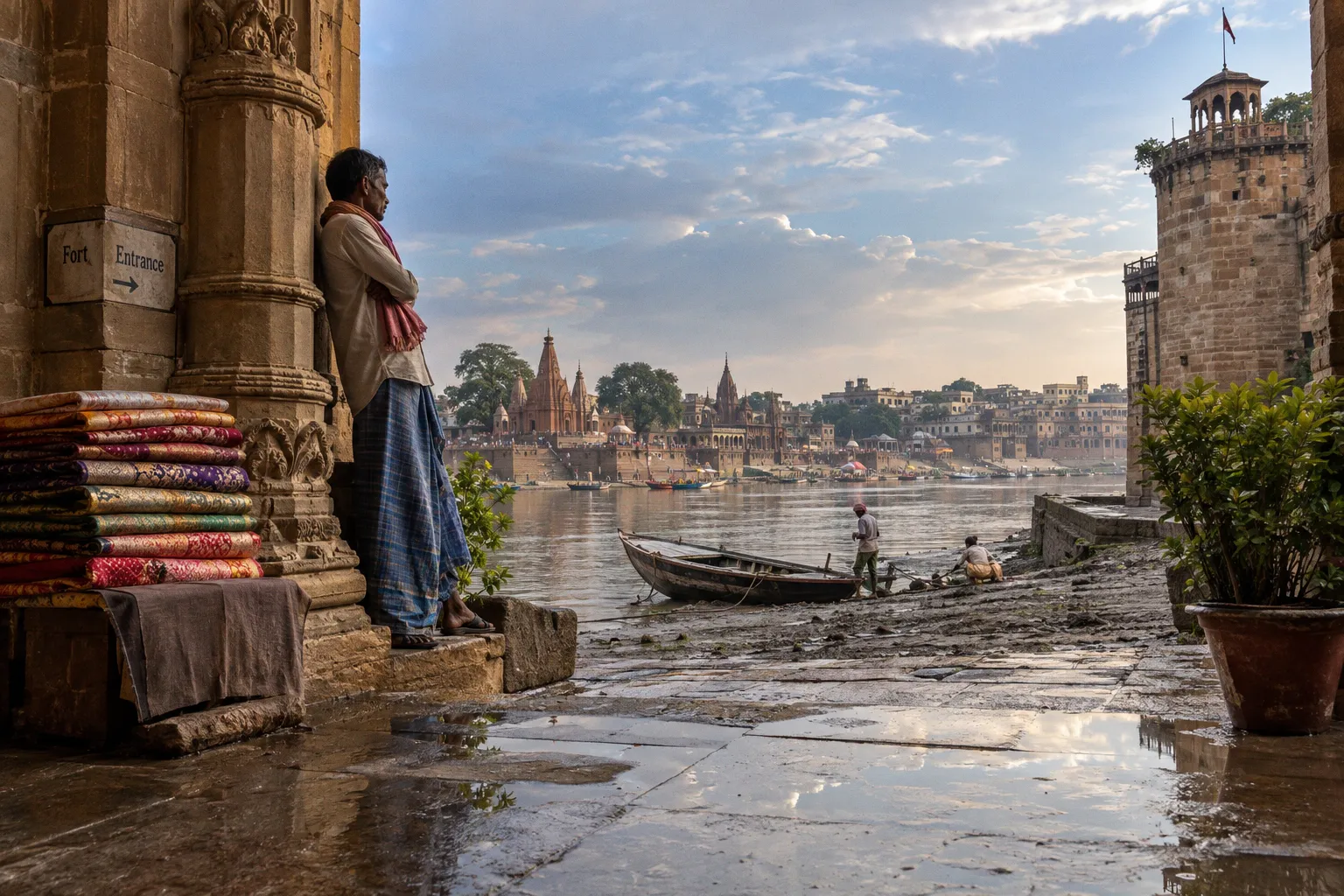
Chunar Fort stands about 40 km southwest, in Mirzapur district, and normally takes 1 to 1.5 hours to reach.
The two destinations should not be treated as interchangeable heritage stops. Sarnath is a concentrated archaeological and museum complex associated with the beginnings of Buddhist teaching in India. Chunar is a fortified riverside site shaped by military control, dynastic succession, and colonial occupation. For a short excursion, Sarnath is the more efficient choice. For a longer day built around fortification, topography, and layered political history, Chunar offers greater spatial breadth.
The practical comparison is straightforward:
| Parameter | Sarnath | Chunar Fort |
|---|---|---|
| Location from central Varanasi | Approximately 10 km northeast | Approximately 40 km southwest, in Mirzapur district |
| Typical road journey | 30–45 minutes | 1–1.5 hours |
| Primary historical character | Buddhist archaeological and religious heritage | Riverside military architecture and political history |
| Principal monument | Dhamek Stupa | Fort complex on a sandstone bluff |
| Site scale | Concentrated, walkable archaeological zone | Dispersed fort compound with elevated and enclosed sections |
| Major museum value | Ashoka Lion Capital and Sarnath archaeological collection | Architectural remains, named structures, and fort traditions |
| Standard ASI monument entry | ₹25 for Indian citizens; ₹200–₹300 for foreign visitors | ₹25 for Indian citizens; ₹200–₹300 for foreign visitors |
| Additional museum entry | Sarnath Archaeological Museum: ₹5 | No equivalent museum is specified in the available visitor data |
| Best suited to | Short itineraries, Buddhist history, archaeology | Fortification, dynastic history, river geography |
Sarnath is the better historical day trip when time is limited. Chunar is the stronger choice when the journey itself is acceptable and the subject is political power expressed through stone.
Sarnath: a concentrated Buddhist archaeological landscape
Sarnath’s value lies in the relationship between a small number of major monuments rather than in the size of the site. The spatial layout is compact. A visitor can move between the archaeological ruins, the Dhamek Stupa, Chaukhandi Stupa, and the Sarnath Archaeological Museum without committing to a full-day road excursion.
The chronology begins with the Mauryan period. In 249 BCE, Emperor Ashoka erected stupas and an Ashoka Pillar at Sarnath. The site was therefore not simply a later medieval pilgrimage centre. It had already acquired imperial significance during the third century BCE, when Ashokan patronage formalized locations associated with the Buddha’s life and teaching.
The central monument is the Dhamek Stupa. It marks the place where Gautama Buddha delivered his first sermon to his first five disciples after enlightenment. The event is associated with the Dhamma-cakka-ppavattana Sutta, often translated as the discourse that set the wheel of the Dharma in motion.
The structure is materially substantial rather than delicate. Dhamek Stupa is a cylindrical mass of red brick and stone, standing 43.6 metres high with a base diameter of 28 metres. Those dimensions determine the visitor’s experience. It is not a ruin that can be understood only through small surviving fragments. Its vertical volume remains the organizing feature of the archaeological zone.
The monument’s historical importance requires chronological discipline. The original Mauryan foundations belong to the period of Ashoka, but the visible structure also reflects later rebuilding and expansion. A major phase is associated with the Gupta period in the fifth century CE. The stupa should therefore be read as a layered monument, not as an untouched third-century BCE object.
How to read the Sarnath ruins
The most efficient route begins with the archaeological ruins and then moves toward Dhamek Stupa. This provides the correct spatial sequence: foundations and excavated remains first, dominant surviving monument second. The ruins establish the former extent of the settlement. Dhamek then provides the vertical reference point against which the rest of the site can be measured.
Chaukhandi Stupa belongs to a different visual and historical category. In 1588, Emperor Akbar added an octagonal tower to the monument in honour of Humayun. The addition is a useful reminder that Sarnath continued to be interpreted and modified after its primary Buddhist phases. The site is not a single-period enclosure sealed in antiquity. Its chronology extends into the Mughal period and beyond.
The Sarnath Archaeological Museum is essential rather than optional for visitors interested in the site’s political and artistic significance. The original four-lion capital of the Ashoka Pillar, discovered at Sarnath, is housed there. The sculpture was adopted as the official National Emblem of India. The pillar remains at the archaeological site, but the intact Lion Capital is not mounted outdoors on the ruins.
The museum ticket is listed at ₹5. Monument entry is generally listed at ₹25 for Indian citizens and ₹200 to ₹300 for foreign visitors, with free entry for children under 15. Fees can change, so the figures are best used for planning rather than treated as permanent tariffs.
Sarnath is particularly effective for visitors who need a clear historical sequence within a limited time:
1. Mauryan state formation: Ashoka’s monuments establish imperial patronage in 249 BCE.
2. Buddhist teaching tradition: Dhamek Stupa marks the first sermon site.
3. Gupta reconstruction: the fifth-century rebuilding phase explains the monumental form visible today.
4. Mughal intervention: the 1588 addition to Chaukhandi Stupa demonstrates later political engagement with the landscape.
5. Modern national history: the Ashoka Lion Capital connects Sarnath to the visual identity of the Republic of India.
This sequence gives Sarnath considerable historical depth despite its compact footprint. The site is not limited to religious history. It connects archaeology, imperial administration, Buddhist transmission, Gupta architecture, Mughal commemoration, and modern nationalism.
Chunar Fort: a defensive site organized by topography
Chunar Fort presents a different problem of interpretation. Its history cannot be separated from its position. The fort stands on a sandstone rock bluff of the Vindhya Range at an elevation of approximately 280 feet above sea level. It overlooks the Ganges and occupies a commanding position south of Varanasi.
The fort covers approximately 34,000 square feet. That figure describes a large compound rather than a single monument. The visitor encounters walls, elevated edges, internal structures, passages, and named locations associated with different periods of occupation. The site is therefore best understood through movement across its spatial layout.
The earliest layers of Chunar’s history are difficult to reduce to one stable date. The available chronology becomes clearer during the Afghan, Mughal, and British periods. In 1532, Sher Shah Suri took control of Chunar Fort as a stronghold. In 1575, Akbar recaptured it for the Mughal Empire. In 1772, the British East India Company seized the fort under Major Munro.
These transfers are not incidental details. They explain why Chunar is a strong choice for visitors interested in the infrastructure of power. A fort positioned above the Ganges offered surveillance, control of movement, and defensive advantage. Its importance was not based on visual decoration alone. It came from the relationship between stone, elevation, river access, and regional routes.
The principal structures inside Chunar Fort
Chunar should not be approached as a single wall viewed from outside. Several named features establish the internal chronology and the administrative character of the complex.
- Samadhi of Bhartihari: a commemorative structure associated with the fort’s older historical and legendary traditions.
- Sonwa Mandap: one of the principal architectural features within the compound.
- Warren Hastings’s bungalow: evidence of the fort’s later British administrative and military history.
- Hanging Place: a designated capital punishment area, demonstrating the coercive function of the site.
- Well of Love: a well associated with secret dungeons and the fort’s enclosed subterranean traditions.
The presence of Warren Hastings’s bungalow alongside the Hanging Place is particularly useful for understanding the fort’s chronological range. Chunar was not merely a medieval stronghold later abandoned. It continued to function within colonial military and administrative systems.
The fort’s sandstone setting also changes the physical demands of the excursion. Sarnath is compact and primarily organized around an archaeological precinct. Chunar involves a more extended movement through a raised compound. Uneven surfaces, exposed sections, and changes in elevation are part of the site’s infrastructure. Visitors should allow more time for orientation and less time for a rapid sequence of isolated monuments.
Chunar’s historical argument is geographical: whoever controlled the bluff controlled a defensible position above the Ganges.
Chunar Fort versus Sarnath ruins day trip: the logistics
The travel time from Varanasi is the most decisive practical difference. Sarnath is approximately 10 km from the city centre and commonly takes 30 to 45 minutes by road. It can be incorporated into a half-day schedule with comparatively little disruption to other Varanasi activities.
Chunar Fort is approximately 40 km away in Mirzapur district. The road journey generally takes 1 to 1.5 hours. That is not a minor extension of the Sarnath route. It creates a separate excursion with a larger transport commitment and less flexibility if the return journey is delayed.
The two routes also produce different expectations about the day. Sarnath can be combined with other nearby heritage locations, museums, and Buddhist institutions. Chunar is more naturally treated as the main destination. A plan that attempts to combine Chunar Fort with several central Varanasi sites on the same day may become transport-heavy rather than historically productive.
A practical planning comparison looks like this:
| Planning issue | Sarnath | Chunar Fort |
|---|---|---|
| Departure requirement | Flexible; suitable for a later morning | Earlier departure is preferable for a complete visit |
| Transport burden | Low to moderate | Moderate to high |
| Return flexibility | High, because of shorter distance | Lower, because of the longer road journey |
| Suitable for a half-day | Yes | Less suitable |
| Suitable as the main day excursion | Yes, especially with museum and additional sites | Yes, and generally preferable as a dedicated trip |
| Main physical challenge | Walking across an archaeological precinct | Walking through an elevated fort compound |
| Best planning logic | Cluster several nearby sites | Reserve the day around Chunar and its approach |
The travel time from Varanasi to Chunar Fort should also be considered against the visitor’s tolerance for road movement. A 1 to 1.5-hour journey each way can be justified by an interest in fortifications, Mughal history, British occupation, and river geography. It is less justified if the main objective is simply to see a major historic monument near Varanasi.
Sarnath is the safer choice for an itinerary with fixed evening commitments. Chunar is more vulnerable to road conditions, delays, and the cumulative loss of time caused by distance. Exact current train schedules between Varanasi Junction and Chunar Junction are not established in the available information, so rail should not be selected on the assumption of a particular departure or punctuality pattern without checking current operations.
Historical depth: concentrated chronology or layered occupation?
The phrase historical depth can mislead if it is measured only by the number of dynasties associated with a location. Both Sarnath and Chunar possess long chronologies, but they preserve different kinds of evidence.
Sarnath offers a concentrated sequence of religious and imperial construction:
- Mauryan patronage under Ashoka in 249 BCE.
- Buddhist monumental development around the site of the first sermon.
- Gupta-period rebuilding and expansion, including the fifth-century phase associated with Dhamek Stupa.
- Mughal-era modification of Chaukhandi Stupa in 1588.
- Modern national symbolism through the Ashoka Lion Capital.
This is a chronology of sanctification, rebuilding, commemoration, and archaeological recovery. The site’s power lies in the fact that major historical meanings are compressed into a relatively small area.
Chunar offers a chronology of strategic possession:
- Control by Sher Shah Suri in 1532.
- Mughal recapture under Akbar in 1575.
- British East India Company seizure in 1772 under Major Munro.
- Continued military and administrative use reflected in surviving structures such as Warren Hastings’s bungalow.
This is a history of territory and infrastructure. The fort is easier to understand when read as an instrument: a raised sandstone position, a protected compound, an observation point above the Ganges, and a site capable of absorbing new authorities without losing its defensive logic.
For a visitor interested in Buddhist heritage, Sarnath is unambiguous. Dhamek Stupa, the archaeological ruins, the Ashoka Pillar remains, and the museum form a coherent group. For a visitor interested in the Mughal and colonial architecture of the wider Varanasi region, Chunar offers a stronger case because its structures retain the physical organization of a fortified settlement.
The distinction can be stated precisely:
- Sarnath preserves the chronology of an important religious landscape.
- Chunar preserves the chronology of a contested strategic position.
Neither is historically deeper in every sense. They answer different questions.
Which site is better for different types of visitor?
The best historical day trip from Varanasi depends on the subject the visitor wants to study, not on a general ranking of monuments.
Choose Sarnath if the priority is Buddhist heritage
Sarnath is the correct choice for visitors focused on the Buddha’s first sermon, Ashokan patronage, Buddhist archaeology, and the relationship between excavated ruins and surviving monuments. The Dhamek Stupa provides a clear central landmark, while the museum supplies the objects needed to interpret the site’s imperial and artistic history.
It is also the more efficient choice for first-time visitors who have only one available excursion day. The shorter journey leaves more time for the monuments themselves. The compact spatial layout reduces the risk that transport will dominate the itinerary.
Choose Chunar Fort if the priority is military and political history
Chunar is the stronger destination for visitors interested in fortification, dynastic transitions, colonial occupation, and the connection between architecture and terrain. The fort’s position on a Vindhya sandstone bluff above the Ganges is not a background detail. It is the central historical fact.
The compound is also more suitable for readers of architecture who want to examine how different authorities used the same strategic site. Sher Shah Suri, Akbar, and the British East India Company belong to separate political systems, but each recognized the value of Chunar’s position.
Choose Sarnath for a tightly scheduled itinerary
Sarnath requires less road time and can be combined more easily with other parts of a Varanasi heritage route. It is the practical option when the day must end in the city, when transport is limited, or when the group includes visitors who prefer a shorter excursion.
The archaeological museum strengthens the case. The ₹5 museum entry listed in the available visitor information makes it a low-cost addition to the monument visit, while the Lion Capital provides an object of national importance that cannot be understood fully from the outdoor pillar remains alone.
Choose Chunar for a dedicated full-day excursion
Chunar makes more sense when the destination itself is the purpose of the day. The journey is longer, the site is more dispersed, and the historical reading depends on moving through the fort rather than checking off a single dominant monument.
The fort also offers a different relation to the Ganges. Sarnath is organized around archaeological and religious topography. Chunar is organized around elevation, visibility, enclosure, and river control. Visitors seeking a contrast with Varanasi’s dense urban lanes and riverfront ghats will find that Chunar provides a distinct infrastructural scale.
Fees, access, and visitor infrastructure
Standard Archaeological Survey of India entry tickets for both Sarnath Archaeological Ruins and Chunar Fort are listed as ₹25 for Indian citizens and ₹200 to ₹300 for foreign visitors. Children under 15 are listed as entering free. These figures should be confirmed locally before travel because monument fees and operating rules can change.
Sarnath has the clearer visitor infrastructure for an independent heritage visit. Its principal locations are close together, the museum is nearby, and the main interpretive sequence can be followed without extensive route-finding. The site rewards a chronological approach: begin with the ruins, identify the Ashokan framework, examine Dhamek Stupa, then visit the museum.
Chunar requires more attention to internal orientation. The fort’s value is distributed across the compound. A hurried visit that focuses only on the outer walls will miss the relationship between the bluff, the named buildings, the punishment area, and the subterranean traditions associated with the Well of Love.
There is also a difference in how restoration should be interpreted. At Sarnath, archaeological conservation has made it possible to distinguish excavated foundations, reconstructed monumental forms, and museum-held objects. At Chunar, the principal preservation challenge is broader: the fort is a large historic structure exposed to weather, visitor movement, and the continuing difficulty of maintaining a complex defensive site.
Visitors should avoid treating restoration as a cosmetic process. At both sites, repair decisions affect how chronology is read. New masonry, stabilized walls, protected sculptures, and controlled access can preserve a monument while also changing the visual relationship between original fabric and later intervention.
Final assessment
For the question of Chunar Fort versus Sarnath ruins as a day trip, Sarnath is the efficient and historically concentrated option. It is closer to Varanasi, easier to navigate, less demanding in transport, and exceptionally strong in Buddhist and Ashokan heritage. The Dhamek Stupa and Sarnath Archaeological Museum provide a coherent route through more than two millennia of religious, imperial, and national history.
Chunar Fort is the more demanding choice but also the more distinctive one for visitors concerned with strategic geography, Mughal power, Afghan rule, British administration, and the architecture of defense. Its 40 km distance and 1 to 1.5-hour road journey each way are part of the calculation, not an incidental inconvenience.
Sarnath should be selected when time, clarity, and archaeological continuity matter most. Chunar should be selected when the visitor is prepared to allocate a full excursion to a riverside fort whose history is inseparable from elevation and control.
Current preservation efforts at both sites serve different objectives. Sarnath depends on maintaining a legible archaeological landscape and protecting objects of national importance. Chunar depends on stabilizing a larger fortified structure whose historical meaning remains embedded in its terrain. The choice between them is therefore not between two versions of the same heritage experience. It is between two historical systems: the monumental geography of Buddhist memory at Sarnath and the defensive infrastructure of political power at Chunar.