Varanasi urban ropeway project: realistic completion expectations
The Varanasi urban ropeway project is reported to be 94% complete as of September 2026, with commercial passenger operations targeted for November.
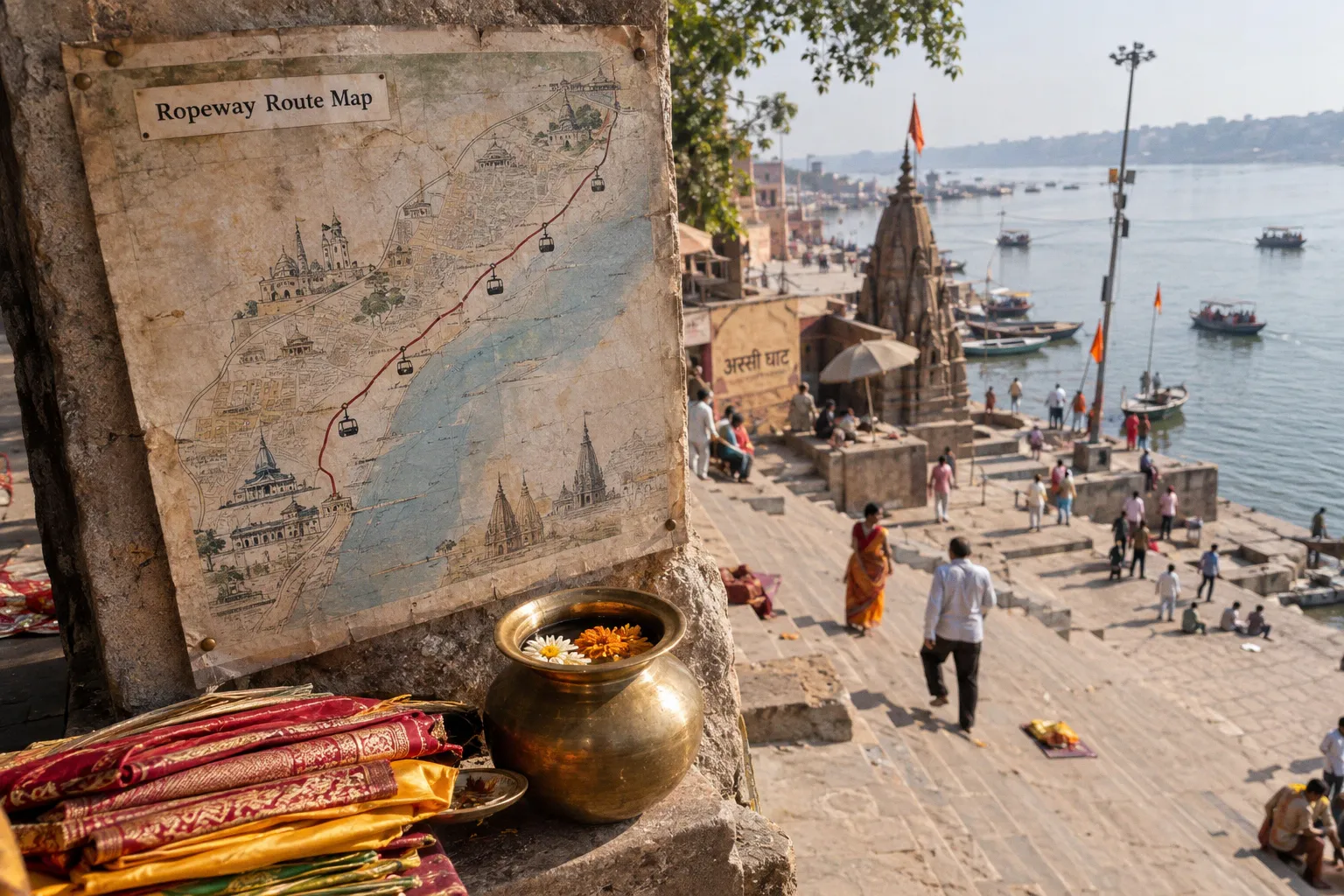
If that target holds, the system will connect Varanasi Cantonment Railway Station with Godowlia Chowk in roughly 16 minutes, replacing a road journey that can take 45–60 minutes when traffic is heavy.
The proposed aerial corridor is approximately 3.8 km long and is designed to link one of the city’s main railway interchanges with the congested heritage core. That is the project’s practical value. It is not simply a scenic ride above the old city. It is intended to move passengers between the northern side of the corridor and the southern heritage destination without depending entirely on roads that narrow, slow, and become difficult to use as they approach Godowlia and the temple district.
The foundation stone was laid in March 2023, and the original August 2025 completion deadline was missed. The revised operational target is November 2026. That timing has been associated with Dev Deepawali, when demand around the ghats and major religious sites is especially high. The date should still be read as a target rather than a guarantee: construction completion, testing, approval, staff readiness, and the opening of a reliable public timetable are separate steps.
From Cantonment to Godowlia: mapping the 3.8 km transit corridor
The route runs between Varanasi Cantonment Railway Station in the north and Godowlia Chowk in the south. This geographic orientation matters because the corridor is often described simply as “Cantonment to Godowlia,” which can make the line sound like a straightforward extension from the railway station into the centre without explaining how it crosses the city.
Five stations are associated with the alignment:
- Varanasi Cantonment Railway Station
- Kashi Vidyapeeth
- Rath Yatra
- Girja Ghar
- Godowlia Chowk
Four of these are passenger stations. Girja Ghar is planned as a technical station rather than a regular boarding and alighting point. For visitors reading a route map, that distinction is essential: the system has four public stops, even though the alignment includes five station structures.
The northern end at Cantonment is the most obvious interchange point. Passengers arriving by train can use the ropeway for the onward journey toward the central and southern parts of the corridor instead of immediately joining the road network. At the other end, Godowlia places passengers close to the heritage core, the Kashi Vishwanath Temple area, Vishwanath Dham, and the lanes leading toward the ghats. The ropeway does not deliver passengers directly to every destination in the old city, but it can shorten the first and most difficult part of the journey: the movement from the railway interchange to the edge of the dense pedestrian and market zone.
Kashi Vidyapeeth is a central stop on the line and is associated with Mahatma Gandhi Kashi Vidyapith, the university whose campus and surrounding urban area give the station its name. It should not be confused with the separate Sanskrit university campus sometimes brought into descriptions of Varanasi’s education districts. That distinction is not merely institutional. Station names are part of how residents and visitors navigate the city, and imprecise descriptions can make an apparently simple route harder to understand.
Rath Yatra is another passenger stop along the corridor. It connects the ropeway to a busy urban area rather than serving only as a link between the two end stations. For local users, that intermediate access may be as important as the full Cantonment–Godowlia trip. A system that is used only for end-to-end tourist journeys would have a narrower transport role; the intermediate stations are what give it a chance to function as public infrastructure.
The ropeway’s central promise is not a view of Varanasi. It is a more predictable connection between the railway interchange and the heritage core.
Godowlia is the southern terminus, not the northern one. Its position makes the station especially significant for visitors, but also creates an obvious integration challenge. The area around the terminus is already busy, and passengers will still need to walk, use an auto-rickshaw, or transfer to another mode for the final part of their journey. The ropeway can reduce the time spent crossing the city; it cannot remove the last-mile problem at the southern end.
The same principle applies at Cantonment. A station beside a major railway interchange is useful only if the transfer between train platforms, station approaches, the ropeway entrance, and onward road transport is legible and manageable. The success of the corridor will therefore depend on more than the cable system itself. It will depend on whether passengers can find the stations, enter them without confusion, and continue their journeys after leaving the cabins.
Construction milestones and the November 2026 operational target
The project began with the laying of its foundation stone in March 2023. The initial completion target was August 2025, but that deadline was not met. By September 2026, reported construction progress had reached 94%, while the revised target for commercial operations remained November 2026.
Those figures describe the project’s position, but they do not remove the difference between construction progress and public operation. A ropeway can appear substantially complete while work continues on station interiors, equipment integration, testing, staff procedures, passenger circulation, and the operating timetable. The final stage is not a ceremonial formality. It determines whether the system can run consistently and safely under ordinary commuter demand as well as during periods of intense tourist movement.
The November target is therefore best understood as an operational window. It indicates when the authorities and project agencies expect the system to be ready for passengers, but it does not establish a guaranteed opening day. No precise November date should be treated as confirmed unless it is announced separately through an official operating notice.
That distinction is particularly important for travellers planning around Dev Deepawali. The festival is a logical moment for a high-profile transport launch because Varanasi experiences exceptional pressure around the ghats and religious landmarks during the period. It is also a demanding environment for a new system. A ceremonial opening and a fully dependable passenger service are not necessarily the same thing. Initial operations may require controlled frequencies, limited hours, or adjustments as staff and passengers become familiar with the network.
For visitors, the sensible approach is simple: treat the ropeway as a possible advantage for a November trip, not as the only basis for an itinerary. Rail connections, road transfers, hotel access, and walking routes should still work if the launch is delayed or if service begins with restrictions.
The available progress figure is encouraging, but it does not answer every question that matters to a passenger. It does not, by itself, confirm the first-day timetable, the frequency at each station, the arrangements for luggage, or the exact interchange design at Cantonment and Godowlia. Those details will shape the real experience more than the headline percentage.
Capacity and commuter experience: inside the 150-cabin network
The planned fleet is described as comprising approximately 150 gondola cabins, with the project specifications placing the total in the range of 148 to 153 cabins. Each cabin is designed to carry up to 10 passengers. Peak capacity is given as 3,000 passengers per hour in each direction, with a planned operating window of 16 hours per day.
| Parameter | Planned specification |
|---|---|
| Route length | Approximately 3.75–3.85 km |
| Passenger stations | 4 |
| Technical station | 1, at Girja Ghar |
| Cabin fleet | Approximately 148–153 gondolas |
| Cabin capacity | 10 passengers |
| Peak capacity | 3,000 passengers per hour per direction |
| Planned daily operation | 16 hours |
| End-to-end journey | Approximately 16 minutes |
| Road journey comparison | Approximately 45–60 minutes |
These numbers explain why the project is being presented as an urban transport system rather than only as a tourist attraction. A recreational cable car is usually judged by the view and by occasional visitor demand. An urban ropeway has to work through repeated boarding cycles, regular dispatches, intermediate stops, and changing passenger loads. Its usefulness is measured by how reliably it moves people at the times they need to travel.
The stated capacity is substantial, but headline capacity is not the same as the number of people who will experience a fast journey at all times. Actual throughput will depend on dispatch intervals, boarding arrangements, crowd management, maintenance requirements, and the balance between passengers travelling from one terminus to the other and those using intermediate stops.
The 16-minute end-to-end time is the most attractive figure for long-distance users of the corridor. It offers a clear contrast with the 45–60 minutes that road travel can require. But passengers travelling only between intermediate stations will judge the system differently. For them, the decisive factors may be the time needed to reach the station entrance, wait for a cabin, navigate security or ticketing, and continue from the destination station to a workplace, hotel, temple, market, or ghat.
That is why station accessibility matters as much as cabin speed. A ropeway can cross the city quickly and still feel slow if its entrances are difficult to reach or if the final walk is poorly connected to the surrounding streets. At Cantonment, the transfer from the railway station will be central to the commuter experience. At Godowlia, the challenge will be managing the transition from an elevated station into one of the busiest areas of the city.
Tourists will also have practical questions that a capacity figure cannot answer. Can visitors with bags move easily through the station? Are the entrances obvious from the main road? Is there space for waiting during peak periods? How close is the station to the pedestrian route toward the temple district? These are questions of design and operation, not of route length, and they will become visible only as the stations enter public use.
The cabins may provide an elevated view over parts of Varanasi, but that should not become the project’s main measure of success. The strongest case for the ropeway is time reliability. During congestion, the aerial route should be less exposed to the delays that affect road traffic. Whether it achieves that advantage consistently will depend on the operating discipline of the finished system.
Economic integration: fare structures and local transit discounts
The planned fare structure places a ceiling of ₹50 per ride for tourists. Local residents are to receive a 20% discount on the standard fare, while monthly pass holders may receive discounts of up to 30%. The policy is intended to distinguish between occasional visitors and people who use the corridor as part of their regular travel.
| User group | Planned fare treatment |
|---|---|
| Tourists | Fare ceiling of ₹50 per ride |
| Local residents | 20% discount on the standard fare |
| Monthly pass holders | Discounts of up to 30% |
The fare matters because the ropeway has two different identities. For visitors, it may be a convenient way to approach the heritage core and an experience in its own right. For residents, it must be useful often enough to justify changing an established habit. A price that works for a single tourist trip may still be unsuitable for daily travel unless the ticketing system and pass options are easy to use.
The resident discount is therefore more than a public-relations detail. It signals that the line is intended to serve people who live, work, study, or regularly travel along the corridor, not only those arriving in Varanasi for pilgrimage or sightseeing. Monthly discounts could further strengthen that role, provided that passes are available through a practical system and cover the journeys people actually make.
The fare also has to be considered alongside the cost of reaching a station. A passenger may pay a modest ropeway fare but still need an auto-rickshaw or e-rickshaw at one or both ends. For tourists staying near the ghats, the price of the ropeway will be only one part of the trip. For residents, the combined cost of feeder transport may determine whether the system is genuinely cheaper or simply faster.
No fare can solve every integration problem. If station access is unclear, if transfers are uncomfortable, or if the ropeway does not connect smoothly with local buses and autos, a discount will not automatically create regular ridership. Conversely, a well-placed station and a dependable timetable can make a moderate fare feel reasonable because passengers are buying time as well as distance.
The project’s capital cost has been publicly discussed in a broad range, but the eventual transport value should not be judged only by the size of the investment or by the number of tourists who use the cabins. The stronger test is whether the system provides a dependable alternative for daily movement while also absorbing some visitor traffic that would otherwise enter the most congested streets.
Navigating the technical role of the Girja Ghar station
Girja Ghar has a different function from the four passenger stations. It is included in the alignment as a technical station, while regular passengers are expected to board and leave the system at Cantonment, Kashi Vidyapeeth, Rath Yatra, or Godowlia.
For a traveller, the immediate consequence is straightforward: Girja Ghar should not be treated as a normal stop when planning a route. A passenger travelling from Rath Yatra toward Godowlia is expected to pass through the technical section rather than leave the cabin there. Station names that appear on a complete engineering map may therefore not all appear as usable destinations on a passenger ticket or timetable.
That distinction is easy to miss because visitors naturally assume that every named station represents a place where they can get off. Clear signage will be important. So will accurate digital maps and ticketing information. If Girja Ghar is shown without an obvious indication of its technical role, passengers may expect access that the operating network does not provide.
The station also illustrates why a route map cannot be read as a simple list of tourist landmarks. Some infrastructure exists to make the system operate; it is not necessarily intended to expand the number of places passengers can reach. For the public, the relevant network is the four-stop passenger corridor. For the operator, the fifth station is part of the machinery that supports that corridor.
Girja Ghar is part of the ropeway’s operating system, not an additional sightseeing stop.
The technical station will also matter during maintenance and service planning. A system with a long operating day and high passenger ambitions must accommodate inspections and operational interruptions without leaving passengers uncertain about which stations remain open. The public-facing timetable will need to translate that technical complexity into simple information: where to board, where to exit, how long the trip takes, and what happens if service is temporarily reduced.
The ropeway’s place in Varanasi’s public transit infrastructure
The ropeway is one element in a much larger transport landscape. Varanasi is simultaneously managing railway connectivity, road traffic, heritage-area access, riverfront activity, airport links, and the daily movement of residents through streets that were not designed for modern traffic volumes. The aerial corridor cannot replace all of those systems, and it is not a substitute for a citywide metro network.
Its role is narrower and more useful: connect the Cantonment interchange with the Godowlia side of the heritage core while avoiding another demand for road space at ground level. That makes the project especially relevant to visitors arriving by train and heading toward the Kashi Vishwanath Temple area or the ghats. It may also give local passengers a faster north–south connection through parts of the city where surface travel is vulnerable to congestion.
The ropeway’s impact on city traffic will depend on how many passengers it actually attracts from roads. A fast aerial journey may reduce pressure on the corridor, but only if people can transfer to it without excessive walking, waiting, or additional cost. The system will not eliminate congestion around either terminus. It may instead shift some of the pressure from the road journey to station approaches, entrance plazas, and the streets where passengers continue on foot.
That is why the first months of operation will be important. The initial service will show whether the project is being used mainly by tourists, by daily commuters, or by a mixture of both. It will also reveal whether the planned capacity is being reached during peak periods, whether station access works in practice, and whether the fare discounts are strong enough to encourage repeat use.
The main implementation challenge is no longer the promise of the corridor on paper. It is converting a nearly completed construction project into a legible, dependable public service. That requires more than cabins moving along a cable. It requires stations that connect to the city, fares that do not exclude regular users, information that distinguishes passenger stops from technical facilities, and a timetable that passengers can trust.
For now, the realistic expectation is a November 2026 launch window rather than a fixed opening date. The 94% progress figure supports the possibility of an opening within that period, but the remaining operational steps still matter. Travellers should plan with the ropeway as a potential improvement, while keeping existing rail, road, walking, and auto-rickshaw options available.
If the project opens on schedule and runs at the planned frequency, its most meaningful contribution will be modest but concrete: a faster, more predictable connection between Varanasi Cantonment and Godowlia. That is enough to change how visitors enter the heritage core and how some residents cross the city. It does not solve Varanasi’s wider transport problems, but it can become a useful part of the city’s evolving public transit network.