Panchkroshi Yatra: essential checklist for a smooth pilgrimage
Many visitors to Kashi arrive expecting the Panchkroshi Yatra to function as a simple walking trail — a long route you finish, photograph, and check off. The circuit is anything but routine.
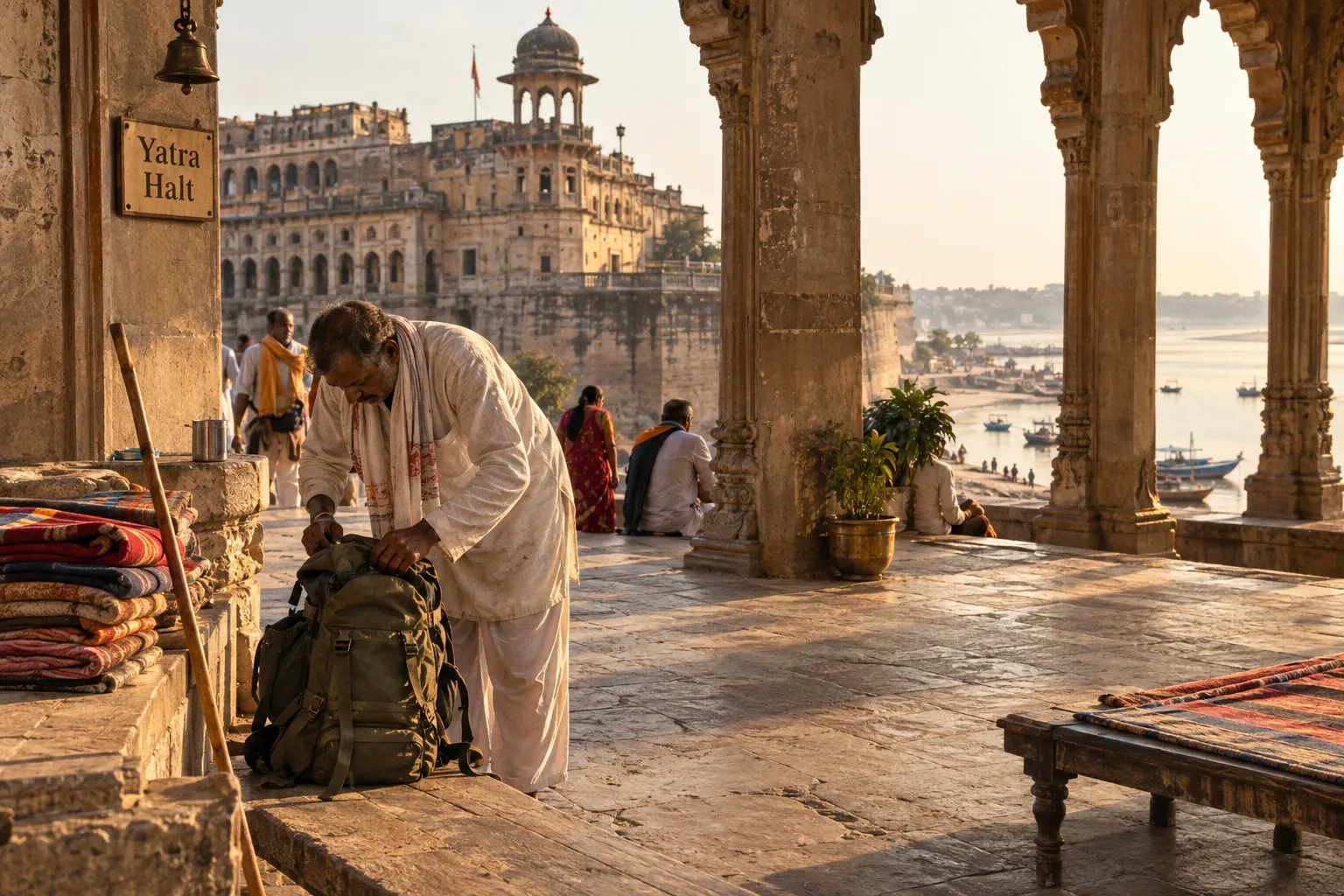
To walk its 25 krosha (approximately 88.5 km / 55.2 miles) is to enter an ancient ritual discipline in which the road itself is the deity, the schedule is the scripture, and your body is the offering. The pilgrims who complete it gracefully are rarely the most athletic or the most devout; they are simply the most prepared. What follows is the preparation we wish someone had walked us through the first time.
The Sacred Circuit: Understanding the 88.5 km Route and Padavs
The Panchkroshi Yatra is an outer circumambulation of Kashi — a ring route traced around the city's sacred boundaries rather than through its urban heart. The classical measurement is 25 krosha, a Puranic and tantric unit that translates to roughly 88.5 kilometers, or 55.2 miles. You will not walk around Varanasi as you see it on a map. You will walk around Kashi as the older texts describe it: a wider geography whose edges reach into agricultural fields, tank-beds, and riverside groves that lie beyond the modern ring road, well past the last traffic light.
The traditional full circuit unfolds over five days on foot, with five principal halt-stations — each called a padav, literally a "foot-step" or stopping place. The named padavs, in the order a clockwise pilgrim typically reaches them, are Kardameshwar, Bhimchandi, Rameshwar, Shivpur, and Kapildhara. After Kapildhara, the trail bends back toward Assi Ghat, completing the ring. At each padav, the pilgrim rests, eats, and spends the night in a dharamshala — a pilgrims' rest house — and the next morning performs a small darshan and ritual at the linked shrine before walking on.
The tradition holds that 108 Shiva temples and sacred stations sit along the right-hand side of the route — the auspicious side as a clockwise pilgrim moves — while the resting dharamshalas sit on the left, where a pilgrim will naturally seek shelter after the day's walk. This is not incidental cartography. The geometry is the teaching. When you rise in the morning and step out of a dharamshala across the road, the first shrine you face is meant to be approached with folded hands before you break your fast, not after you have eaten.
The yatra is not measured by distance but by padavs: each halting station is a doorway, and the body learns the shrine by stopping, not by passing.
Spiritual Foundations: Performing the Sankalpa at Assi Ghat
Before a single kilometer is walked, the yatra formally begins with a Sankalpa — a ritual declaration of intent spoken before an officiating priest at a sacred site. Sankalpa can be translated as "resolve" or "sacred vow," but a more precise reading is that you are announcing — to yourself, to the deities you name, and to the lineage of pilgrims behind you — that you are entering the yatra deliberately, not by accident. The officiant records the date, the place, and your stated purpose; you offer a dakshina; you receive a Sankalpa patra, a written note you carry with you, often in a small cloth pouch, for the full five days.
For the Panchkroshi specifically, the formal Sankalpa is traditionally taken at Assi Ghat, at the southern edge of the city, which is both a major bathing ghat and the symbolic threshold of the route. Skipping it, or treating it as a formality, is the most common misstep first-time pilgrims make: they assume that the act of walking is the yatra, when the vow is what makes the walking count. To take the Sankalpa slowly, to listen to the priest recite the lineage of the route, and to receive the patra with both hands — that is the yatra's true opening.
When pilgrims undertake the yatra also shapes its character. Although the circuit is performed year-round, certain seasons are considered especially favorable. The spring months of Phalguna, Chaitra, and Vaisakha (roughly January through May) are the most popular, the intercalary Adhimasa (Mala-masa) in the Hindu lunar calendar is regarded as a particularly auspicious leap month, and the night of Maha Shivaratri draws large organized groups who complete either the five-day version or a single-day motorised form. None of these windows is forbidden elsewhere; they are simply when the road is most populated with fellow pilgrims, and when the mela atmosphere at each padav is most alive.
Physical Conditioning and Health Essentials for the Long Walk
Eighty-eight kilometers over five days — averaging 17 to 18 km a day — is not extreme by trekking standards, but it is not casual either. Most of the route is flat: paved village lanes, farm tracks, stretches of riverbank, and occasional dust paths between sugarcane and mustard fields. The difficulty is duration, not altitude. You are walking for roughly six to seven hours per day with short breaks, in weather that swings between cold dawns and warm afternoons, on surfaces that change underfoot without warning.
Condition your feet first. A month before the yatra, walk one to two hours daily in shoes you intend to wear on the road. Break in the soles, harden the skin on the heel and instep, and check whether your footwear gives on long downhill stretches. By the time you reach Assi Ghat to take your Sankalpa, your feet should already know the pace.
A small medical kit is non-negotiable. The Panchkroshi passes through villages with pharmacies, but padav halts are not clinics, and a blister that goes untreated on day one can end the walk on day three. Pack:
- Oral Rehydration Solution (ORS) sachets — heat, dehydration, and salt loss are constant companions on the outer loop
- Blister bandages (hydrocolloid, not just cotton plasters)
- Antiseptic cream for cuts and scrapes from rural tracks
- Pain-relief spray or gel for calves, knees, and ankles
- A course of any personal prescription medications you already take
- A simple crepe bandage for a twisted ankle
Hydration discipline matters more than gear. Drink small amounts through the walk rather than large amounts at halts. Most padav dharamshalas serve clean drinking water, but carry a one-liter bottle for stretches where shops are sparse, and add a pinch of sugar and salt if the ORS sachets feel too clinical for the road.
It is not your devotion that will carry you across the five days; it is your knees, your soles, and the water in your bottle. Treat them as carefully as you treat the shrines.
Logistics and Gear: Packing for the Five-Day Pilgrimage
Pack lightly. The yatra is walked, and every extra kilogram is felt by the end of day three. A small jhola or a modest 25–30 litre backpack is the right scale; what cannot fit into a single bag should be reconsidered before departure.
| Category | Items to carry | Why it matters |
|---|---|---|
| Documents | Photo ID, photocopy of ID, the Sankalpa note from Assi Ghat | ID is asked for at some padavs and dharamshalas; the Sankalpa note is your formal entry into the yatra |
| Clothing | Two sets of modest, breathable clothes; one shawl; one light cotton lower garment for temple entries; spare socks | Respectful dress is required at shrines — covered shoulders and knees, no leather above the waist in sanctums |
| Footwear | One pair of broken-in walking shoes or durable sandals; rubber slippers for evenings | Trekking shoes grip village dust; rubber slippers breathe in the dharamshala and at the river |
| Personal care | Toilet paper, soap, a small towel, sunscreen, a wide-brimmed cap or cotton stole for the sun | Sun exposure on the open agricultural stretches is far stronger than inside the city |
| Medicines | The first-aid kit outlined in the previous section | Self-sufficient travel — pharmacies lie in villages, not on the trail itself |
| Cash | A small bundle of notes in lower denominations; coins for temple offerings and padav fees | Card payments are not an option on most of the rural loop |
| Spiritual | A small pouch for the Sankalpa note, a rudraksha or personal mala if you use one, an unbreakable water vessel | Symbolic continuity across the five padavs |
| Optional but wise | A walking stick (can be picked up en route), a headlamp for early-morning temple visits, a light sheet for sleeping | Resting dharamshalas provide a cot and pillow, but a personal sheet is hygienic and consistent |
Clothing choices have an etiquette dimension as well as a practical one. The temple tradition — including the villages ringing Kashi — reads modesty as a sign of respect. Shoulders covered, knees covered, no loud prints, no leather belts visible above the waist inside sanctums. The discipline is not legalistic; it is observant. Visitors who treat it that way are welcomed warmly; visitors who treat it as an inconvenience are not turned away, but the warmth is thinner.
What you should not bring: heavy luggage, expensive jewellery, large audio devices, leather goods worn visibly through temple precincts, and anything you would be distressed to lose on a rural road. We have watched pilgrims leave behind, by day three, the things they thought they would use, and never miss them.
Modern Alternatives: Navigating the Circuit by Motorized Transport
Not every pilgrim walks. The yatra can also be completed by motorized transport — typically a hired taxi or a shared car — in roughly eight hours for the full loop, returning to Assi Ghat the same day. For elderly pilgrims, families with children, devotees recovering from injury, or visitors whose time in Kashi is measured in days rather than weeks, this one-day motor route is a recognized and respected option. There is no doctrinal disqualification for completing the yatra by vehicle, provided the formal Sankalpa at Assi Ghat is observed and the same shrines — at least the principal padavs — are still visited, even briefly.
The shape of the experience changes, and it is worth naming honestly. A motor route trades the observance of the trail for the efficiency of the ring. You will arrive at each padav, descend briefly, perhaps offer a flower and a prayer, and continue within the hour. There is no nightfall at Shivpur, no pre-dawn bell at Kapildhara, no slow digestion of the day's walking in the body before sleep. Many pilgrims who complete the circuit by taxi return to do it on foot years later, when their circumstances allow, and they tend to speak of the second time as the one that "counted" — not because the first was invalid, but because the second carried what only the road can teach.
A practical note: most taxi operators in Varanasi will arrange the full Panchkroshi loop as a single-day booking, but they expect you to name the shrines you wish to stop at in advance and to coordinate the timings with the temples' opening hours. Confirming this before sunrise on the day of departure avoids a common frustration — reaching Bhimchandi or Rameshwar at midday to find the inner sanctum briefly closed for arati or for priestly rituals.
What This Preparation Protects
Across all of this, a single thread holds. The Panchkroshi Yatra rewards pilgrims who treat it as a participation rather than a tour. The 88.5 km is not a destination to reach; it is the discipline that walks you, while you are given the chance to walk it. The Sankalpa, the conditioning, the medical kit, the modest cloth, the cash in your pocket, the resolve to wake at four in the morning — none of this is a checklist to satisfy before the trip. It is the beginning of the yatra itself. The road will not change for you. The road does not change for anyone. Your readiness is the only moving part.
Take the Sankalpa the way you would take a vow in front of a family elder: slowly, with both hands, and on the understanding that you will be held to it.
If we offer one piece of practical advice before you set out from Assi Ghat, it is this. Speak the Sankalpa with care, listen to the priest, hold the patra in your own hand, and walk the first kilometer as if the entire 88 depend on it. They do — not because anyone is counting, but because the lineage of pilgrims who have walked this circuit for centuries is, in some quiet and unprovable way, walking beside you, and they know the difference between a traveler and a yatri. The checklist above is meant for the yatri — the one who has come to walk this road, not to skim it.