Lal Bahadur Shastri Airport transit: taxi versus shuttle routes
Lal Bahadur Shastri International Airport is approximately 22–30 km northwest of central Varanasi and the main ghat zone. The distance is moderate by Indian city standards. The travel time is not.
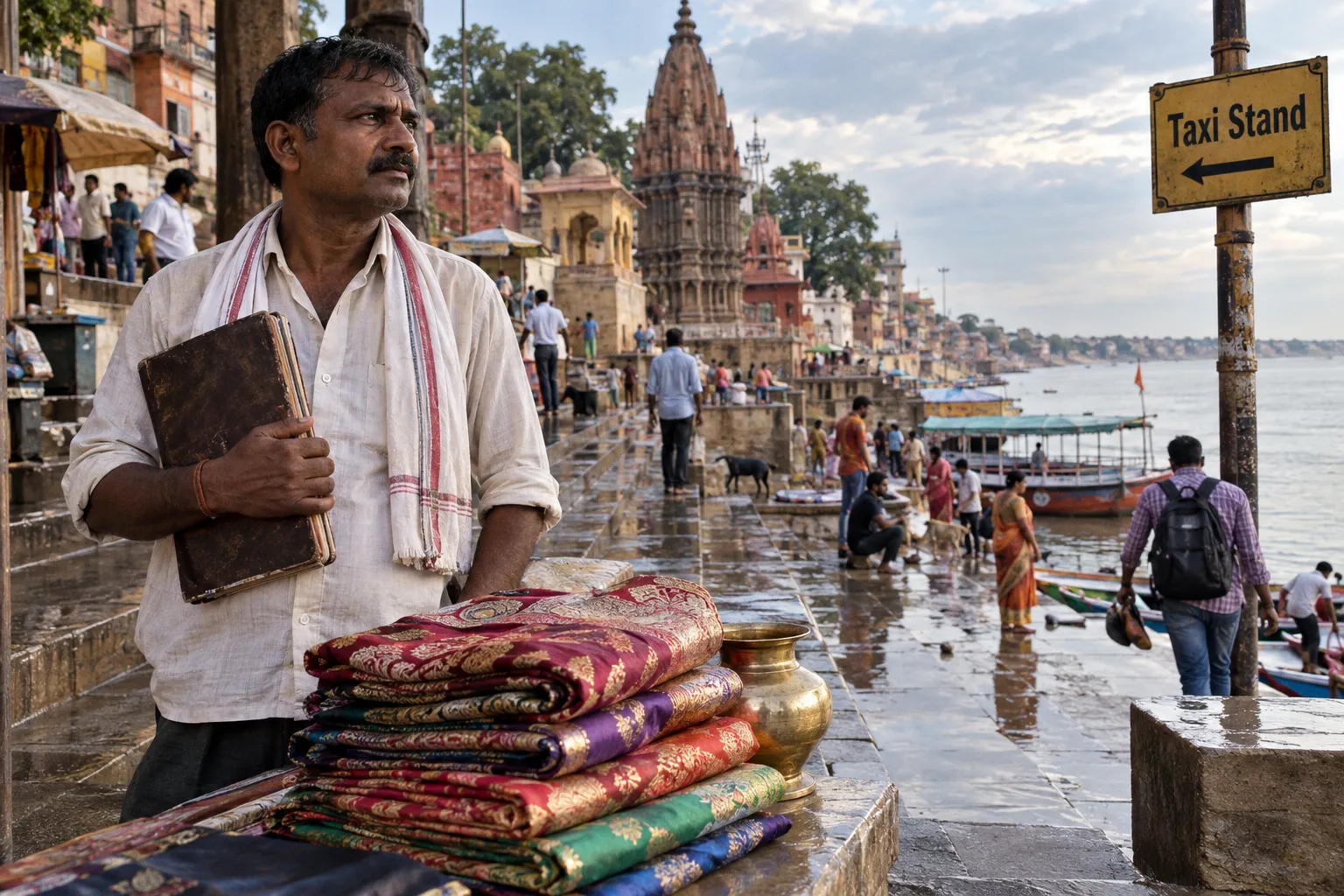
Road congestion, the chosen drop-off point, and the restricted street network of the Old City can extend a taxi journey from roughly 40 minutes to 90 minutes.
The practical choice is between a private vehicle and a public bus connection to Cantonment, usually called Cantt station. A pre-booked sedan starts at approximately ₹899. Public buses cost about ₹20–₹50 and take around 1 hour 10 minutes to reach the city centre or Cantt area. Neither option delivers passengers directly to the riverfront ghats by road. The final section must be completed on foot or by a short local transfer.
The spatial problem: a 30-kilometre airport transfer
The airport is located near Babatpur, northwest of the urban core. Varanasi’s principal arrival points are distributed across several different areas:
- Cantt station: the main railway and bus interchange on the western side of the central city.
- Godowlia: a major access point for the Old City and the route toward Dashashwamedh Ghat.
- The ghats: a continuous riverfront zone connected to the old neighbourhoods by narrow lanes.
- The eastern and southern districts: areas reached by bridges and arterial roads rather than by the direct airport corridor.
This spatial layout makes the phrase “Varanasi city centre” imprecise. A taxi reaching Cantt station has not completed the same journey as a taxi reaching Godowlia. A vehicle stopping near Godowlia has still not reached the riverbank. The last approach to the ghats is controlled by the physical limits of the Old City: narrow lanes, pedestrian movement, and restrictions on regular motor traffic.
For this reason, airport transit should be planned in two stages:
1. Airport to an urban drop-off point.
2. Drop-off point to the hotel, ghat, or neighbourhood on foot or by a short local ride.
The first stage is measured in kilometres and road time. The second is governed by access. These are different infrastructure problems.
The airport transfer ends at an access point, not necessarily at the hotel door. In the Old City, the final 500 metres can require more route planning than the preceding 25 kilometres.
A traveller going to a hotel near Cantt may have a direct vehicle journey. A traveller going to a guesthouse in the lanes behind Godowlia should expect the driver to stop at a permitted road near the pedestrian network. The hotel’s own directions are more useful than a generic destination label such as “Varanasi centre.”
Taxi versus public bus: the basic comparison
The main Varanasi airport connectivity options can be compared by four variables: cost, travel time, luggage handling, and final-mile access.
| Parameter | Pre-booked taxi or app-based ride | Public bus to city centre or Cantt |
|---|---|---|
| Indicative fare | Sedan rates start around ₹899; larger vehicles cost more | Approximately ₹20–₹50 |
| Typical journey time | About 40–90 minutes, depending on traffic and destination | Approximately 1 hour 10 minutes |
| Arrival point | Destination selected in the booking, subject to road access | City centre or Cantt station area |
| Luggage | Suitable for normal checked luggage; capacity depends on vehicle | Less predictable for large luggage, especially at busy times |
| Group travel | Efficient when several passengers share one vehicle | Low individual cost but less control over seating and timing |
| Old City access | Cannot normally enter narrow pedestrian lanes or reach the riverbank directly | Does not provide direct ghat access |
| Price certainty | Pre-booked services provide an indicative quoted rate; app rides show upfront pricing | Low fare, but the onward connection must be arranged separately |
| Main limitation | Road congestion and restricted final access | Limited schedule information and an additional transfer after arrival |
A taxi is not automatically the fastest option. Its advantage is control over the route and the ability to stop at a useful urban edge. During severe congestion, however, a private car is still using the same road network as other traffic. The fare buys flexibility, not immunity from the city’s bottlenecks.
A public bus is not simply a cheaper version of the same journey. It is a different chain of movement. The bus links the airport with the wider transport system, particularly the Cantt area. From there, the traveller must select another route to Godowlia, the hotel district, or the Old City.
Pre-booked taxi and app-based ride realities
Pre-booked airport taxis remain the most legible option for visitors carrying luggage or arriving after a long flight. Standard sedan fares from Lal Bahadur Shastri Airport to city destinations start at approximately ₹899. The quoted amount should be treated as an indicative base fare rather than a universal tariff. Vehicle category, destination, traffic conditions, and booking conditions can alter the final price.
App-based services such as Uber also operate from the airport. Their principal advantage is price visibility at the time of booking. The passenger can enter the destination and see an upfront quotation before confirming the ride. That does not remove the need to identify the correct airport pick-up point or to confirm where the vehicle can stop inside the Old City.
A private transfer is most useful in three situations:
- The destination is outside the Cantt area and requires a direct road connection.
- The group has luggage that would be inconvenient on a bus and through multiple interchanges.
- The traveller needs a controlled arrival at a hotel with a known road-access point.
The route should be specified by destination zone rather than by a broad city name. “Godowlia,” “Cantt station,” and a hotel’s nearest accessible road are operationally different instructions. A booking that lists only “Varanasi city centre” leaves the driver and passenger to resolve the final location after departure.
How long does the taxi journey take?
The available travel range is approximately 40–90 minutes. The lower figure is possible when traffic is moving and the destination lies on a relatively accessible road. The upper figure is more relevant when the journey coincides with congestion, a busy arrival period, or a drop-off near the Old City.
The route is affected by more than distance. Varanasi’s road system contains a contrast between newer corridors and older, compressed urban fabric. The airport approach can be relatively direct. The final movement toward Godowlia becomes less predictable as traffic volume increases and the road network approaches the historic core.
A traveller should therefore avoid scheduling a tightly timed connection immediately after landing. The airport transfer is not a fixed-duration rail journey. A stated duration of 40–90 minutes describes the road variability; it is not a promise that the vehicle will arrive at the ghat entrance within that window.
Public bus connectivity to Cantt station
The public bus is the lowest-cost airport transit option documented for the route. Varanasi City Transport Service Ltd. operates services connecting Lal Bahadur Shastri Airport with the city centre and Cantt railway station. Fares are approximately ₹20–₹50. The journey takes around 1 hour 10 minutes.
For a solo traveller with limited luggage, this is a rational connection. The price difference between a bus fare and a private sedan is substantial. The bus also provides a direct link into the established transport network rather than requiring a separate airport transfer booking.
Its weakness is not cost or the basic route. It is the uncertainty of the final connection. The available information does not establish a fixed, continuously repeating timetable from the terminal entrance. Services and boarding points can change. Major boarding activity may occur near Babatpur crossing rather than directly at the terminal in the manner expected by visitors accustomed to airport rail links or dedicated shuttle systems.
The public bus is therefore better understood as a low-cost city connection, not as a fully integrated hotel shuttle.
The Cantt interchange
Cantt station is an important orientation point because it sits outside the narrowest section of the Old City. It connects the airport route with railway services, local roads, and onward urban transport. It is not, however, a substitute for the final destination.
From Cantt, the traveller may still need to reach:
- Godowlia and the southern approach to the central ghat area.
- A hotel in the Cantonment or Sigra districts.
- A guesthouse located inside the old lane network.
- A riverfront destination whose nearest vehicle-accessible road lies away from the actual ghat.
The bus can reduce the cost of the airport-to-city leg. It does not eliminate the need for a map-based decision after arrival. Passengers carrying large cases should account for the physical effort of transferring at Cantt and then walking through streets where vehicles may not be able to stop near the accommodation.
The public bus solves the airport-to-city problem. It does not solve the Cantt-to-ghat problem.
Real-time bus frequencies should be confirmed locally on the day of travel. The absence of a stable published frequency in the available information is itself a planning factor. A traveller who arrives without a time constraint can tolerate this uncertainty. A traveller meeting a guide, joining a fixed ceremony, or checking into a hotel after midnight may prefer a pre-booked vehicle.
Vehicle capacity: when a sedan is not enough
The standard sedan is suitable for one or two passengers with ordinary luggage. It becomes less efficient when the group includes several people, oversized bags, or equipment. Larger pre-booked vehicles are available at indicative rates:
- Sedan, such as a Dzire or Etios: from around ₹899.
- Ertiga, with capacity for up to seven passengers: around ₹1,299.
- Innova, with capacity for up to six passengers: around ₹1,500.
- Tempo Traveller, with capacity for up to 17 passengers: around ₹2,500.
These figures are indicative quotations from airport transfer information and should not be treated as fixed prices for every date or operating condition. Peak travel periods, late-night arrangements, and vehicle availability may affect the final booking.
Vehicle capacity also has a spatial dimension. A vehicle advertised for seven passengers may carry that number of people but not seven passengers with full-size luggage in equal comfort. The same applies to larger vans. The relevant calculation is not the seat count alone. It is the combination of passengers, baggage volume, and the distance between the road drop-off and the accommodation.
For group arrivals, a larger vehicle is generally more efficient than booking several sedans. It also simplifies coordination at the airport. The trade-off is manoeuvrability. Larger vehicles require more room at the destination and may need to stop farther from a narrow lane entrance.
Travelling from the airport to Godowlia
Godowlia is a useful destination label for travellers heading toward the central Old City, but it should not be confused with a hotel-specific drop-off. The area functions as an approach to the ghat district and the historic lanes. It is a road-access point, not a guarantee of direct access to the riverfront.
A taxi driver may be able to stop near a suitable entrance to the pedestrian network. The exact point depends on local traffic controls, congestion, and the accommodation’s location. Hotels and guesthouses in the old lanes often provide their own instructions because the shortest map route may not be the usable route for a car.
The practical sequence is:
1. Enter the accommodation’s full name and location before booking the ride.
2. Ask for the nearest road-accessible drop-off point.
3. Keep the property’s walking directions available offline.
4. Expect the driver to stop outside the narrowest lane network.
5. Move the final distance with manageable luggage rather than assuming a vehicle can reach the ghat.
This is particularly relevant for travellers who describe their destination as “near the ghats.” The ghats are not a single road address. They form a long riverfront sequence, and each ghat has a different approach through the urban fabric.
Why vehicles cannot reach the riverfront directly
The Old City has developed through a dense network of lanes rather than a modern street grid. The road hierarchy changes as the route approaches the river. Main roads give way to narrower streets, then to pedestrian passages and steps leading down toward the water.
This creates a hard limit on airport transfers. A taxi can bring passengers close to the relevant neighbourhood, but it cannot be presented as a direct ghat drop-off service. The final approach may involve walking, a handcart, or a short local transfer arranged near the accessible road.
The limitation is not a minor inconvenience. It affects arrival time, luggage selection, and the choice between a private car and a bus. A traveller with a single small bag can absorb the final walk. A family with multiple suitcases may prefer a hotel outside the deepest lane network, even if the room is farther from the river by map distance.
Choosing the best way to reach Varanasi city from the airport
The best airport transfer depends on the destination and the passenger’s tolerance for uncertainty. A universal ranking is not useful because the city’s spatial layout creates different requirements for different arrivals.
Choose a pre-booked taxi when:
- The destination is a hotel outside the immediate Cantt area.
- The group includes several passengers or substantial luggage.
- The arrival time is fixed and the traveller cannot wait for an uncertain bus connection.
- The accommodation has supplied a specific vehicle-accessible drop-off point.
- The traveller needs a direct road journey rather than an airport-to-interchange connection.
A pre-booked taxi is particularly appropriate for first-time arrivals staying near Godowlia or the southern Old City. It reduces the number of decisions at the airport. It does not remove the final walk, but it places the passenger closer to the correct urban edge.
Choose an app-based ride when:
- Upfront price visibility is more important than a fixed pre-arranged vehicle.
- Mobile data and app access are available after landing.
- The passenger is comfortable confirming the airport pick-up procedure.
- The destination can be described accurately in the booking.
The app is useful for price comparison, but the quoted amount should be read alongside the destination. A low fare to a broad area is not necessarily a complete transfer to the accommodation.
Choose the public bus when:
- The priority is minimum cost.
- The destination is near Cantt or has an easy onward connection.
- The traveller has limited luggage.
- The arrival schedule is flexible.
- The passenger is prepared to confirm the boarding point and manage the final transfer independently.
The bus is a sound transport choice for travellers who treat the journey as a connection into the city rather than a door-to-door service. It is less suitable for anyone expecting a dedicated airport shuttle with a simple, fixed timetable and a stop beside the hotel.
Planning around traffic and arrival conditions
Taxi journey times vary from approximately 40 to 90 minutes. That range should shape the rest of the itinerary. A flight landing at the airport does not translate into an immediate city arrival. Passengers must collect baggage, locate the vehicle or bus, leave the airport zone, cross the outer road network, and then reach a destination whose access may be restricted.
Three planning errors are common.
Treating the distance as the travel time
The airport is only 22–30 km from the city centre and ghats, but the distance does not predict the arrival time with precision. Urban traffic is the controlling variable. The final approach to the historic core can be slower than the open section of the airport road.
Using “the ghats” as a complete address
A ghat name, a hotel name, and a road-access point are not interchangeable. The accommodation should be identified before the vehicle is booked. If the property lies inside a pedestrian lane, the driver needs a practical stopping location rather than a riverfront landmark.
Assuming the bus operates like an airport express service
The public bus connects the airport with Cantt and the city centre at a low fare. Available information does not confirm a fixed frequency that can be relied on without local verification. The boarding location and current service pattern should be checked after arrival.
These are basic planning distinctions, but they determine whether the transfer is straightforward or unnecessarily difficult. Varanasi’s airport infrastructure is not isolated from the city’s historical structure. The arrival route moves from a modern terminal environment into a metropolitan road system and then, for many visitors, into a historic pedestrian network.
A route decision by passenger type
The following model is more reliable than choosing solely by price.
| Passenger profile | More suitable option | Reason |
|---|---|---|
| Solo traveller with one small bag and flexible timing | Public bus | Lowest fare and acceptable journey time to Cantt |
| Couple with luggage staying near Cantt or Sigra | Taxi or app-based ride | Direct route and easier hotel access |
| Family with several bags | Pre-booked larger vehicle | Fewer interchanges and better luggage control |
| Group of six to seven passengers | Ertiga or Innova | Shared vehicle cost and coordinated arrival |
| Large group | Tempo Traveller | One vehicle and simplified airport departure |
| Traveller staying deep inside the Old City | Taxi to a confirmed access point | The vehicle cannot reach the narrowest lanes, but it can reduce the final walk |
| Passenger with a fixed evening appointment | Pre-booked taxi | Greater control over departure and destination |
| Budget traveller with no strict arrival deadline | Public bus | Low cost outweighs the additional transfer |
The table does not establish that one mode is always superior. It shows where the infrastructure favours each option. The bus is strongest on price. The taxi is strongest on route control. Neither mode changes the physical constraints of the Old City.
Current infrastructure and the limits of connectivity
Lal Bahadur Shastri Airport’s connection with Varanasi is an example of a wider urban pattern. The airport lies outside the historic core, while the main visitor destinations remain embedded in a dense, older settlement. Improving airport connectivity therefore requires more than expanding the road between Babatpur and central Varanasi.
The decisive points are the interchanges:
- How clearly passengers can move from the terminal to a bus or taxi.
- How reliably the service reaches Cantt and the city centre.
- How easily travellers can transfer from Cantt to the Old City.
- How accurately hotels communicate their vehicle-accessible entrances.
- How pedestrian movement is managed near Godowlia and the ghat approaches.
The airport-to-city road is only one layer of the system. The final-mile connection is governed by conservation, traffic control, and the survival of the historic lane structure. Any improvement that ignores this spatial reality will produce a faster arrival at the edge of the problem rather than a complete route to the destination.
For current travel, the operational answer remains clear. The public bus offers an inexpensive connection to Cantt in approximately 1 hour 10 minutes, subject to service conditions. A private sedan offers more control, with indicative fares from around ₹899 and a road journey of approximately 40–90 minutes. Larger groups should select the vehicle by passenger and luggage volume rather than by seat count alone.
The preservation challenge is equally clear. Varanasi must improve airport connectivity without treating the Old City as an ordinary road corridor. The historic core cannot absorb unrestricted vehicle access without damaging the very urban structure that draws visitors. The effective solution is not a taxi reaching every ghat. It is a coordinated transfer system that brings passengers to the correct access point, makes the final walk legible, and protects the narrow streets from unnecessary traffic.