Birla Temple BHU: walking route and visitor access guide
The Birla Temple at Banaras Hindu University is easy to miss if you treat it as a quick stop beside the main road.
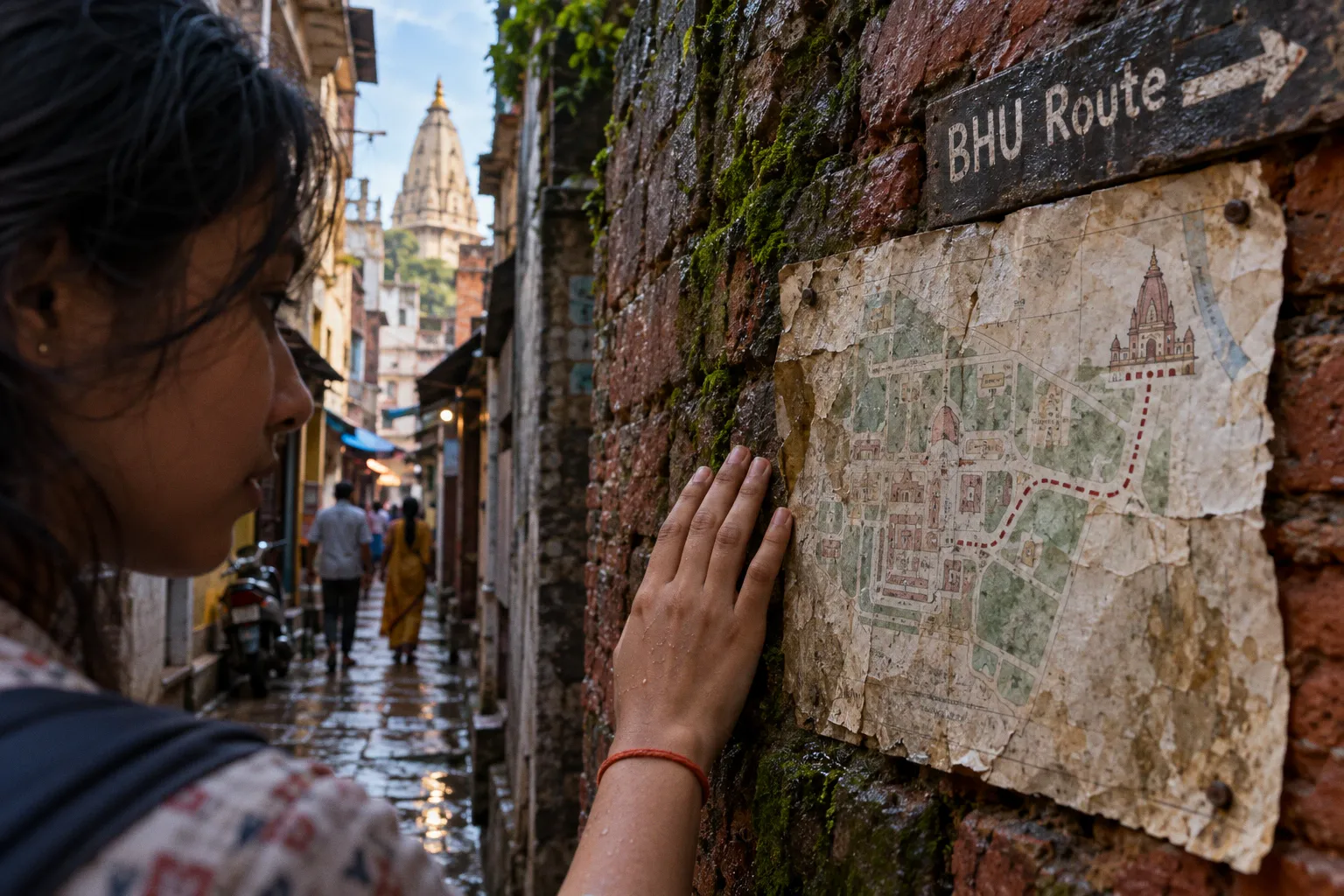
The New Vishwanath Temple, often called Birla Temple or simply VT by local visitors, stands inside the BHU campus, approximately 1.7 kilometres from the university’s Lanka Gate entrance. That distance is manageable on foot, but the visit becomes much smoother when you understand the campus as part of the route rather than as a space to cross hurriedly.
The temple is also frequently misunderstood as a smaller replica of Kashi Vishwanath with restricted access. Its significance is different. Conceived by BHU founder Pandit Madan Mohan Malaviya and financed by the Birla family, it was created as an open devotional and educational space, welcoming people of all castes and faiths without an entry fee. To visit well is therefore not simply to reach a shrine, but to observe the relationship between university life, public worship, architecture, and the wider religious lineage of Kashi.
Navigating the BHU Campus: the 1.7 km route to the temple
For most visitors, the clearest approach begins at Lanka Gate, the prominent entrance associated with BHU. From there, the New Vishwanath Temple lies roughly 1.7 kilometres inside the campus. The walk is not a pilgrimage route in the formal sense, and it does not require a ritual preparation before you enter the university grounds, but it does create a gradual change in atmosphere: the dense movement of Lanka gives way to a broad academic campus, and the temple’s white marble structure appears within that more spacious setting.
The simplest way to think about the Birla Temple BHU campus walking route is as a direct walk from the main gate toward the central university area, following campus signs and asking for the New Vishwanath Temple, Birla Temple, or VT. These names are used interchangeably in ordinary conversation. If you rely on a map application, search for more than one name because different map listings may emphasise either “New Vishwanath Temple” or “Birla Temple.”
A visitor walking from Lanka Gate should allow time for the route itself rather than treating the 1.7 kilometres as a precise arrival guarantee. Campus conditions can affect the pace: heat, pedestrian traffic, university activity, and the need to pause for directions all matter, particularly if you are carrying bags or arriving during the warmer part of the day. The route is short enough for many travellers to walk comfortably, but a cycle rickshaw or auto-rickshaw may be preferable for visitors with limited mobility, older travellers, or anyone making the journey in strong afternoon heat.
The practical sequence is straightforward:
1. Reach Lanka Gate, the main reference point for the visit and the most recognisable entrance to BHU.
2. Enter the campus and confirm the temple direction with a guard, student, or nearby campus worker if signage is not immediately clear.
3. Follow the internal campus road toward the New Vishwanath Temple, keeping the temple’s alternative names in mind when asking for directions.
4. Approach the temple complex respectfully, reducing noise and preparing to leave footwear and other belongings according to the arrangements in place at the entrance.
5. Check the current opening session before beginning the walk back, since the temple operates in separate morning and afternoon-evening periods rather than remaining continuously open throughout the day.
The campus itself is not a tourist monument in the narrow sense. It is a functioning university, and that distinction shapes the etiquette of the walk. Students, staff, residents, service workers, and worshippers share the same roads. Do not assume that every person you see is part of the temple visit, and avoid turning ordinary university activity into an unsolicited photographic subject.
The 1.7-kilometre walk is part of the visit’s orientation: you are moving from the public threshold of Lanka into a university space where worship and learning have been deliberately placed together.
Timing the walk
The best time to visit Birla Temple in Varanasi depends on what you want from the observance. Early morning generally offers a quieter and more temperate walk, while the evening session may suit visitors who have spent the day exploring the ghats and old city. The middle of the day is less comfortable in hot weather, especially when the temple closes between its two daily sessions.
Published schedules commonly describe seasonal timings along these lines:
| Season | Morning session | Afternoon-evening session |
|---|---|---|
| Summer | Approximately 4:00 AM–1:00 PM | Approximately 2:00 PM–9:00 PM |
| Winter | Approximately 5:00 AM–12:00 PM | Approximately 1:00 PM–8:00 PM |
These hours should be treated as a planning guide rather than an unchanging promise. Temple schedules can be adjusted for festivals, special observances, maintenance, or local administrative decisions. If you are making the walk specifically for darshan—the respectful viewing or presence before a deity—confirm the same-day opening hours locally before setting out.
For many visitors, an early morning arrival is the most balanced choice. It avoids the sharper heat, gives you more time to read the inscriptions inside, and allows the temple visit to remain contemplative rather than compressed between other appointments. An evening visit has its own significance, particularly when worshippers gather after the day’s work, but it requires closer attention to the closing time and your return journey through the campus.
Why the temple matters: architecture and the 35-year construction legacy
The New Vishwanath Temple belongs to the modern history of Banaras, even though its design consciously participates in an older sacred vocabulary. Its foundation work began in 1931, and construction was completed in 1966 after 35 years of work. That long period is not a decorative detail. It places the temple within the institutional and national history of BHU, an environment in which education, cultural revival, religious practice, and public access were being brought into deliberate conversation.
Pandit Madan Mohan Malaviya conceived the temple, while the Birla family provided the financial support for its construction. This lineage matters when reading the building. It was not established as a private family shrine or as a small neighbourhood temple. Its location within the university and its open access policy reflect a broader ambition: to create a place where devotion and learning could meet, and where the symbolic presence of Shiva would be available to a wide public.
The temple’s most immediate architectural feature is its tall white-marble shikhara. A shikhara is the rising tower above the sanctum, the vertical form that signals the sacred centre of a Hindu temple. At Birla Temple, the principal tower is approximately 250 feet, or 77 metres, high. Its height makes the structure visible across parts of the surrounding campus and gives the building a strong vertical presence even before you reach the entrance.
The white marble also changes how the temple is experienced during the day. In bright light, the surfaces can appear almost severe in their clarity; at quieter hours, the building’s proportions and carved details become easier to read. Visitors often arrive expecting the dense sensory layering of the old city’s shrine lanes and are surprised by the temple’s spaciousness. That difference is not a failure of authenticity. It reflects another form of sacred organisation—one shaped by a university campus rather than by the compressed urban fabric around the Vishwanath shrine in the old city.
Reading the structure without reducing it to a replica
Calling the building the “New Vishwanath Temple” connects it symbolically to the older Kashi Vishwanath tradition, but the two sites should not be treated as interchangeable stops. Kashi Vishwanath is part of the concentrated sacred geography of the old city and the Ganga ghats. The BHU temple offers a more expansive, institutional setting in which the worship of Shiva is presented alongside several other shrines and an extensive textual programme.
That distinction is useful for visitors planning a sacred-temple itinerary in Varanasi. If your purpose is to understand the city’s ritual geography, Birla Temple should be read alongside—not substituted for—the old Vishwanath shrine, Kal Bhairav Temple, Sankat Mochan Hanuman Temple, and the many smaller Shiva temples embedded in neighbourhood life. Each carries a different lineage, rhythm of worship, and social setting.
Inside the complex: nine shrines and the Bhagavad Gita inscriptions
The main shrine on the ground floor is dedicated to Shiva through the presence of a lingam, the aniconic form through which Shiva is worshipped. A lingam is not merely an object placed in a room; within the observance of puja, it is the focus of offerings, attention, and darshan. Visitors who are unfamiliar with the form should not feel obliged to imitate gestures they do not understand. Quiet observation, a respectful distance, and awareness of the worshippers around you are sufficient.
The complex also contains nine secondary shrines dedicated to deities including:
- Durga
- Lakshmi Narayan
- Parvati
- Ganesha
- Hanuman
- Saraswati
- Nataraj
- Nandi
The presence of these shrines gives the temple a wider devotional frame. Shiva remains central, but the complex does not ask visitors to encounter him in isolation. The accompanying deities express different aspects of divine presence and religious practice: protection, prosperity, wisdom, devotion, household continuity, and the cosmic dance associated with Nataraj, the dancing form of Shiva. Nandi, the bull traditionally associated with Shiva, also holds a particular significance in the visual and ritual arrangement of a Shiva shrine.
The temple’s educational character becomes especially clear in the inscriptions on its inner walls. The complete text of the Bhagavad Gita, together with scriptural excerpts and illustrations, is inscribed throughout the interior. The Bhagavad Gita is a Sanskrit philosophical dialogue presented within the Mahabharata, and its significance in the temple is not limited to private reading. Here, the text becomes part of the architecture itself.
You do not need to read Sanskrit to appreciate this arrangement. Look at how the written word is given physical space, and how a visitor moves through a building that functions simultaneously as shrine, memorial, and teaching environment. The inscriptions invite a slower form of attention than a quick photograph or a single glance at the central image. If you can, leave enough time to walk through the interior without blocking worshippers who are making their own observance.
Photography inside the interior shrine is strictly prohibited. This rule should be followed without negotiation. The prohibition protects the atmosphere of worship and keeps the sanctuary from becoming a viewing platform shaped primarily by cameras and phones. If photography is permitted in any exterior area at the time of your visit, follow the instructions given on site and never assume that permission outside extends into the shrine rooms.
Visitor access and entry policies at New Vishwanath Temple
One of the most important facts for first-time visitors is that entry to the Birla Temple complex is free. There is no paid darshan ticket, and the temple was established as a place open to people of all religions, creeds, and castes. This openness is part of the temple’s institutional significance and should be understood accurately: you are welcome to enter, but welcome does not remove the responsibilities of conduct that accompany a sacred space.
For tourists, access is usually uncomplicated when approached with patience. The more common difficulties are practical rather than administrative: arriving during the midday closure, carrying items that cannot be taken into the shrine, or assuming that the temple can be visited in the same hurried manner as a roadside monument. Schedules and local arrangements may change, so allow flexibility.
Before leaving for the temple, it is sensible to plan around the following points:
- Check the day’s session. The temple generally opens in a morning period and an afternoon-evening period, with a closure between them.
- Dress for a place of worship. Comfortable, modest clothing is the most respectful choice and also makes the walk through the campus easier.
- Carry only what you need. Temple entrances may have arrangements regarding footwear, bags, or other belongings, and rules can be applied differently during busy periods.
- Keep your phone away inside the sanctuary. Photography is prohibited in the interior shrine, and a silent phone helps preserve the atmosphere for everyone.
- Allow time for walking back. If you visit during the later session, do not leave the return journey until the last few minutes before closing or after campus activity has thinned.
- Ask rather than assume. If you are uncertain about where to stand, how to move through the shrine, or whether an exterior photograph is acceptable, ask an attendant quietly.
The word darshan is often translated as seeing, but that translation does not capture its full significance. In Hindu practice, darshan describes a reciprocal encounter between worshipper and deity: the visitor comes to see and be seen. You do not need to reproduce a particular ritual form to participate respectfully, yet you should understand that the space is not arranged primarily for sightseeing. People may be praying for health, mourning a loss, giving thanks, or maintaining a family observance that has its own lineage and emotional weight.
Etiquette for a respectful visit
The etiquette at Birla Temple is not complicated, but it is meaningful. Begin by recognising that visitors arrive with different levels of religious familiarity. Some may be making a formal offering; others may be accompanying family members; others may be entering simply to observe the architecture. None of these positions gives a visitor permission to interrupt another person’s observance.
Move with the direction of the space rather than stopping abruptly in the centre of a passage. If worshippers are offering prayers, give them room. Avoid touching sacred objects, railings, images, or offerings unless an attendant or a customary arrangement clearly invites it. Do not place personal objects near a shrine simply because you have seen someone else do so; ritual actions belong to particular contexts and are not always transferable from one visitor to another.
The most respectful behaviour is often understated:
1. Lower your voice before entering the shrine area. The temple is open to visitors, but it remains an active place of worship.
2. Follow the movement of the queue or the people around you. Do not push forward for a better view of the lingam or another deity.
3. Keep photography outside the interior sanctuary. The prohibition is part of the temple’s visitor etiquette, not an optional suggestion.
4. Observe offerings without handling them. Flowers, water, food, and other materials may have ritual significance that is not visible to an outsider.
5. Make space for elderly worshippers and families. A busy shrine works best when visitors understand that access is shared.
6. Do not turn the campus into a backdrop. BHU is a living academic institution, and the people moving through it are not scenery for a travel photograph.
It is also worth resisting the temptation to compare the temple with a familiar religious building in a way that flattens its meaning. The New Vishwanath Temple combines a modern institutional history, a Shiva-centred shrine, multiple devotional lineages, and an extensive textual programme. Its significance lies in that combination. You will understand more by asking how these elements work together than by deciding whether the temple feels “old” or “new.”
A practical route for combining the temple with the rest of your day
Birla Temple works well as a separate BHU visit rather than as an accidental stop squeezed between the ghats and the old city. The 1.7-kilometre walk from Lanka Gate is short, but traffic across Varanasi can make the approach and return less predictable than the distance suggests. If you are also visiting Sankat Mochan Hanuman Temple, the university area, or other southern Varanasi landmarks, grouping these stops may reduce unnecessary crossings of the city.
Set aside enough time for three distinct parts of the visit:
- the walk from Lanka Gate and orientation inside the campus;
- the temple’s shrine complex, inscriptions, and architecture;
- the return journey and any onward travel.
Visitors who arrive only for a photograph of the shikhara may finish quickly, but that approach misses the temple’s strongest feature: the way its design brings together worship and instruction. Visitors who stay too long without observing the closing session may instead find themselves rushing away. The useful middle path is to arrive in a suitable opening period, move attentively through the complex, and leave before your schedule becomes anxious.
The temple is particularly valuable for travellers who want to see how sacred space continues to be built and interpreted in modern Varanasi. Its foundation was laid in 1931, its construction lasted 35 years, and its location within BHU reflects an explicit relationship between education and religious culture. That is a different historical register from the ancient lanes, but it is no less part of Kashi’s living heritage.
The practical takeaway
To visit Birla Temple BHU well, begin at Lanka Gate, plan for the approximately 1.7-kilometre walk inside the university, and confirm the current morning or afternoon-evening session before you set out. Entry is free and open to people of all faiths and castes, but the temple remains an active place of worship, not simply an architectural attraction.
Allow yourself time to understand the white-marble shikhara, the 35-year construction legacy, the nine subsidiary shrines, and the Bhagavad Gita inscriptions. Keep photography out of the interior shrine, follow local instructions, and let the people making their observance determine the pace of the space. When we approach the New Vishwanath Temple with that combination of curiosity and restraint, the visit becomes more than a walk across the BHU campus: it becomes an encounter with one of Kashi’s modern sacred institutions and the many forms of lineage it holds together.