Baba Kinaram Sthal: a guide to the historic Aghori seat
Baba Kinaram Sthal is often approached with a misunderstanding already in place: that an Aghori shrine must be visited as a spectacle, a place where outsiders come to confirm dramatic stories about cremation grounds, transgression, or occult practice.
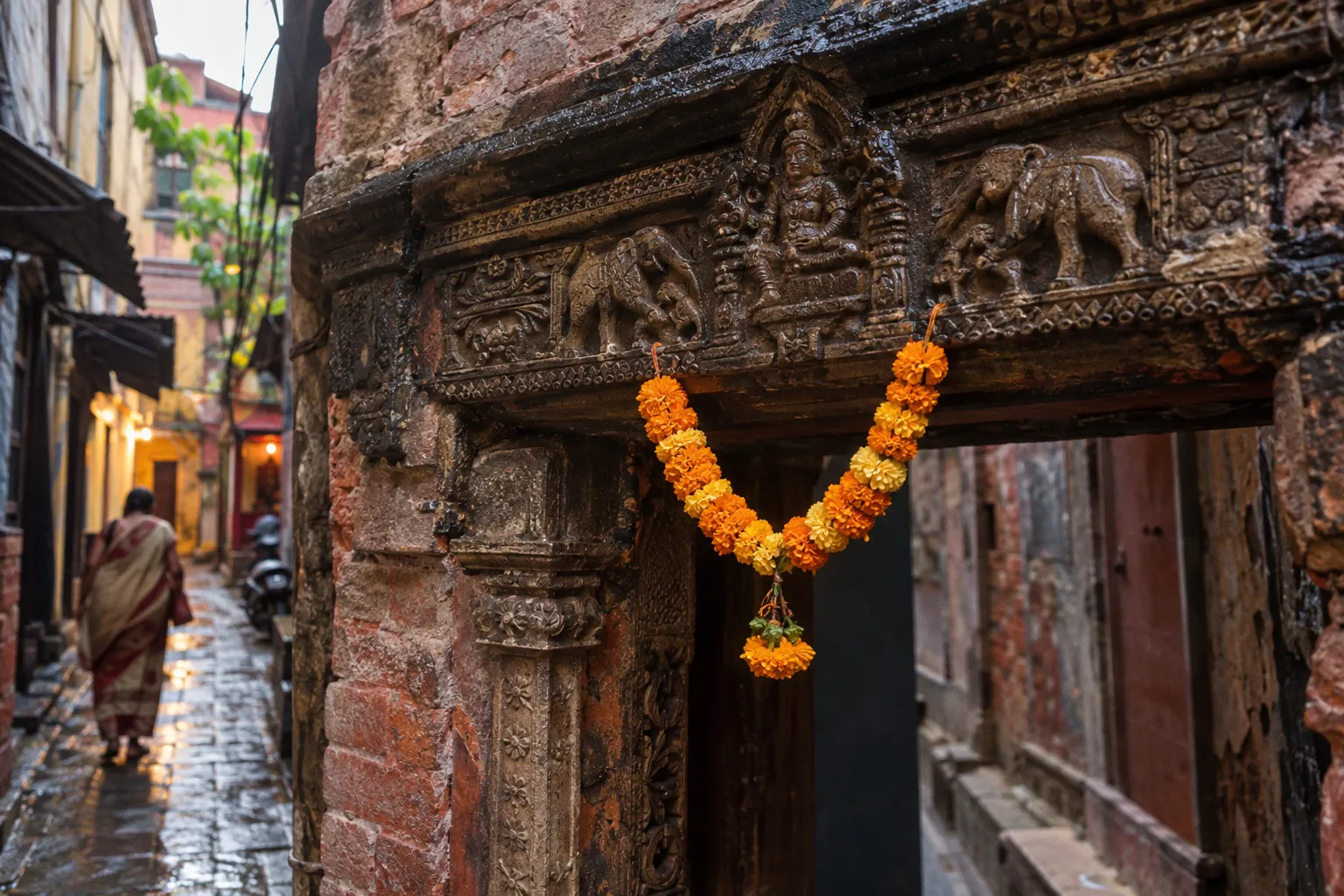
The Ravindrapuri sanctuary asks for a different kind of attention. It is a living centre of Aghor Shaivism, a place of lineage, discipline, remembrance, and service, where the sacred geography is held not only in buildings but also in the continuing observance of a spiritual tradition.
Known also as Baba Keenaram Sthal or Krim Kund, the complex stands in Anandbagh in Ravindrapuri, near the Bhelupura and Shivala areas of Varanasi. Its principal landmarks include the sacred Krim Kund water tank, the continuously maintained flame called Akhand Dhuni, and the samadhi of Baba Kinaram, together with the resting places of later Siddhas of the Aghor lineage. For a visitor, the significance of the site lies in learning how these elements belong together rather than treating them as isolated attractions.
A respectful Baba Kinaram Sthal pilgrimage route and visitor access plan therefore begins with preparation: understanding the history, arriving with appropriate etiquette, and allowing the sanctuary to remain a place of observance rather than turning it into a theatrical stop on a city tour.
The spiritual legacy of Aghoracharya Baba Kinaram
Baba Kinaram is traditionally remembered as the founding figure associated with the modern lineage of Aghor at this sanctuary. He was born in 1601 CE on Aghor Chaturdashi, during the month of Bhadrapad, in Ramgarh village in the area that is now Chandauli district near Varanasi. His life and teachings are preserved through the institutions, texts, and succession of spiritual heads connected with Baba Kinaram Sthal.
The word Aghor is frequently misunderstood when it is separated from its philosophical setting. In Sanskrit, a-ghor can be understood as that which is not terrible or frightening, pointing toward a way of seeing beyond fear, aversion, and rigid divisions. This does not mean that every aspect of Aghor observance is intended for public display, nor does it reduce the tradition to a simple slogan. Rather, the term belongs to a disciplined Shaiva framework in which the practitioner works toward a condition free from hatred and exaggerated distinctions between the pure and impure, the acceptable and rejected.
That distinction matters when visiting. The sanctuary is not a museum of unusual customs, and the people connected with it should not be treated as objects of curiosity. Aghori tradition in Varanasi is part of a broader religious landscape that includes monastic lineages, household devotion, temple ritual, service, pilgrimage, and textual study. Baba Kinaram Sthal holds its own identity within that landscape, with its own inherited forms of practice and its own standards of conduct.
A lineage rather than a single historical personality
The word lineage refers here to more than a family succession. In a religious setting, it describes the transmission of teaching, authority, ritual responsibility, and ethical discipline from one spiritual guide to the next. Baba Kinaram Sthal preserves this continuity through the samadhi shrines of Baba Kinaram and later Siddhas, allowing visitors to see how memory is organized through place.
The current head of the sanctuary, Baba Siddharth Gautam Ram, has held that position since 1978. His role belongs to the living administration and spiritual continuity of the site, while the samadhi spaces connect present observance with the teachers who came before. These are not merely memorials in the secular sense. They form part of the sacred arrangement through which devotees acknowledge the presence and authority of the lineage.
When you enter a shrine associated with a living tradition, it is useful to ask not only what happened there in the past, but also what kind of relationship the community maintains with that past today. At Baba Kinaram Sthal, the answer is expressed through continued care of the sacred landmarks, the keeping of the Akhand Dhuni, and the preservation of teachings attributed to Baba Kinaram.
The central significance of Baba Kinaram Sthal is not its reputation for unusualness, but its continuity: a lineage still organized around place, observance, and responsibility.
Finding the sanctuary in Ravindrapuri
Baba Kinaram Sthal is located in Anandbagh, Ravindrapuri, within the wider Bhelupura–Shivala area of Varanasi. This places it in a part of the city where residential lanes, religious institutions, riverfront access, and older neighbourhoods meet. It is not situated in the same immediate temple cluster as Kashi Vishwanath, so it is better understood as one stop within a southern Varanasi itinerary rather than as an extension of the central Vishwanath Corridor visit.
For visitors exploring Ravindrapuri spiritual sites, the practical challenge is less about distance alone than about the character of movement through the neighbourhood. Varanasi’s lanes do not always produce a straightforward relationship between a map pin and the entrance you eventually find. Road conditions, traffic, construction, and the final approach on foot can affect the experience. A driver may bring you to the general area, after which the last section may require local orientation and walking.
Because standardized public visiting hours have not been reliably established in the available information, do not plan your day around an assumed opening and closing schedule. Ashram and shrine access can vary with daily observance, festival periods, maintenance, and the presence of ongoing religious activity. The most responsible approach is to confirm current access locally before setting out, especially if the sanctuary is the principal purpose of your visit.
There is also no verified basis for assuming a compulsory ticket or a special paid entry procedure. Many religious institutions are accessible without a conventional admission system, but that does not mean every part of the complex is automatically open to every visitor. A shrine may welcome darshan while limiting photography, conversation, or access to areas used for private observance.
What to expect from the setting
The sanctuary should be approached as an active religious institution rather than a curated monument. You may encounter devotees, attendants, students, residents of the associated institution, or visitors engaged in prayer. The pace may be quiet, but quietness should not be mistaken for an invitation to explore every space.
A useful way to orient yourself is to distinguish between:
| Element | What it represents for the visitor | Appropriate approach |
|---|---|---|
| Krim Kund | A sacred water tank central to the identity of the site | Observe respectfully and follow local instructions about proximity or ritual use |
| Akhand Dhuni | A continuously maintained holy flame associated with ongoing observance | Treat it as a living sacred focus, not a photographic installation |
| Samadhi of Baba Kinaram | A memorial and devotional centre connected with the founding teacher | Keep the visit quiet and allow worshippers precedence |
| Samadhi spaces of later Siddhas | The visible continuity of the Aghor lineage | Notice the succession and lineage rather than viewing the spaces as separate curiosities |
| Ashram and institutional areas | Places of teaching, residence, administration, or service | Enter only where visitors are clearly permitted |
This distinction also helps with photography. A camera can record the outline of a courtyard, but it cannot record the etiquette that makes the visit acceptable. Ask before photographing people, ritual activity, sacred flames, or restricted areas. If the answer is uncertain, the respectful choice is to put the camera away.
Krim Kund and the meaning of sacred water
Krim Kund is one of the defining features of Baba Kinaram Sthal. Its significance cannot be reduced to the physical presence of water. Across South Asian religious traditions, tanks, wells, rivers, and springs may serve as places of purification, remembrance, offering, initiation, or contact with a sacred lineage. Their meaning is formed by ritual use and inherited interpretation, not simply by appearance.
The name kund commonly refers to a sacred tank or reservoir, while the full significance of Krim Kund belongs to the history and teachings associated with this particular sanctuary. A visitor does not need to claim personal access to every layer of that tradition in order to behave appropriately. It is enough to recognize that the tank is not decorative architecture and not a public recreational feature.
If a local attendant or devotee explains a practice connected with the kund, listen carefully and follow that instruction without improvising. Do not touch the water, enter a restricted area, place objects at the edge, or conduct a private ritual simply because a similar action is familiar from another temple. Hindu pilgrimage sites often share visual forms while differing in their specific observances.
This is one of the places where the word etiquette becomes more than a matter of politeness. Religious etiquette is a way of acknowledging that the visitor has entered a social and sacred order that existed before the visit and will continue after it. We participate properly by noticing the limits of our role.
The Akhand Dhuni
The Akhand Dhuni is the continuously maintained holy flame of the complex. Akhand means unbroken or uninterrupted, while dhuni refers to a sacred fire or ascetic hearth. Together, the term describes a flame whose continuity is itself an act of observance.
The fire should be understood through care and succession. It is maintained over time by people who carry responsibility for the sanctuary, which means that its meaning is inseparable from labour: tending, protecting, feeding, and preserving. The flame is not simply a symbol placed in a room for visitors to interpret. It is part of the institution’s daily religious life.
For this reason, avoid leaning over the fire, attempting to add offerings without instruction, or positioning yourself in a way that obstructs worship. If photography is permitted, take it discreetly and without flash unless you have been told otherwise. A visitor’s desire for a clear image should never take priority over the observance taking place around the dhuni.
Baba Kinaram’s texts and the Aghor intellectual tradition
The history of Baba Kinaram Sthal is not preserved only through architecture and ritual. Baba Kinaram is associated with a body of writing that gives the lineage an intellectual and theological foundation. His named works include Viveksar, Ramgita, Ramrasal, and Unmuniram, with Viveksar regarded as the primary treatise on Aghor principles.
The title Viveksar can be approached through the Sanskrit idea of viveka, or discernment: the capacity to distinguish, understand, and see clearly. It would be misleading to treat the text as a tourist explanation of Aghor practice, because a religious work belongs to a larger tradition of instruction and interpretation. Yet its existence is important for correcting a common assumption that Aghor is defined only by outwardly unconventional behaviour.
Textual traditions demonstrate that religious lineages also develop through argument, teaching, reflection, memory, and disciplined language. The written works attributed to Baba Kinaram place his legacy within a field of thought. They invite questions about how the self is understood, how social aversion is confronted, how devotion is practiced, and how a spiritual teacher’s insight is transmitted to later generations.
Visitors will not necessarily encounter a public reading room or a simple exhibition that translates these works into modern travel language. That is not a deficiency. Some forms of knowledge remain embedded in monastic instruction and lineage-based study. We can respect that boundary while still recognizing that the sanctuary’s heritage is literary as well as ritual.
To understand the site fully, look beyond the dramatic image of the Aghori and toward the quieter structures of teaching, authorship, succession, and daily care.
How to visit with the right etiquette
A first visit becomes easier when you know what not to demand from the place. Baba Kinaram Sthal is not required to perform an identity for a visitor, and you are not required to understand every observance immediately. The appropriate posture is patient attention.
A few practical principles will help:
1. Dress for a religious institution. Choose clean, modest clothing that allows you to sit or walk comfortably while avoiding styles that may feel deliberately conspicuous in a shrine environment. The aim is not to imitate a renunciant or to create a costume, but to remove unnecessary distraction.
2. Observe before acting. Watch how devotees approach the kund, samadhi spaces, flame, and attendants. If you are unsure whether an action is permitted, wait and ask quietly rather than copying someone from a distance.
3. Keep the volume low. Conversations, phone calls, and social-media commentary can quickly change the atmosphere of a sacred space. Speak only as loudly as needed, and silence your phone before entering.
4. Request permission for photographs. This applies particularly to people, ritual activity, the Akhand Dhuni, and any interior space that appears associated with residence or worship. Permission from one person does not necessarily authorize photographing everyone present.
5. Do not sensationalize the Aghor tradition. Avoid asking residents or practitioners to reproduce stories learned from sensational media. Questions about the lineage, texts, history, or public service are more respectful than demands for spectacle.
6. Follow the sanctuary’s instructions over guidebook assumptions. A general rule from another temple may not apply here. Local directions take precedence because they reflect the current conditions of the site.
7. Leave offerings only through established channels. If you wish to contribute, ask an authorized attendant how donations or offerings are received. Do not place money, food, or objects randomly near a sacred landmark.
8. Allow worshippers to lead. If a devotee is praying at a samadhi or near the dhuni, give them space. Your visit can wait; their observance may be brief, personal, and not available for interruption.
These practices are modest, but they shape the entire quality of the visit. They also prevent a familiar problem in sacred tourism: the visitor arrives with the assumption that access is the same as entitlement.
Planning the pilgrimage route
The phrase “pilgrimage route” can suggest a fixed ceremonial path, but for most visitors it is more useful to think in terms of a respectful sequence through the southern sacred geography of Varanasi. Baba Kinaram Sthal can be combined with other landmarks in the wider Ravindrapuri, Bhelupura, and Shivala area, provided the day is not planned so tightly that each shrine becomes a rushed photograph.
Begin by identifying the sanctuary’s current access conditions. Then allow time for the journey to and from the site, including the possibility of walking during the final approach. If you are visiting several temples, place the institutions that require quiet attention earlier in the day rather than treating them as a late addition after a crowded sightseeing schedule.
A thoughtful route might include:
- arrival in the Ravindrapuri or Anandbagh area;
- time at Baba Kinaram Sthal without rushing through the kund, dhuni, and samadhi spaces;
- a pause for notes or reflection away from the immediate worship areas;
- continuation to other nearby sacred landmarks only if their access and your energy allow it;
- return before evening congestion or changing local conditions make movement difficult.
This is not a ceremonial prescription. It is simply a way to keep the visit proportionate to the significance of the place. If your wider interest is in spiritual heritage sites in Varanasi, you may later compare Baba Kinaram Sthal with the very different ritual environments of Kashi Vishwanath, Kal Bhairav, Sankat Mochan, or the monastic institutions of Kabir Chaura. Each site has its own lineage and etiquette; none should be used as a template for another.
What the site reveals about living heritage
Baba Kinaram Sthal belongs to a category of heritage that cannot be adequately described through age, architectural style, or a list of famous names. Its importance lies in the interaction between physical place and continuing practice. The tank matters because it remains part of a sacred environment. The dhuni matters because it is maintained. The samadhi spaces matter because the lineage continues to organize memory and authority around them.
This is why the sanctuary should not be placed in the same category as an abandoned ruin. A living religious institution changes according to the needs of its community, even while protecting inherited forms. Access may be adjusted. Areas may be used differently at different times. The visitor may see only a small portion of the activity that sustains the site.
The same principle applies to news and public discussion about Varanasi’s religious landmarks. Expansion, restoration, improved access, and tourism can bring attention and resources, but they can also alter how visitors understand sacred places. A corridor, a new road, or a more visible sign may make a shrine easier to locate without making its customs easier to interpret. Orientation is therefore only the beginning; respectful conduct still depends on listening.
Baba Kinaram Sthal offers a particularly clear lesson in this regard. Its public identity is inseparable from a tradition that has often been represented from the outside in exaggerated terms. The visitor’s responsibility is not to repeat those representations, but to encounter the site on its own terms: as a centre of Aghor Shaiva lineage, textual memory, ritual observance, and institutional continuity.
Final guidance for a respectful visit
The most reliable way to approach Baba Kinaram Sthal is to replace curiosity without context with curiosity shaped by care. Learn the basic history of Baba Kinaram, understand that Krim Kund and the Akhand Dhuni are active sacred landmarks, recognize the samadhi spaces as part of a continuing lineage, and accept that not every area or practice is arranged for public explanation.
Exact Baba Kinaram Sthal opening hours should be confirmed locally because standardized public timings are not clearly established, and access may depend on daily observance. Likewise, do not assume a compulsory entry fee or a guaranteed right to enter every part of the complex. Arrive with modest expectations, enough time, and a willingness to follow the instructions of those responsible for the sanctuary.
The practical takeaway is simple: visit as a guest in a living institution, not as a spectator at a cultural performance. When we allow the site’s own lineage, etiquette, and observance to guide us, Baba Kinaram Sthal becomes more than an unusual landmark on a Varanasi itinerary. It becomes what it has long been for its community—a place where spiritual memory is kept active through disciplined care.