Kal Bhairav Temple: essential preparation for your visit
Many visitors to Varanasi arrive at the Kal Bhairav Temple assuming it is simply another stop along their temple itinerary, a secondary shrine to tick off between the more famous ghats and the queue for Kashi Vishwanath.
What they often do not realise is that local tradition places this deity in a position of singular authority over the pilgrimage itself. Kal Bhairav is revered as the Kotwal of Kashi — literally the chief guardian of the holy city — and it is customary, even expected, for pilgrims to seek his blessing and permission before proceeding to the main Jyotirlinga darshan of Kashi Vishwanath. This is not folklore dressed up as suggestion; it is a living sequence that anyone wishing to follow the canonical order of worship in Varanasi is encouraged to observe.
The good news is that preparing for a respectful visit to the Kotwal's shrine is far more straightforward than newcomers sometimes fear. There is no entrance fee for basic darshan, the temple sits barely a kilometre from Kashi Vishwanath in the Visheshwarganj neighbourhood, and the etiquette in place is meant to honour a tradition rather than to test a visitor's familiarity with it. What follows is the practical framework we recommend for any traveller who wants to walk into that courtyard prepared — covering the role of the guardian, the temple's split daily schedule, the dress code that applies inside, the offerings that carry meaning, and the logistics of actually getting there from the railway station or the airport.
The Role of the Kotwal: Why Tradition Dictates a Pre-Vishwanath Visit
The single most useful thing to understand before your visit is that Kal Bhairav is not, in the local devotional hierarchy, simply one deity among many. He is the Kotwal — the chief guardian, the keeper of the city's threshold — and the lineage of that role stretches back through centuries of Shaivite tradition in Kashi. Visiting him first is part of how a pilgrim signals to themselves, and to the city, that they are approaching the darshan of Shiva at Kashi Vishwanath in the proper order. We find that visitors who absorb this single point tend to have a far more meaningful experience, because they arrive knowing what they are stepping into: an audience, of sorts, with the sentry.
In practice this means that if you intend to visit both temples on the same day, the local convention is to begin with Kal Bhairav in Visheshwarganj and then continue on foot toward Kashi Vishwanath. The two shrines are roughly a kilometre apart through the winding lanes, and walking between them is itself part of the rhythm of a traditional pilgrimage day. Even visitors who arrive at Kal Bhairav having already completed the Kashi Vishwanath darshan are welcome — the temple does not turn anyone away — but the canonical flow goes guardian first, Vishwanath second.
Visiting Kal Bhairav before Kashi Vishwanath is not a rule enforced at the gate — it is a centuries-old custom that frames your entire pilgrimage day.
One practical consequence of this ordering is worth noting: the morning hours at Kal Bhairav tend to draw a steady stream of devotees who are on their way to or from Kashi Vishwanath, so timing your arrival with that flow in mind can shape how crowded the sanctum feels when you step up. The main temple structure in its present form is generally dated to the seventeenth century, with renovations attributed in the eighteenth century to the Maratha ruler Rani Ahilyabai Holkar — a small piece of historical context that explains why the courtyard feels both lived-in and carefully maintained.
Navigating Temple Hours and Seasonal Access in Visheshwarganj
Kal Bhairav Temple operates on a split schedule that catches a number of first-time visitors off guard. The doors typically open in the early morning, around 5:00 AM, and remain accessible until roughly 1:30 PM. They then close for the afternoon and reopen in the late afternoon — usually around 4:30 PM during most of the year, though this opening time shifts forward to about 3:00 PM during the hotter summer months. The evening session generally runs until around 9:30 or 10:30 PM, depending on the day and the season.
The reason for the split is straightforward: it gives the priests and the space itself a midday pause that aligns with the older rhythms of temple life in this part of the city, and it also helps manage the long queue that forms during the most popular darshan windows. If you are planning your day around a Kashi Vishwanath visit, we find that arriving at Kal Bhairav within the first hour of the morning opening tends to give you the calmest experience and leaves the rest of the day open for the longer darshan queue at the main Jyotirlinga.
Crowd density is one area where we cannot give you a precise figure, because the variation between a quiet weekday morning and a festival afternoon is enormous. Margashirsha Ashtami — the eighth day following the full moon in the Margashirsha month — is one of the major annual observances associated with this temple, and you can expect that day and the days immediately around it to be substantially busier than average. Weekends, festival periods, and the early evening band during school holidays will also see heavier footfall. If your schedule allows any flexibility, a weekday morning is generally the most forgiving window for a relaxed visit.
Dress Code and Sanctum Etiquette for a Respectful Darshan
The temple asks for modest dress from every visitor, regardless of gender, and the rule is simple: shoulders and knees should be covered. Light cotton trousers or a long skirt paired with a shirt or kurta that covers the upper arms is appropriate. Saris and dupattas work well for those who have them. What the temple is gently asking you to avoid is shorts, short skirts, sleeveless tops, and any garment that leaves the shoulders bare — these are considered unsuitable for the sanctum space, and turning up in them usually means you will be turned away at the entrance or asked to cover up with something improvised.
Footwear is removed before entering the inner temple area. You will find a shoe-keeping area near the entrance, usually operated by attendants who expect a small payment in return for watching your footwear while you go inside. We recommend carrying small change for this — a few rupees is the customary amount, and it is a small price for the convenience of not having to carry your shoes through the crowded inner lanes.
Inside the sanctum, the etiquette is much the same as at any active Shaivite shrine in Varanasi: move slowly with the flow of pilgrims, avoid crossing in front of anyone who is in the act of praying or making an offering, and do not reach toward the deity or the draped structure. The Kal Bhairav idol is unique in one particular respect — only the silver-faced mask of the deity is visible through the doorway of the garba griha, while the rest of the figure is draped in cloth. This is the traditional form of the shrine, and it shapes the darshan into something more intimate and contained than the wide-open sanctum spaces of some larger temples. You will see the silver face, make your offering, and receive the priest's blessing.
Photography inside the inner sanctum is not permitted. It is fine in the outer courtyard and from the approach lanes, but once you step up to the garba griha doorway, the camera goes away. Most visitors find this a welcome pause rather than an inconvenience — a few moments of darshan without the mediation of a screen.
Traditional Offerings: Understanding the Significance of Oil and Threads
The little stalls that line the lane approaching the temple sell a fairly consistent set of items, and understanding what each one represents helps you make a more considered choice rather than simply buying whatever is pressed into your hands at the entrance.
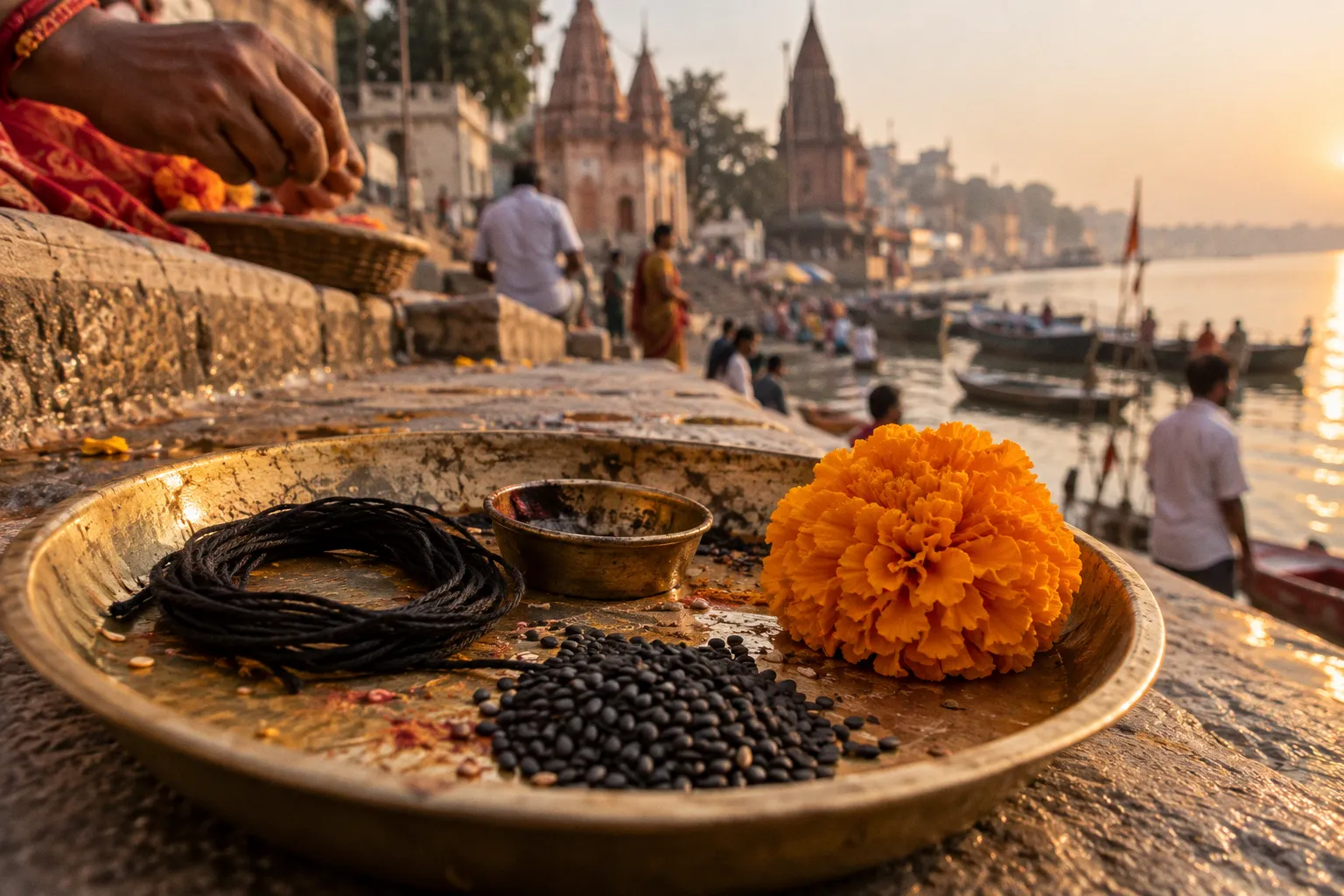
Mustard oil is one of the most common offerings, and it carries a specific significance: Kal Bhairav's name includes the element of fierceness, and the mustard seed, sharp and pungent, is associated in this tradition with protective power. Vermilion, or sindoor, is offered as a mark of devotion and is applied to the deity's mask by the priest on your behalf. Black sesame seeds carry their own lineage of significance in Shaivite ritual, generally linked to ancestral rites and to the warding off of inauspicious influences. Coconut is a standard offering across most Hindu traditions, symbolising the breaking of the ego. Marigold flowers are the typical floral offering in this part of India, chosen for their bright colour and their association with auspiciousness. And then there are the black protective threads — called ganda or mauli in different traditions — which are tied around the wrist after being blessed at the shrine, and which are traditionally worn until they wear through on their own.
| Offering | Ritual Significance | Practical Note |
|---|---|---|
| Mustard oil | Protective offering tied to the deity's fierce aspect | Sold in small sealed bottles outside the temple |
| Vermilion (sindoor) | Applied to the deity as a mark of devotion | Often offered through the priest at the sanctum |
| Black sesame seeds | Linked to ancestral rites and the dispelling of inauspicious influences | Typically small quantities, mixed with other offerings |
| Coconut | Symbolises the surrender of ego | Standard offering, easy to carry |
| Marigold flowers | Auspicious floral offering | Sold in small garlands just outside the entrance |
| Black protective thread (ganda) | Tied on the wrist after blessing | Worn until it naturally wears through |
None of these are strictly required for entry or for basic darshan — the temple itself is free to enter, and the act of darshan does not depend on any purchase. The offerings are a personal choice and a way of engaging more fully with the ritual tradition rather than a condition of being admitted. If you are unsure how much to buy, the smallest quantities are usually sufficient; the priests will guide you through the sequence once you are inside.
The temple's entrance is free; the offerings outside are a personal choice, not a condition of admission — buy what feels right, and do not let anyone pressure you into more than you intended.
One more note on the offerings: a small payment to the priest who assists you at the sanctum — sometimes called dakshina — is customary after the blessing. Again, small denominations are appropriate, and there is no fixed amount; what matters is the gesture rather than the figure.
Logistics and Transit: Reaching the Shrine from Varanasi Junction
Kal Bhairav Temple sits in the Visheshwarganj area of the old city, and its proximity to Kashi Vishwanath is part of what makes the canonical pilgrimage order easy to follow on foot. From the Kashi Vishwanath complex, the walk to Kal Bhairav is roughly a kilometre through the lanes of Visheshwarganj and Bharonath, and we recommend doing it on foot if you are reasonably steady on the narrow gullies — auto-rickshaws and e-rickshaws cannot easily penetrate the older parts of this neighbourhood, so walking is often the most practical option anyway.
From Varanasi Junction, the main railway station (also marked as Varanasi Cantt or BSB on some tickets), the distance is approximately 4 to 6 kilometres depending on which exit you emerge from and the specific routing through the city. A prepaid auto-rickshaw or a cycle-rickshaw will get you there in a reasonable window outside the busiest hours; during peak congestion, allow extra time. If you are coming from the cantonment area or from the ghats in the southern part of the city, expect the journey to take a little longer still.
For those arriving by air, Lal Bahadur Shastri International Airport at Babatpur is roughly 22 to 25 kilometres from the temple. The drive typically runs between three-quarters of an hour and an hour and a half, depending on traffic and the time of day. Prepaid taxi counters at the airport offer fixed-rate transfers into the city, and we recommend using one rather than negotiating with unmarked drivers outside the terminal.
A few practical notes on navigating the old city once you are close. The lanes around Visheshwarganj are narrow, busy, and easy to get disoriented in, particularly for first-time visitors who have not yet calibrated their sense of direction to the gridless layout of old Kashi. The temple itself is a known landmark, so asking for "Kal Bhairav" or "Bhairav Baba" will get you pointed in the right direction almost anywhere in the surrounding quarter. Mobile data coverage is generally good in this part of the city, so a maps application with offline capability is a sensible backup.
Closing Takeaway
Preparing for a visit to Kal Bhairav Temple is less about memorising a long list of rules and more about understanding the role the shrine plays in the broader pilgrimage ecology of Kashi. Once you grasp that Kal Bhairav is the Kotwal — the guardian whose permission traditionally precedes the darshan of Vishwanath — the rest of the preparation falls naturally into place. Dress modestly, arrive within the morning or evening window, walk if you are coming from Kashi Vishwanath, and bring a small selection of offerings only if you wish to engage more fully with the ritual. None of it is difficult, and the temple itself makes none of it a barrier to entry.
What we find most rewarding about this visit, and what we hope you will take away, is the way it reframes the rest of your day in Varanasi. Starting with the guardian rather than the main Jyotirlinga gives your pilgrimage a sequence, a narrative shape, and it sets a contemplative tone that tends to carry forward into the longer queue at Kashi Vishwanath. The Kotwal's role, after all, is to grant passage — and beginning with him is a quiet way of preparing yourself for everything that follows.