Kashi Vishwanath Temple darshan: essential documents and rules
Kashi Vishwanath darshan is not always a simple walk-in visit. The temple receives devotees through several routes: ordinary entry, paid darshan, aarti bookings, ritual services, and dedicated access for local residents.
Each route has its own documents, reporting time, and security procedure. Arriving without the right ticket or identification can mean leaving the queue to find a helpdesk, returning to a hotel, or missing the reporting window altogether.
For anyone researching kashi vishwanath temple darshan booking requirements, the central rule is straightforward: prepare the documents before you enter the temple area. A printed ticket, matching photo identification, and enough time for verification matter more than carrying a large amount of information on your phone. The temple’s entry process is built around documents that staff can check quickly and clearly.
At Kashi Vishwanath, preparation is part of the visit. The less you have to resolve at the gate, the more attention you can give to the darshan itself.
Mandatory documentation for darshan and rituals
For Sugam Darshan and paid aarti bookings, visitors should carry a printed copy of the ticket together with a valid government-issued photo ID. The name on the identification document must correspond to the name on the booking. The ticket and the ID are checked together, so showing a booking on a mobile phone should not be treated as a substitute for the printed document when the published instructions call for a hard copy.
Accepted identification may include an Aadhaar card, passport, voter ID, or another valid government-issued photo document. The important point is not only the type of document but also the match between the document and the booking. A spelling difference, an incomplete name, or an identification document belonging to another member of the group can create a problem at the verification desk.
This requirement applies to the main paid entry categories and to booked rituals such as Mangla Aarti, Sapt Rishi Aarti, and Rudrabhishek. These are separate services rather than interchangeable versions of the same ticket. A visitor who has booked one category should carry the document for that booking and should not assume that it automatically provides access to another ritual.
Bookings are generally non-transferable and cannot be rescheduled after confirmation. If the date or the names on the booking are wrong, it is safer to resolve the matter through the official booking or helpdesk channel before travelling to the temple. Staff at the entry point may not be able to correct a booking while a queue is moving behind you.
Keep the printed ticket readable. A clear page makes it easier for staff to locate the booking details, check the name, and complete the process without unnecessary delay. It is also sensible to keep the document flat and dry, particularly during the monsoon, when damp paper and faded print can become a practical nuisance.
| Entry category | Documents to carry | What to check before leaving |
|---|---|---|
| Sugam Darshan | Printed ticket and government-issued photo ID | The name and photograph on the ID correspond to the booking |
| Sapt Rishi Aarti | Printed ticket and government-issued photo ID | The ticket shows the correct ritual and reporting instructions |
| Mangla Aarti | Printed ticket and government-issued photo ID | The booking date and visitor details are correct |
| Rudrabhishek and other booked poojas | Printed ticket and government-issued photo ID | The ritual is listed separately on the booking |
| Children below 12 accompanying paying adults | Follow the applicable child-entry rule for the booking | Do not assume every ritual uses the same child policy |
The last line is worth treating carefully. Children below 12 may be admitted without a separate ticket when accompanying paying adults for the entry categories covered by the temple’s published rule, including Sugam Darshan and Sapt Rishi Aarti. That concession should not be extended automatically to every specialised pooja. Check the conditions attached to the particular service before completing the booking.
A family should also check the spelling of every visitor’s name before confirming a booking. It is easy to enter one person’s details incorrectly when several tickets are being arranged at once. The mistake may look minor on a screen, but a name mismatch becomes more consequential when the ticket and ID are checked together at the temple.
The safest arrangement is to keep one person’s ticket with that person’s identification rather than placing every document in a single mixed stack. This is especially useful for families, larger groups, and travellers carrying both ordinary darshan tickets and separate ritual bookings.
Verification protocols for international visitors
Foreign visitors should plan for an in-person document check. The required documents are the original valid passport and a valid visa, together with photocopies for submission at the temple helpdesk. The helpdesk is located at CK - 37/40-41-42, near Shapuri Mall, Bansphatak.
The practical sequence is different from an ordinary online booking. International visitors need to appear at the helpdesk with their documents so that the passport and visa can be verified. After that process, the applicable darshan ticket can be issued. An online booking alone should not be treated as proof that the visitor can bypass this document check.
This is one of the most important distinctions in the online darshan registration process in Varanasi. Indian visitors booking an eligible service can generally prepare their printed ticket and matching ID in advance. Foreign nationals should allow time for the additional verification step and should not schedule their arrival as though the temple entrance were the only place where documents will be checked.
The fee listed for this foreign-visitor darshan process is ₹600. It should be understood as part of the applicable ticket and verification procedure, not as a general charge added to every visitor’s entry. The exact service, date, and instructions should be confirmed through the current official channel before travel, since ticketing arrangements can change.
For an international visitor, the passport check is the part of the journey that needs the most planning: keep the original documents available, carry the requested copies, and leave time for the helpdesk before the darshan entry window.
Carry the original passport and visa when attending the verification process. Keep the photocopies organised in a separate folder so that the documents can be handed over without searching through a large bag. The original should remain with you unless an authorised official gives a specific instruction otherwise.
International visitors should also remember that the name used during registration needs to correspond with the passport. Avoid using a shortened first name, a hotel booking name, or a spelling that differs from the travel document. When several people are travelling together, organise each person’s passport copy and ticket separately. Group travel is easier to manage when every document can be identified at a glance.
It is worth allowing extra time between the helpdesk visit and the planned temple entry. Document verification may involve waiting, checking copies, or following directions from staff before the visitor proceeds to the next stage. A schedule with no margin leaves little room to deal with any question about a visa, a name, or the selected service.
International visitors should also avoid handing over documents to unauthorised intermediaries. The original passport is a sensitive travel document. Use the designated helpdesk and follow instructions from authorised temple or security personnel rather than accepting an informal promise that someone can arrange entry more quickly.
Strict security and prohibited items policy
Kashi Vishwanath’s security rules affect what visitors can carry into the temple complex. Mobile phones and other electronic devices are not permitted inside the restricted temple area. This includes items that travellers often forget they are carrying, such as smartwatches, Bluetooth earbuds, power banks, and electronic car keys.
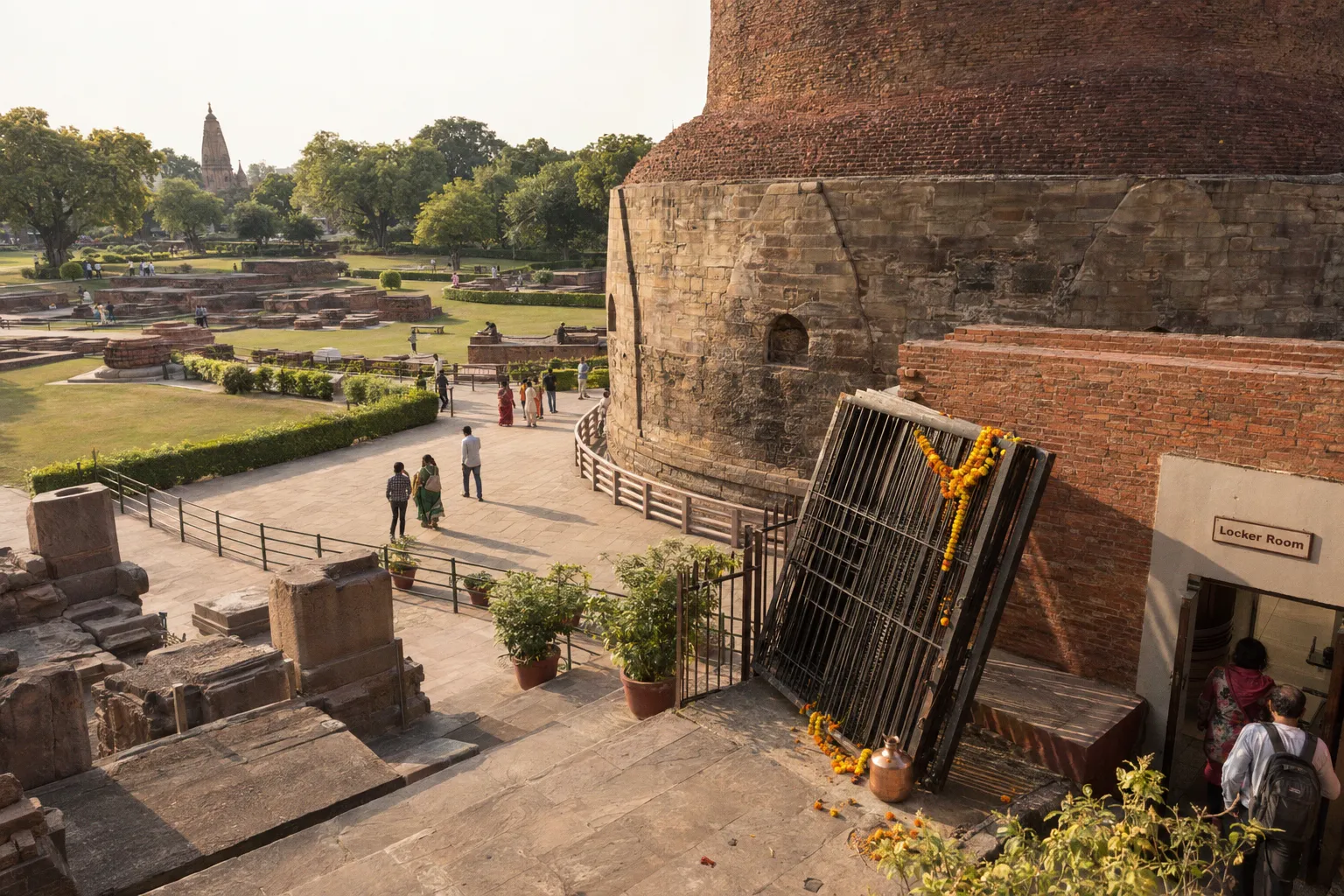
The safest approach is to decide before leaving the hotel where each device will remain. Visitors can leave prohibited electronics at their accommodation or use the designated locker arrangements outside the restricted area, subject to the current instructions of temple and security staff. Do not rely on switching a phone off or placing it in airplane mode. A device remains a device even when it is not connected to a network.
The rules also cover tobacco products, cigarettes, lighters, pan-masala, firearms, and other restricted objects. Medicines require particular care: visitors should check the current instructions before entering, especially if they need to carry prescription medication during the visit. Requirements can depend on the item and the security arrangement in force that day. Do not conceal medication or assume that a general visitor rule answers a medical need; ask authorised staff for the correct procedure.
A small bag is easier to manage than a large backpack. It reduces the number of items that need to be checked and makes it less likely that a prohibited object will be overlooked before you reach the entry point. Even permitted belongings may be subject to the security process, so arriving with only what you genuinely need is the more efficient choice.
For the kashi vishwanath entry rules for tourists, the following preparation is useful:
- Leave mobile phones, smartwatches, Bluetooth devices, and power banks at the hotel or in the permitted locker facility.
- Check pockets and small compartments for lighters, cigarettes, tobacco, and pan-masala before leaving.
- Do not bring firearms or other restricted objects to the temple entrance.
- If you need prescription medicine, confirm the current procedure with authorised temple or security staff before entering.
- Keep the ticket and identification documents accessible, but separate from items that must be deposited.
- Avoid taking a large backpack when a small permitted bag will do.
Security instructions can be applied at the entrance even when a visitor has a valid darshan ticket. A ticket confirms the booked service; it does not cancel the prohibited-items policy. Visitors should follow the directions given at the entry point rather than arguing that an item is harmless or switched off.
The same caution applies to valuables. Visitors should avoid bringing unnecessary jewellery, expensive accessories, or bags that they would be uncomfortable leaving in a locker. A temple visit is easier to manage when the only items carried to the entrance are the documents, permitted essentials, and anything specifically allowed under the current security instructions.
Because policies can be enforced at the gate, travellers should not rely solely on advice from a hotel, driver, social media post, or an older travel itinerary. The current instructions of temple and security staff take priority. Rules may be clarified or adjusted, and the fact that an item was allowed during a previous visit does not guarantee that it will be accepted on the day of your darshan.
Navigating aarti timings and entry deadlines
Aarti bookings operate according to fixed reporting windows. The ticket is not simply permission to arrive at any point during the day. Visitors need to read the reporting time and entry deadline attached to their particular booking, then plan the journey to the temple accordingly.
For Sapt Rishi Aarti, the published schedule runs from 7:00 PM to 8:15 PM on evenings when outside participants are admitted. Ticket holders are required to reach the gate by 6:30 PM. That deadline is separate from the beginning of the aarti. Arriving at 7:00 PM may mean arriving when the entry process has already closed, not arriving at the start of the ritual.
Mangla Aarti has its own morning schedule and its own reporting requirements. Rudrabhishek bookings operate within the published 4:00 AM to 6:00 PM window. These services should be treated as separate bookings, each with its own instructions. The times can change, so use the ticket and the official temple information as the final reference rather than relying on an old itinerary or a general travel article.
The half-hour interval before Sapt Rishi Aarti is not a convenient margin to spend elsewhere in the city. It gives the temple time to process ticket holders before the ritual begins. Visitors should arrive at the stated gate by the deadline, with the ticket and ID ready, and should expect security and verification to take place before entry into the ritual area.
If you have more than one booking on the same day, avoid planning them back-to-back. A morning ritual, a separate darshan slot, and an evening aarti may involve different reporting points or queues. Leave enough time to travel between locations, collect or deposit belongings, and complete the required entry process. A schedule that looks possible on paper can become difficult if the first service runs late or local traffic slows the journey.
The same principle applies to ordinary darshan. A paid ticket should not be read as a guarantee of immediate access at any time of day. The temple’s security arrangements, crowd movement, and ritual schedule may affect the pace of entry. Reaching early is usually more sensible than trying to arrive at the last possible minute.
When planning aarti, build the day around the reporting time rather than the ceremony’s advertised start. The reporting time is the moment that controls the visitor’s journey: it determines when to leave the hotel, when to stop for food, and when to finish depositing prohibited items. Treating the start of the ritual as the arrival target is one of the easiest ways to turn a valid booking into a missed entry.
Keep the ticket accessible during the approach. It should not be necessary to open several phone applications, search through messages, or unpack a large bag at the gate. Where a printed ticket is required, use that copy as the primary document and keep any digital version only as a backup reference.
Access guidelines for local residents and families
Residents of Varanasi have a separate access provision through Kashi Dwar. The local-entry arrangement is based on valid address identification, allowing eligible residents to use the designated gate without booking a Sugam Darshan ticket in advance. A local resident should carry the document that establishes the Varanasi address and present it as directed at Kashi Dwar.
This route is not a general shortcut for visitors staying in Varanasi. A hotel booking, temporary accommodation, or the fact that someone has travelled to the city does not by itself establish local eligibility. The document must meet the current requirement for resident entry. If there is any uncertainty about which address ID is accepted, confirm it before setting out rather than arriving at the gate with an assumption.
For local families, the access rule can simplify a regular visit, but every member of the group should still carry appropriate identification where required. Children and adults may not be covered by exactly the same conditions, and the local-entry procedure should not be confused with the ticket rules for paid rituals.
Families visiting from outside Varanasi should check the age condition attached to their booking. Children below 12 may not need a separate ticket when accompanying paying adults for Sugam Darshan and Sapt Rishi Aarti under the stated rule. The adult’s ticket does not, however, automatically cover every specialised service. A family booking Rudrabhishek or another pooja should review that service’s separate requirements before payment.
This is also where many families make an avoidable mistake: they assume that one rule governs all forms of darshan. It does not. The age policy for one entry category should not be used as evidence that a child can join every ritual without being included in the booking. Read the conditions for the exact service, especially when the visit includes both a standard darshan and a separate pooja.
For a mixed group of residents and visitors, do not assume that one eligible local resident changes the status of everyone else. Each person may need to qualify under the relevant access route or booking condition. Carry the appropriate identification for every member and ask the authorised staff how the group should proceed rather than trying to enter through a local route on the basis of a shared family or travel arrangement.
Families should also think about the practical consequences of the security rules. A child may be carrying a small electronic toy, a smartwatch, or another item that adults have forgotten to check. Before leaving the hotel, inspect everyone’s pockets and bags. This prevents a family from reaching the gate only to separate, deposit belongings, or search for a locker while the rest of the group waits.
Preparing for the gate
The most useful temple darshan preparation checklist is not complicated. It is a matter of matching the preparation to the type of visit:
1. Identify the service. Confirm whether the booking is for Sugam Darshan, Mangla Aarti, Sapt Rishi Aarti, Rudrabhishek, or another category.
2. Print the ticket. Keep a clear hard copy available when the published instructions require one.
3. Match the name and ID. Check spelling, date, and visitor details before travelling.
4. Prepare international documents. Foreign nationals should carry the original passport and visa, along with the required photocopies, and allow time for helpdesk verification.
5. Read the reporting time. Treat the entry deadline as a real deadline, not as the beginning of a flexible arrival period.
6. Remove prohibited items. Plan for phones, watches, power banks, tobacco products, lighters, and other restricted belongings before reaching the gate.
7. Check child-entry conditions. Do not assume that the rule for Sugam Darshan or Sapt Rishi Aarti applies to a separate pooja.
8. Use the correct local route. Residents eligible for Kashi Dwar entry should bring valid local address identification.
The documents should be kept somewhere accessible but secure. There is little benefit in placing a ticket at the bottom of a crowded backpack when it will be needed at the first desk. A small folder for tickets, identification, and photocopies is enough. Keep the original passport with the international visitor, and keep copies separate so that the documents do not become mixed up.
It is useful to prepare the folder before leaving for the temple rather than organising it in the queue. Put each person’s ticket next to the corresponding ID, check the date and service, and separate documents that need to be submitted from those that must remain with the traveller. This takes only a few minutes and avoids a surprisingly common source of confusion at the verification point.
Dress and movement also matter in practical terms, although they do not replace the formal requirements. Comfortable clothing and footwear make it easier to manage the approach to the temple and the surrounding lanes. The important preparation, however, remains documentary: the correct ticket, the correct ID, and the correct arrival time.
A visitor should also have a simple plan for the period before entry. Decide where prohibited electronics will stay, how the group will meet if belongings need to be deposited, and who will hold the documents. These arrangements are particularly helpful when the visit includes children or older family members, since the group may move through security at different speeds.
Kashi Vishwanath darshan becomes considerably less stressful when visitors distinguish between the temple’s different entry systems. A paid booking is not the same as a ritual booking. A foreign visitor’s passport verification is not the same as an Indian visitor’s ticket check. Local resident access is not the same as tourist access, and a child-entry concession for one category does not automatically extend to another.
The practical formula is simple: carry the document that matches the service, arrive before the stated deadline, and bring nothing that the security rules prohibit. The temple visit still involves queues, checks, and the movement of a large number of devotees, but those parts become easier when the avoidable problems have been dealt with before reaching the gate.