Ganga river ghats photography: timing and etiquette tips
The bottleneck at Varanasi’s riverfront is rarely your camera gear. It is the clock, the crowd, and the distance between a considered frame and an intrusive one.
Miss the low-angle light on the stone steps, and you may spend the rest of the morning fighting flat glare, haze, and a thousand people competing for the same view.
The practical advantage is simple: arrive before the scene becomes busy, choose a position that gives the riverfront room to breathe, and treat the ghats as lived religious spaces rather than a backdrop. The best time for Ganga river ghats photography is usually early morning, but the right hour changes with the season, the weather, the ghat, and the kind of image you want to make.
A long lens cannot repair poor positioning. A wide lens cannot create soft light at midday. And no photograph is worth crossing a sacred boundary.
Chasing the Golden Hour: Sunrise and Sunset Strategies
Morning light along the eastern-facing ghats can be brief and uneven. The sun may illuminate the upper facades while the lower steps remain in shadow, or haze may turn the river into a pale reflective band before the direct light becomes harsh. That transition is part of the appeal, but it rewards preparation rather than a late arrival.
Start with the season, not the timetable
In the warmer months, sunrise comes early. Photographers planning to work around Assi Ghat should be on the steps or already on a boat before the riverfront becomes active. If you are relying on the first clean light, allow time to reach the water, find a workable position, and let your eyes adjust before the strongest color appears.
During the cooler months, sunrise is later and morning haze can soften the contrast between the river, boats, and buildings. That softer atmosphere can be useful for silhouettes and layered compositions, especially when the far bank almost disappears. It can also make the light feel delayed, so do not treat a generic sunrise time as a guaranteed start to the useful photographic window.
The most reliable approach is to check the local sunrise time for your dates, then arrive early enough to account for walking, security, boat boarding, and the inevitable pause while a boatman or guide confirms the plan. If you are photographing a morning ritual, verify its current timing locally rather than assuming that a schedule from another season still applies.
The useful light is not always a fixed number of minutes. Clouds, haze, river mist, and the height of the sun can change the scene from one morning to the next. Think in terms of a sequence:
1. Blue hour and pre-sunrise: lamps, silhouettes, dark water, and quiet preparation.
2. First direct light: long shadows and warm edges on the steps.
3. Rising sun: brighter reflections, stronger separation between the ghats and the river, and more visible activity.
4. Later morning: harder contrast and less forgiving highlights on pale stone.
The Ganga does not care about your itinerary. Arrive before the light turns, or be ready to photograph a different riverfront altogether.
Assi Ghat and the southern riverfront
Assi Ghat is a practical starting point for sunrise photography because it gives you access to both the steps and the river. From the shore, you can work with the geometry of the ghat, the broad reflection of the sky, and the movement of people arriving for morning prayers or exercise. From a boat, you can turn the entire row of ghats into a layered composition.
Do not assume that the first visible activity is automatically the best subject. Morning scenes are full of gestures that disappear quickly: a person arranging flowers, a priest preparing a small ritual, a boat cutting through reflected light, or a group gathering at the edge of the steps. Watch for a few minutes before raising the camera. The scene usually becomes clearer once you understand where people are moving.
A stable position matters more than chasing every moment. If you are on the steps, avoid blocking narrow access routes or standing directly in front of people who are approaching the river. If you are on a boat, leave enough room for other boats to pass and do not ask the boatman to force a close approach for a single frame.
Sunset and the evening transition
The riverfront changes character in the evening. The light can move from warm stone and blue water to lamps, smoke, and deep shadows within a short period. This is less predictable than a simple sunset shoot because the visual centre of attention may shift toward a ceremony, a crowd, or a line of illuminated boats.
For sunset photography, reach the area before the light becomes dramatic. You need time to choose whether to work from the steps, a nearby terrace where photography is permitted, or a boat arranged in advance. Once the crowd thickens, moving from one position to another becomes difficult and may disturb people who have come for prayer.
Do not build your plan around an exact ceremony start time unless you have checked it locally. Evening Ganga Aarti timings can vary by season, ghat, and day, and the ceremony may not align precisely with sunset. If you intend to photograph the Dashashwamedh Ganga Aarti, arrive before dark, confirm the current local timing with a responsible local source, and allow extra time for the crowd and boat traffic. A flexible arrival is more useful than treating one printed schedule as permanent.
Mastering the Riverfront: Lens Selection and Boat Positioning
Many visitors arrive with a wide-angle lens because the ghats look expansive from a distance. A wide lens has its place, particularly for a broad skyline or a boat framed against the full riverfront, but it is not the answer to every scene. On the water, a short telephoto or telephoto zoom often gives more control.
Why a telephoto works
A lens in the 70–200mm range can help separate layers of the riverfront without requiring you to move physically close to a person or ritual. It is useful for:
- compressing several ghats into a single graphic arrangement;
- isolating a boat, balcony, shrine, or staircase from the visual clutter around it;
- photographing reflected light without filling the frame with empty foreground;
- working from a respectful distance when people are bathing, praying, or preparing for a ceremony;
- capturing gestures and activity without turning the camera into a visible interruption.
Distance is not a substitute for consent. A 200mm lens can make it easier to avoid stepping into someone’s space, but it can also make it easier to photograph someone who has no idea they are being photographed. Use the reach to create room, not to evade basic courtesy.
A 24–70mm zoom is more flexible for boats, broad compositions, and the lanes behind the ghats. A wide lens can exaggerate the height of the steps and pull the riverfront into a dramatic perspective, but it also includes everything: plastic bottles, tour groups, electrical cables, parked boats, and people who did not agree to be part of your image. Frame deliberately.
Choosing a boat position
Arrange the boat before the shoot rather than beginning negotiations when the best light is already on the water. Confirm the approximate route, duration, price, and whether the boatman is comfortable with your equipment. Keep the plan uncomplicated. A stable, predictable drift is usually more useful than a rushed tour that tries to cover every ghat.
Three positions are particularly useful:
1. Mid-river and parallel to the ghats: This gives a compressed view of steps, buildings, boats, and morning activity. It is often the safest starting point for a broad series.
2. A measured approach toward the steps: A closer position can reveal details in architecture and reflected light, but it should never become an excuse to crowd bathers or interrupt a ritual. Keep the lens choice and your body language unobtrusive.
3. A slower drift toward the southern ghats: The area around Tulsi Ghat and the quieter stretches beyond the busiest central riverfront can offer cleaner compositions and fewer competing boats.
Avoid stopping in the main path of ferry or tourist traffic. Even a small boat can rock noticeably when another vessel passes, which is enough to spoil a slower exposure. Keep your camera strap secure, your bag low, and your movements controlled. A boat is not a tripod, and the water will expose every careless adjustment.
| Scene | Useful focal length | Positioning approach | What to watch |
|---|---|---|---|
| Broad morning activity around Assi Ghat | 70–135mm | Parallel to the riverfront, with open water between you and the steps | Boats entering the frame and uneven morning haze |
| Layered steps and architectural details | 100–200mm | Mid-river or at a respectful distance from the shore | Compressed backgrounds becoming visually crowded |
| Riverfront skyline and sunrise reflections | 35–100mm | Stable position on the steps or a slowly moving boat | Bright sky and reflective water competing for exposure |
| Evening lamps, smoke, and ceremonial movement | 100–200mm | Pre-arranged boat position or a permitted shore location | Low light, motion blur, and people moving into the frame |
Exposure on moving water
Keep the shutter speed high enough to account for both subject movement and boat movement. Image stabilization can help, but it will not freeze a person’s hand or compensate for a boat rocking as another vessel passes. If the light is changing quickly, prioritize shutter speed and accept a moderate increase in ISO rather than losing the gesture that made the image.
For reflections, expose carefully around bright sky and lamps. The river can look dark to the eye while still producing strong highlights that clip quickly. Check the histogram when possible, and do not rely only on the rear screen in direct daylight.
Navigating the Galis: Mid-Day Street Photography Alternatives
By late morning, the open riverfront often becomes a difficult place for subtle photography. Direct sun creates hard shadows on pale stone, highlights on the water become aggressive, and the crowd makes clean compositions harder to hold. This is the moment to leave the river edge rather than force a weak version of the sunrise image.
The galis—the narrow lanes running behind and between the ghats—offer a different visual rhythm. Their shade can soften contrast, while walls, balconies, doorways, shopfronts, and overhead fabric create natural frames. The light is not necessarily easy, but it is more layered and directional than the open glare of the steps.
A 24–70mm lens is useful here because the lanes change scale quickly. At the wider end, you can show how tightly the buildings enclose the street. At the longer end, you can isolate a sign, a doorway, a hanging object, or a person moving through a strip of light without pressing into the scene.
Practical Varanasi street photography tips
- Keep the camera ready but not permanently raised. A camera held at eye level at every corner can make people feel watched. Observe first, then photograph when the gesture and the setting work together.
- Leave room in narrow lanes. Do not stop in a doorway, at the foot of a staircase, or in the middle of a route used by residents, porters, worshippers, and motorbikes.
- Ask before making a close portrait. A smile or a nod is not always permission for a tight, prolonged portrait. If the person hesitates, lower the camera and move on.
- Use existing light. Doorways and side streets often provide better separation than a flash. Direct flash can be disruptive in a temple corridor or a small shop.
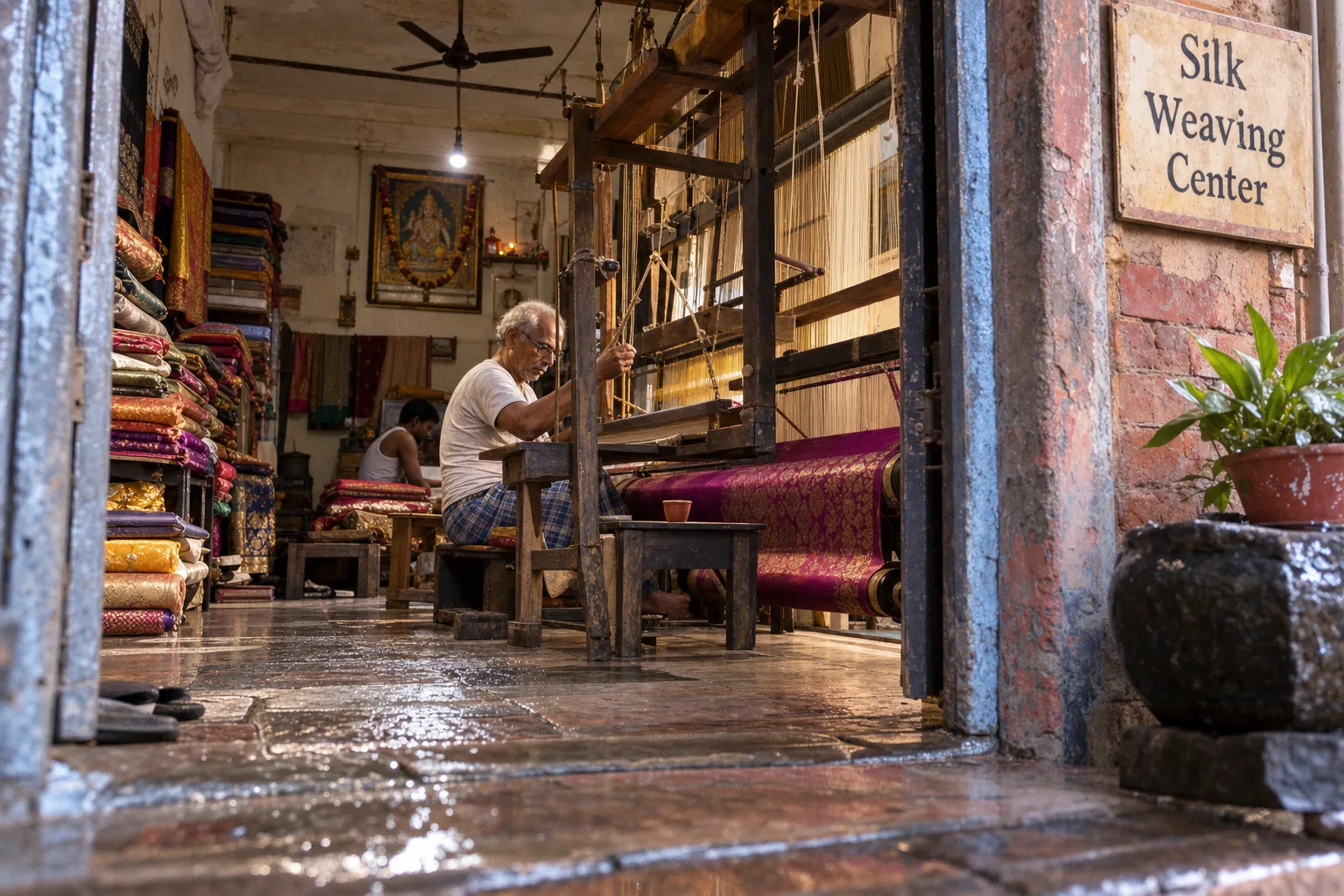
- Do not turn workers into props. Weavers, metalworkers, flower sellers, and chai vendors are subjects with their own routines, not scenery arranged for a photograph.
- Return to the same junction. The galis can be confusing, especially when the river is no longer visible. Carry only the equipment you can manage without blocking the lane and note recognizable turns.
The quieter southern lanes behind Assi Ghat can be a useful place to begin. From there, you can move north toward the busier lanes behind Dashashwamedh and compare the change in density. The point is not to collect every alley. It is to notice how the city’s religious, commercial, and domestic life overlap within a few metres.
Midday also works well for details that do not depend on golden light: painted surfaces, carved doors, stacked brass vessels, worn stone, laundry above a lane, or the geometry of stairs disappearing into shadow. These images can give a travel story more texture than another broad riverfront panorama.
Sacred Boundaries: Respecting Cremation Rites and Privacy
The cremation ghats require more restraint than any other photographic location in Varanasi. Manikarnika Ghat and Harishchandra Ghat are active places of mourning and religious duty, not public performances staged for visitors. Local expectations may be strict, and practices can differ depending on where you are standing, who is accompanying you, and what is taking place.
Photography of funeral pyres, grieving families, and identifiable mourners should be treated as off limits. Do not assume that a long lens, a boat, or a distant position makes the act acceptable. Distance can reduce physical intrusion, but it does not remove the ethical problem or the possibility of causing distress.
Manikarnika and Harishchandra Ghats
If you pass near a cremation ghat, put the camera away unless a clearly authorized local arrangement tells you otherwise. Do not photograph the bodies, the fire, the relatives, or private moments of preparation. Do not use a telephoto lens from the river to obtain images that would be unacceptable at close range.
The most responsible visual approach is to photograph the surrounding public context without making a person’s grief the subject. Architecture, the river, the movement of boats, wood stacked for general use, or the changing smoke above the skyline may communicate the atmosphere without identifying a family or recording a private rite. Even then, check your frame carefully. A distant composition can still contain a recognizable mourner or a moment that should remain undocumented.
The respectful distance is not measured only in metres. It is measured by whether the people in the frame still have control over what happens to their image.
Bathing, prayer, and personal rituals
The riverfront is public space, but public does not mean permission. Bathing, prayer, ablutions, offerings, and family rituals can be deeply personal even when they happen in full view of the ghats.
Avoid photographing people who are undressed, bathing, visibly distressed, or engaged in private prayer. If someone notices the camera and changes expression, posture, or behaviour, take that as a clear signal to stop. Lower the camera, turn away, or move to another subject.
For a portrait or a close environmental photograph, ask first. A local guide can help with language and context, but a guide’s approval is not automatically the subject’s consent. If the person says no, do not bargain, explain, or take a hidden frame after walking away.
Be especially careful with children. Do not make a child the main subject without a parent or guardian’s clear permission, and avoid using the busy riverfront as an excuse to photograph groups of children repeatedly.
Securing the Perfect Angle for the Evening Ganga Aarti
The evening Ganga Aarti at Dashashwamedh is a difficult subject because the visual action, the audience, the lamps, and the river are all competing for space. It is also a religious ceremony, not a photography set. The goal is to find a position that lets you work without blocking worshippers or treating the priests as performers available from every angle.
The steps option
If you want to photograph from the steps, arrive before dark and verify the current local aarti time. Seasonal changes, local arrangements, crowd conditions, and special observances can affect the schedule, so do not rely on an exact sunset-based start time from an old guide. Build in enough time to pass through the area, find a permitted place to stand or sit, and settle before the crowd closes the gaps.
The most useful shore positions are usually those that offer a clear view without placing you directly in front of the priests or in a route used by worshippers. An upper platform can give a broader composition, while a lower position may provide stronger reflections but more obstruction. Wooden structures, railings, and moored boats can become foreground elements, but do not climb onto or occupy them if they are reserved for the ceremony or the congregation.
Once the ceremony begins, stay where you are. Moving through a packed audience with a camera and a bag is disruptive and rarely improves the photographs. Compose for intervals between heads rather than trying to hold the camera over everyone. If your position offers no clear view, accept the limitation or leave; pushing forward is not a photographic technique.
The stationary boat option
A boat can provide a clean relationship between the river, the ceremonial platform, and the lamps, but it must be arranged responsibly. Hire the boat well in advance of the ceremony, confirm the departure point, and ask where the boat is allowed to remain. Boat traffic can become dense, and a boatman may need to move for safety or for the passage of other vessels.
A position across from the main ceremonial area can work with a 100–200mm lens, particularly for silhouettes, flames, smoke, and the repetition of raised lamps. Keep the camera supported against the boat’s movement, but do not attach equipment in a way that creates a hazard for the boatman or other passengers. A beanbag or carefully braced support is often more practical than a rigid clamp.
Do not ask the boatman to push into the front row of boats for a closer image. The ceremony is already surrounded by spectators, and a small change in position can block another boat’s view or disturb the movement on the steps.
Exposure for lamps and smoke
The aarti is a high-contrast scene: bright flames against dark water, deep clothing, illuminated faces, and smoke that catches light unpredictably. Manual exposure or exposure compensation can help you avoid letting the dark background force the flames into a featureless white patch.
A shutter speed around 1/125 may help freeze a moving lamp or hand gesture, but the correct setting depends on the available light and the focal length. Slower speeds can produce expressive fire trails, though they also exaggerate movement from the boat and the crowd. A moderate aperture gives you some separation while retaining enough depth for layered lamps and figures. Raise ISO when necessary rather than underexposing so heavily that the shadows become unusable.
Shoot RAW if your workflow allows it. The colour of firelight, electric bulbs, dusk, and reflected river light rarely fits a single preset. A neutral starting point leaves room to adjust the balance without turning the flames orange or the river blue.
Do not use flash during the ceremony unless it is explicitly permitted. It can distract the priests and worshippers, flatten the atmosphere, and announce your position to everyone around you. The light is already part of the scene; work with it.
Position Before Gear
The strongest Ganga river ghats photography usually comes from a sequence of small decisions made before the shutter is pressed: arriving before the useful light, choosing a position that does not obstruct anyone, carrying the focal length that suits the distance, and recognizing when a scene is private rather than available.
For sunrise, favour preparation over a rigid minute-by-minute schedule. For midday, leave the glare of the riverfront and work the galis with patience. For the Ganga Aarti, arrive before dark, confirm the current local timing, and accept that the clearest angle may not be the closest one. Around the cremation ghats, restraint is more important than access.
The practical order remains the same: position before gear, timing before framing, and distance before intimacy. When those choices are right, the photograph usually becomes simpler—and the city remains more important than the act of taking it.