Ganga boat ride costs and common overcharging traps
I've watched tourists walk down to the ghats with a fixed budget and walk back two hours later having handed over four times the official rate for a boat ride they thought they had agreed on.
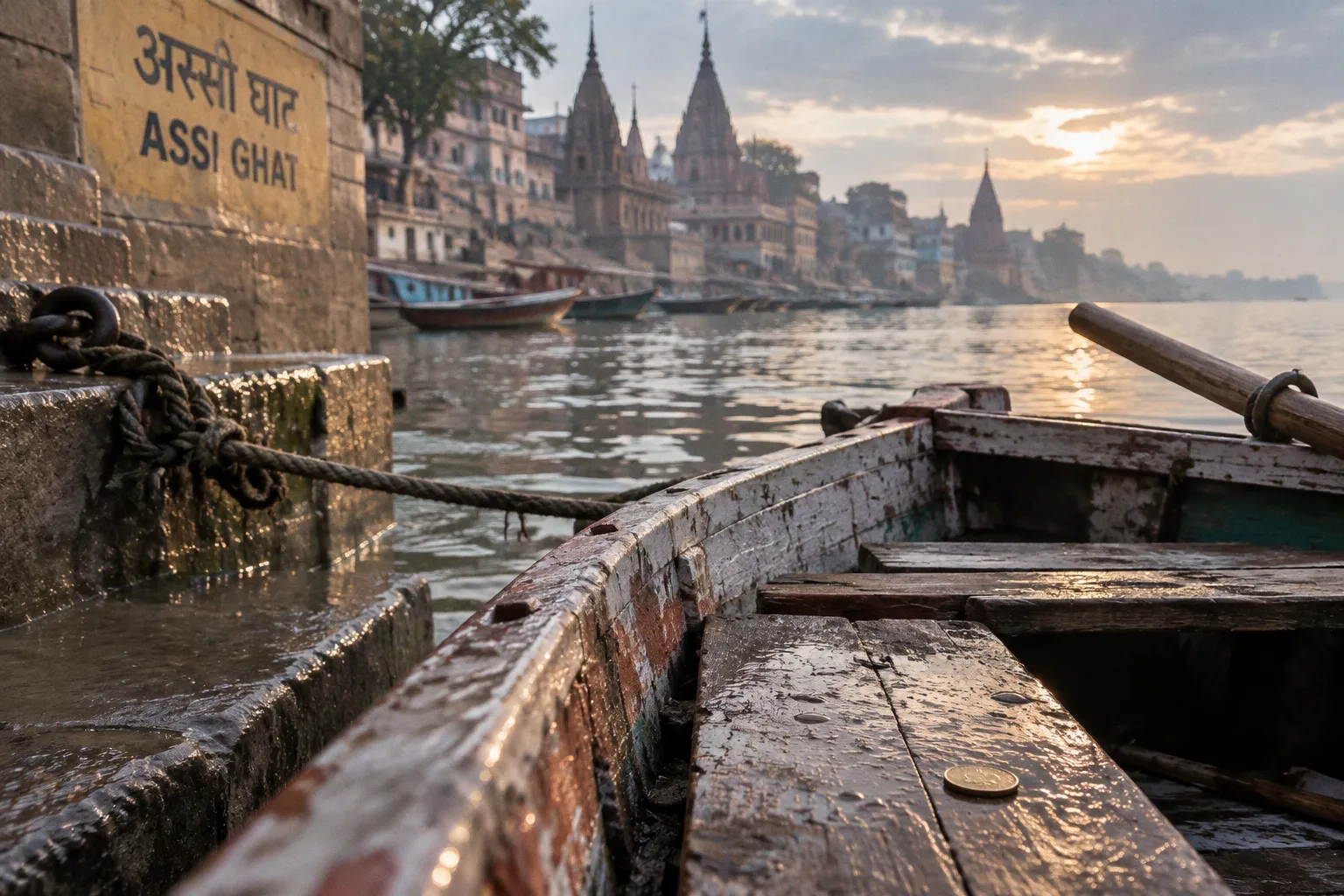
It happens every single evening, and it happens because the pricing system in Varanasi is built on two parallel tracks: one printed on a government rate card nailed to a pole near the ticket counter, and one spoken in the ear of anyone who doesn't know better. The gap between those two tracks is where your money disappears. I've spent enough mornings on the steps at Assi Ghat and enough evenings at Dashashwamedh to know exactly where the bottlenecks are, and I'm going to walk you through them in the order you actually encounter them on the ground.
The official rate card is real. So is the negotiated rate. The trap is treating them as if only one exists.
The Dual Pricing Reality: Official Rates vs. Street Negotiation
Here's the setup most tourists never crack. Varanasi's tourism authorities publish rate cards at the major ghats, and those cards carry real, enforceable prices for shared rides between the standardized routes. At the same time, every boat operator on the ghats operates on direct cash negotiation. That negotiation is the local practice, not an exception to it. When a boatman quotes you a price, he is not breaking any rule — he is working inside the unofficial economy that has run these ghats for decades.
The problem is not that prices are negotiable. Negotiation, done right, can land you a fair fare. The problem is asymmetry: the boatman knows every rate on the official card, knows what other operators are quoting tonight, and has read your face to figure out whether you have ever been to Varanasi before. You, on the other hand, are standing in the dust in late afternoon with luggage and a sunset deadline. That is the asymmetric information problem, and it is the root of every overcharge complaint you'll read in a travel forum.
The optimal move is not to refuse to negotiate. It is to negotiate from a foundation of the official number. Anchor first, haggle second. Anyone who refuses to discuss price anywhere near the official rate is signaling that they plan to take you somewhere you did not ask to go — usually a "special" boat with cushions and a prayer, which is the standard upsell script.
To cut through this clearly:
- Always confirm the official rate for your intended route before you talk to any boatman.
- Treat the printed figure as the ceiling for a shared boat, not the floor.
- Treat any private package quote as negotiable by at least 25–30 percent from the opening ask.
- Walk away from any quote that is more than double the printed rate for a comparable route.
The aim is not to squeeze the boatman. The aim is to land inside the band where a fair local would settle. That band almost always exists.
Standardized Municipal Tariffs for Shared Riverfront Routes
The fixed municipal rate for the standardized Assi Ghat to Namo Ghat shared ride is ₹345 per person. That number is the most useful anchor you will get on the riverfront, because every shared route in Varanasi clusters around a similar government-set per-head figure during off-peak hours. The rate card is posted at the ghat entry, usually near the staircase landing or the ticket shelter, and it lists the routes by name with the matching fare.
If you are traveling alone or as a couple, the shared boat is the cheapest legal option in town. You join a boat that other tourists are also boarding, the operator fills the seats up to a maximum capacity, and you ride the standard route at the standard rate. The catch is timing. Shared boats leave on a roughly fixed timetable tied to the ceremonial schedule — usually clustering around the Subah-e-Banaras morning slot at Assi Ghat and the late-afternoon window before the Dashashwamedh Aarti begins. Miss the window and you end up paying for a private charter whether you wanted one or not.
Two practical points that rarely get printed on a tourism blog:
First, the shared rate applies to the standard downstream corridor — Assi Ghat to Namo Ghat via the central arc of the riverfront. If a boatman tries to extend the route to Manikarnika or Panchganga on a shared ticket, that is a route change, and you should expect to renegotiate from the standard shared fare.
Second, the per-person rate is the rate. Boatmen sometimes try to quote per-couple or per-boat even on a shared departure, especially when only one or two of you show up at the ghat. The phrasing matters: ask for "per person, shared boat, Assi to Namo." If he hesitates, he is preparing to fold you into a private charter at private rates. Politely decline and wait for the next group.
| Route Category | Format | Typical Quoted Band | Anchor Rate |
|---|---|---|---|
| Assi Ghat ↔ Namo Ghat | Shared, per person | ₹200–₹400 | ₹345 (municipal fixed) |
| Cross-river / single-point transit | Shared, per person | ₹100–₹200 | Lower official band |
| Assi Ghat morning Subah ritual | Shared, per person | ₹300–₹450 | Cluster around ₹345 |
| Pre-Aarti shared slot | Shared, per person | ₹350–₹500 | Premium on ceremonial timing |
The bands above are what you will actually be quoted across a normal week. If a quote falls outside them on either end, you are either at a specialized private package or at the opening salvo of an overcharge.
Private Boat Packages: Understanding Market Rates for Aarti and Kashi Darshan
When timing does not line up with the shared schedule — and it often does not, especially if your train arrives at 4 p.m. or your flight the next morning forces a pre-dawn departure — you are in the private charter market. This is where most of the tourist damage happens, because private pricing has no single printed anchor. Everything is "depends," and "depends" is boatman-speak for "I am about to read you."
Three private packages dominate the bookings:
- Evening Ganga Aarti at Dashashwamedh. Quoted between ₹3,000 and ₹4,500 per boat. This is the most common private booking in Varanasi, full stop. The boat launches roughly an hour before sunset, positions you mid-river facing the ghat steps, and lets you watch the priests do their synchronized fire ritual. The package is variable because the timing window is short and the demand is high — every tourist who arrives on an evening train wants exactly this experience tonight.
- Kashi Darshan riverfront tour. Quoted between ₹5,000 and ₹6,500 per boat. This is the longer route — usually a two- to three-hour loop covering the major ghats from Assi down to Manikarnika, often including a stop at one of the heritage riverside structures. The duration is what justifies the higher rate, not the spectacle.
- Ramnagar Fort crossing. Quoted between ₹6,000 and ₹7,500 per boat. This is a dedicated run across the river to the fort on the eastern bank, often combined with a short palace tour. It is a niche product, mostly booked by heritage travelers and photographers, and pricing here is the most elastic of the three.
The opening quote on any of these packages is always on the high end of the band. That is the local convention. Your job is to negotiate somewhere into the middle of the band — typically ₹3,500–₹4,000 for an Aarti charter, ₹5,500–₹6,000 for a Kashi Darshan loop, and ₹6,500–₹7,000 for the Ramnagar run — without insulting the operator. Haggle too aggressively and you will either get a worse boat or a strange "fuel surcharge" added at the ghat steps.
Here is where I part ways with most travel guides: I do not recommend lowballing. The optimal private fare for any of these packages sits at roughly 70 to 80 percent of the opening ask. Aim for that window, settle in the middle, and move on. Trying to grind a boatman down to half his opening quote works once and burns you the next time you set foot on a ghat — boatmen talk, and not just to other boatmen.
Tactics of Middlemen and Mid-River Price Hikes
The single biggest money leak on the Varanasi riverfront is not the boatman you hired. It is the person who walked you to him. Touts operate in a layered system at the ghats: someone approaches you near the approach road or the parking area, offers to "arrange a special boat," quotes a price that sounds reasonable, collects a cut from the boatman, and disappears. You never see the commission, but it is baked into your fare.
Three of the most common middleman scripts:
1. The "tourism department" call. The tout claims to be from the official tourism office, mentions a fixed package rate, and leads you to a specific boat. He is not from the tourism office. There is no such official package agent at the ghat steps. The official counter is a counter at the ghat, not a man who walks up to tourists with a laminated card.
2. The "Aarti requires a ticket" script. You are told that the evening Aarti viewing requires a special boat ticket and that the regular boats will not get you close enough. This is a flat lie. The river is open, the viewing line of sight is generous, and any licensed boat operator can position you correctly. The "special ticket" is just a private charter being marked up.
3. The "best boat is on the other side" reroute. You are walked past three working boat landings to a fourth, where a particular operator is "expecting you." That operator is the one paying the commission. Every minute you spend walking is a minute the tout is collecting.
The mid-river tactic is a separate genre. You settle on a price, board the boat, push off, ride for fifteen minutes, and then the operator slows the engine and announces that the price was actually per person, not per boat. Or that the route is longer than agreed. Or that the Aarti viewing needs an extra ₹1,000 for a "prime position." You are mid-river at sunset, surrounded by other boats, and your leverage has collapsed. The boatman knows this.
The counter to both is not charm, not a complaint, not a phone call to a tourist helpline that does not exist at that hour. The counter is the agreement you made before stepping onto the boat. Which is the next section.
Securing Your Fare: Essential Pre-Boarding Agreements
The pre-boarding agreement is the single instrument that neutralizes every trap described above. It is not a contract. It is a verbal handshake with three specific terms, repeated out loud, in the boatman's presence, before a single oar touches water. I have used this handshake a dozen times and walked away clean every time.
The three terms:
- Exact price. State the total fare for the boat, in rupees, and confirm that this is the final number for the duration of the ride. Not per person. Not per stop. Not plus service. Total.
- Total duration. State how long the boat is yours, in minutes or hours. If you booked for the Aarti, that means until the Aarti ends and you return to the ghat. If the boatman suggests a shorter duration than the ritual actually runs, correct it on the spot.
- Specific ghat route. Name the ghats, in order, that the route will cover. "Down the riverfront from Assi to Manikarnika" is unambiguous. "Around the main ghats" is a blank check you do not want to sign.
Repeat the three terms back at the boatman before you board. If he hesitates on any one of them, you have just learned something useful about how the rest of the ride would have gone. Step off, walk twenty meters, and try the next operator. There are always at least four or five working boats at any of the major ghats during Aarti season.
One more: pay in cash, in full, only at the end of the ride. The standard local practice is a small deposit at the ghat and the balance on return. If a boatman asks for the full fare up front, he is either new to the line or signaling that he may try to adjust the terms mid-river. Either way, you have your answer.
Negotiate the three terms before the boat leaves the shore. That conversation is cheaper than any argument after.
I will give you the same closing rule I give every traveler who asks me about the ghats: treat the price as the only thing worth negotiating, treat the route as the only thing worth memorizing, and treat the sunset as the only thing worth missing if the boat is late. Varanasi is not a city that rewards improvisation on the river. It rewards people who knew the answer before they asked the question.