Banarasi silk weaving workshops: choosing your authentic tour
A visit to a Banarasi silk weaving workshop is not simply a shopping excursion with a loom placed conveniently in the corner.
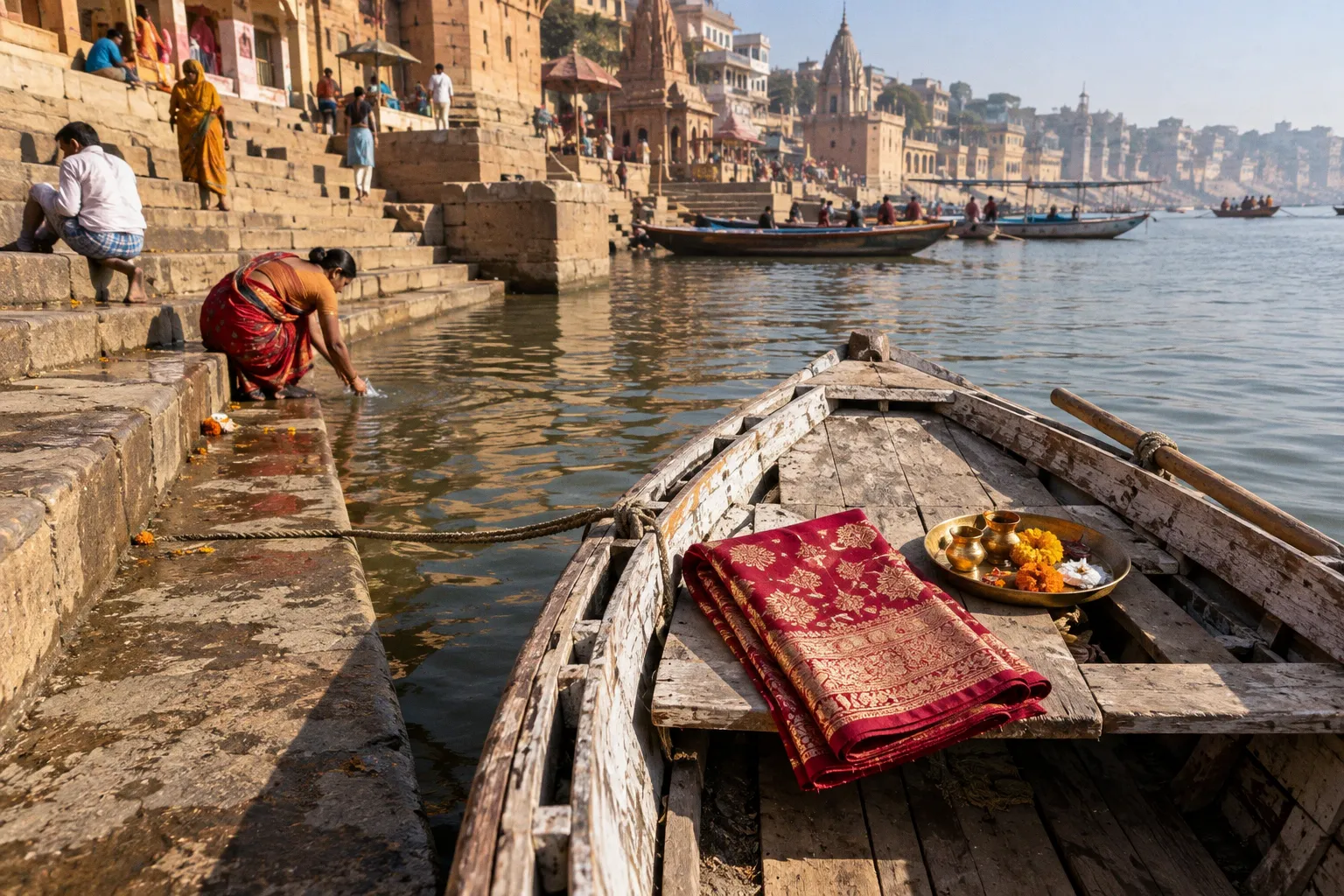
In Varanasi, weaving is organized through neighborhoods, households, inherited skills, design systems, and working rhythms that are often invisible in the finished sari. The most meaningful tour is therefore the one that lets you understand how the textile comes into being, while respecting the people and homes where that work continues.
For travelers comparing banarasi silk weaving workshop visit options, the first decision is geographical. A short urban walk through Lallapura offers close access to Varanasi’s historic weaving neighborhoods and private residence workshops. A longer excursion to villages such as Sarai Mohana, Ayodhapur, or Kotwa adds rural context and usually takes about half a day. Neither format is automatically more authentic. They reveal different parts of the same textile lineage.
The geography of weaving: Lallapura and the rural hubs
The phrase “Banarasi silk” can make the craft sound as though it belongs to one single monument or market street. In practice, weaving is distributed across a network of urban colonies and surrounding villages, with households and workshops forming part of the city’s wider cultural landscape.
Lallapura: the urban weaving district
Lallapura is one of the oldest weaving neighborhoods in central Varanasi. It lies approximately 4–5 kilometers from Kashi Vishwanath Temple, close enough to combine with other city visits but distinct in character from the temple lanes and riverfront ghats.
Here, a guided walk commonly lasts between two and three and a half hours. Visitors are usually taken into private residence workshops, where the loom may occupy part of a family home rather than a separate industrial building. This arrangement matters. It means that weaving is encountered as domestic labor and inherited livelihood, not only as a performance prepared for tourists.
An urban tour may include:
- A walk through the weavers’ neighborhood, where the working environment is part of the experience.
- Observation of traditional jacquard handlooms.
- An explanation of how silk yarn is prepared, treated, and colored.
- A look at the design process, including graph paper and punched Jacquard cards.
- Conversation with artisan families, when the household is comfortable receiving visitors.
- The possibility of purchasing fabric directly from a weaver or workshop, depending on the arrangement.
The most useful question to ask before booking is not simply whether you will “see a loom.” Ask whether the itinerary enters active home workshops and whether the guide explains the stages of production. A loom without context can become a photograph; a loom explained through the maker’s process becomes an encounter with skill, lineage, and labor.
Sarai Mohana, Ayodhapur, and Kotwa: the village dimension
Village weaving excursions travel farther from central Varanasi and generally take about four hours. Routes may include Sarai Mohana, Ayodhapur, or Kotwa, combining textile demonstrations with elements of rural life.
This format is often better suited to travelers who want to understand the social setting around the craft rather than fit a workshop visit into a crowded city itinerary. You may spend more time on the road, but the journey gives the experience a wider frame: weaving is seen alongside village homes, agricultural surroundings, and the slower movement of daily life outside the central lanes.
A village tour can offer:
1. A longer explanation of the production sequence. There is often more time to discuss yarn preparation, degumming, dyeing, and the preparation of motifs.
2. A closer view of design planning. Banarasi patterns are not improvised at the loom. Motifs may first be mapped on graph paper and then translated into punched cards for the Jacquard mechanism.
3. Contact with artisan households. This can create a more personal exchange, but it also requires greater sensitivity because you are entering a living home and workplace.
4. A broader understanding of rural livelihoods. The sari is connected to a community economy, not only to the person seated at the loom.
5. More travel logistics. Pick-up arrangements, traffic, meal timing, and return transport become part of the planning.
The village option is not necessarily a guarantee of deeper access. The quality depends on the guide, the relationships with participating families, and the permissions given on the day. A thoughtful operator will describe what you are likely to observe without promising private conversations, hands-on work, or unrestricted photography.
An authentic handloom experience in Banaras is measured less by how much you are allowed to touch than by how clearly the maker’s work is explained and respected.
What you are actually seeing at the loom
Visitors often arrive expecting the loom itself to reveal the whole story. It does not. The significance of Banarasi weaving lies in the sequence of decisions before and during weaving: the preparation of the yarn, the treatment of the silk, the arrangement of colors, and the translation of a visual design into a mechanical pattern.
From yarn preparation to woven cloth
A workshop explanation may begin with silk yarn preparation. The yarn can be treated through processes such as degumming, which removes the natural gum from silk fibers, and then dyed in the colors required for the design. These stages are easy to overlook because they happen before the loom starts moving, yet they shape the final texture, sheen, and behavior of the fabric.
The loom is the visible center of the workshop, but the cloth carries the work of many stages:
- Silk yarn must be prepared for weaving.
- Degumming changes the character of the fiber and prepares it for later use.
- Dyeing establishes the palette of the sari or fabric.
- Design motifs are planned rather than randomly produced.
- Graph paper helps map the arrangement of the pattern.
- Punched Jacquard cards translate that arrangement into instructions for the loom.
- The weaver coordinates the threads and the mechanical rhythm to build the textile row by row.
The term Jacquard refers to the mechanism that allows complex woven patterns to be controlled through a system of punched cards. You do not need a technical background to appreciate what this means: an intricate border or repeated motif has been converted from an artistic plan into a precise sequence that the loom can follow.
This is one reason a good Banarasi silk loom tour for tourists should include design interpretation rather than only a demonstration of moving parts. Ask your guide to show how a motif becomes a card and how the card influences the pattern. If the household permits questions, you may also learn how the weaver manages interruptions, repairs, thread tension, and the physical demands of maintaining concentration over a long session.
The household is part of the workshop
Many urban tours visit private residence workshops. That detail should shape your etiquette.
You are not entering a museum with neutral display hours. You may be stepping into a family’s home, where weaving, conversation, meals, childcare, rest, and commerce can overlap. A visitor who treats the space as a showroom can easily miss the very social reality that makes the experience valuable.
A respectful visit usually means:
- Asking before photographing people, rooms, tools, or unfinished work.
- Keeping your voice and movement measured, especially in a small home workshop.
- Allowing the weaver to continue working rather than interrupting repeatedly.
- Avoiding contact with yarn, cards, fabric, or loom components unless invited.
- Accepting that some questions may not receive a detailed answer.
- Discussing prices without turning the artisan into a spectacle or assuming that direct purchase means the lowest possible price.
- Giving the household time to explain its work, rather than rushing immediately toward a sales decision.
Hands-on access is not a standard feature of every tour. Some workshops may permit limited interaction, while others may not, and the decision belongs to the weaver or household. The absence of hands-on participation does not make a visit less genuine. In many cases, careful observation is the more appropriate form of participation.
Choosing between an urban walk and a village excursion
The best places to see handloom weaving in Varanasi depend on what you want from the day. If your priority is access, the urban district is practical. If you want more time and a wider social setting, the village route may suit you better.
| Factor | Lallapura urban walk | Village weaving excursion |
|---|---|---|
| Typical duration | About 2–3.5 hours | About 4 hours |
| Setting | Historic central weaving neighborhood and private home workshops | Outer communities such as Sarai Mohana, Ayodhapur, or Kotwa |
| Best for | Travelers with limited time or a city-based itinerary | Travelers seeking rural context and a slower half-day experience |
| Main focus | Loom operation, neighborhood history, artisan interaction, fabric viewing | Weaving demonstrations combined with village life and household context |
| Transport needs | Usually easier to combine with central Varanasi visits | Requires more deliberate pick-up, travel, and return planning |
| Buying fabric | May be possible directly from participating workshops | May be possible, but depends on the households and tour arrangement |
| Access considerations | Compact spaces and active domestic workshops | Longer travel, varied household settings, less predictable timing |
| Price examples in available tour listings | Approximately ₹1,200–₹2,000 per person, depending on group size and operator | One dedicated private village walk is listed at ₹2,699 per person |
The price ranges above are examples rather than a universal tariff. Operators structure these tours differently: some use tiered prices based on group size, while others charge a flat rate for a dedicated walk. The price may also reflect transport, guide time, language support, village coordination, and the number of workshops included.
When the urban route makes more sense
Choose Lallapura if you are staying near the old city, have only part of a day available, or want to combine weaving with other cultural visits. Its location, approximately 4–5 kilometers from Kashi Vishwanath Temple, makes it easier to place within a Varanasi itinerary.
The urban option can also be more comfortable for first-time visitors who want an introduction without committing to a longer excursion. A two-hour visit is enough to see an active handloom, understand the basic design process, and begin recognizing why a Banarasi sari is more than a finished pattern on a shop shelf.
When the village route makes more sense
Choose a village excursion if your interest lies in the relationship between craft and community, or if you prefer an itinerary with fewer abrupt transitions. The four-hour format gives the guide room to explain more of the process and allows the visit to unfold beyond a brief loom demonstration.
It is also a better fit if you want to understand how weaving exists away from the tourist center. That does not make the village communities more authentic than Lallapura; it simply changes the lens. Lallapura shows the craft within Varanasi’s urban fabric, while the village route places it within a different rhythm of domestic and rural life.
How to assess a tour before booking
Descriptions of guided tours of Banarasi silk workshops often use similar language: authentic, traditional, local, family-run. Those words can be meaningful, but they are not enough to compare one itinerary with another.
Before booking, look for concrete answers to the following questions:
- How long will the visit inside the weaving neighborhood or village actually last?
- Is the tour a walking experience, a transport-based excursion, or a combination of both?
- Will you visit an active private workshop, a showroom, or both?
- Does the itinerary explain yarn preparation, dyeing, design mapping, and Jacquard cards?
- How many households or workshops are included?
- Is the guide expected to interpret conversations, or are visits mainly observational?
- Is fabric purchasing optional, and is that made clear in the description?
- Are photography and hands-on activities subject to artisan permission?
- What happens if a workshop is not operating on the day of your visit?
- Does the tour pause during major festivals or other local observances?
The question about showrooms deserves particular attention. A showroom may sell beautiful textiles, and visiting one is not inherently problematic, but it is different from seeing handloom production in a working household. If the distinction matters to you, ask directly whether the advertised workshop is a place where weaving is currently taking place.
You can also ask how the operator works with participating families. The exact commission arrangements are not standardized across tours, so avoid assuming that a higher price automatically means better compensation or that a direct visit automatically removes intermediaries. What can be assessed is whether the operator speaks with clarity about the structure of the experience and avoids exaggerated promises.
Pricing, duration, and the practical shape of the day
Available tour examples place some private urban weaving walks in the range of ₹1,200–₹2,000 per person, with pricing varying according to group size and provider. A dedicated village walk is listed at ₹2,699 per person. These figures should help you understand the scale of the options, not function as a fixed market table.
A lower-priced urban walk may be appropriate when the main service is neighborhood interpretation and a short workshop visit. A higher-priced village excursion may include additional travel, coordination, and a longer period with the guide. Compare what is included rather than comparing the numbers in isolation.
A realistic schedule should allow for the fact that weaving does not always follow a visitor’s timetable. The loom may need adjustment. The household may be receiving another responsibility. A particular artisan may not be available. Traffic may lengthen the journey to an outer village. These are not necessarily failures of organization; they are reminders that you are visiting a working environment rather than a stage-managed attraction.
For a useful visit, plan around the following:
Allow time for explanation
If the itinerary promises a two-hour visit but most of that time is spent traveling between shops, you may not receive the depth you expected. Ask how much time is reserved for the workshop itself.
Dress and move comfortably
Urban weaving lanes can be narrow and uneven, while village visits may involve walking through residential areas rather than paved visitor facilities. Wear practical clothing and footwear, and avoid bringing large luggage into a private workshop.
Treat purchasing as separate from learning
You may have the opportunity to buy a sari or fabric directly from a weaver. Decide in advance whether you are interested in purchasing, because the retail portion can easily become the dominant part of a short tour. It is reasonable to ask about the textile’s production and composition, but it is equally reasonable to decline a purchase politely.
Build flexibility into festival periods
Some specialized weaving walks suspend operations during Holi, Diwali, Eid, and Moharram, as well as for 15 days following Ramzan. These pauses reflect the observance of major religious festivals and the working calendars of participating communities. They should not be interpreted as a problem to be overcome; they are part of the cultural setting you are visiting.
Tours may also operate differently during other periods of heightened local activity. Confirm availability close to your travel date, particularly if the weaving visit is central to your itinerary.
The workshop is not a backdrop arranged around your schedule; it is a household and livelihood that has agreed, for a time, to receive you.
Etiquette inside a living craft tradition
Cultural etiquette is not a list of restrictions designed to keep visitors at a distance. It is a way of recognizing the relationship between access and responsibility. When we enter a weaver’s home, we receive knowledge that has been shaped by family lineage and daily practice; our conduct should acknowledge that the encounter is reciprocal, even when money changes hands.
Ask before photographing
A photograph of a loom may seem harmless, but the image can include family members, religious objects, unfinished designs, or details of a household’s working method. Ask before raising your camera, and do not assume that a guide’s permission replaces the household’s own consent.
If someone declines, accept the answer without negotiation. The purpose of a visit is not to collect proof of access.
Do not handle the loom casually
The loom is a precision tool. Threads, cards, and mechanisms are arranged for a reason, and an apparently small disturbance can interrupt the work. Wait for an invitation before touching anything. If the guide demonstrates a component, listen first and move only as directed.
Be thoughtful with questions about labor and price
It is appropriate to ask how long a design takes, how patterns are prepared, or how the work is organized. It is less helpful to reduce the entire encounter to whether the sari is cheaper than one in a city shop.
You can ask about the maker, the materials, and the process without demanding private financial details. A respectful conversation recognizes that skill has value even when the final textile is being sold within a competitive market.
Remember that not every household wants to perform intimacy
Visitors sometimes expect tea, personal stories, or a long conversation with the artisan. These exchanges can happen, but they are not obligations. A household may be generous with its time while still wishing to maintain privacy. The most considerate guest allows the relationship to remain professional and does not treat warmth as an invitation to cross boundaries.
Keep the group small when possible
Small groups are generally better suited to private workshops. They reduce noise, make it easier for the weaver to continue working, and allow questions to be answered without turning the visit into a crowded demonstration. If you are booking privately, ask whether the group size is limited and how the operator manages larger parties.
Recognizing depth without turning craft into a test
Travelers often ask how to know whether a workshop is “real.” The concern is understandable, especially in a city where textile shopping and cultural tourism overlap. Yet authenticity is not established by a single visual clue, a dramatic room, or a claim that one seller is the only trustworthy source.
A more useful approach is to observe the relationship between explanation and practice. Does the guide distinguish handloom weaving from general textile retail? Can they explain the role of the Jacquard mechanism, graph paper, and punched cards? Are you shown an active working process rather than only finished stock? Are household permissions and photography rules treated seriously? Does the tour acknowledge that operations may change during festivals?
You should also remain open to the fact that tradition is not frozen. A workshop may use inherited techniques while responding to contemporary orders, changing color preferences, new markets, and economic pressure. The presence of modern tools or commercial decision-making does not automatically diminish the craft. Banarasi weaving remains a living tradition precisely because it is practiced by people making decisions in the present.
If you are especially interested in the social history of the craft, ask your guide about the lineage of the workshop, the division of tasks, and the relationship between design preparation and weaving. The answer may be brief, and it may vary from household to household, but the question invites a fuller account than a simple request to see the most expensive sari.
A practical way to choose your Banarasi silk workshop visit
For most travelers, the decision can be made through three questions.
1. How much time do you have?
Choose an urban Lallapura walk if you need a compact two- to three-and-a-half-hour experience. Choose a village excursion if you can set aside around four hours and want the visit to include travel beyond central Varanasi.
2. What kind of understanding do you want?
Choose the urban route for a concentrated introduction to handloom operation, neighborhood life, and direct workshop observation. Choose the village route for a broader view of artisan households and the rural context surrounding the craft.
3. What does the operator actually promise?
Read beyond the word “authentic.” Look for details about active workshops, production stages, group size, transport, purchasing, photography, and festival closures.
The most rewarding authentic handloom experience in Banaras is not necessarily the longest or most expensive one. It is the visit where the route, timing, and expectations match the reality of the workshop. You should leave understanding more about how a textile is made, who sustains that knowledge, and why the finished sari carries significance beyond its visible ornament.
Banarasi silk weaving is encountered best through patience. Watch the rhythm of the loom. Notice the design before it becomes cloth. Let the guide explain the relationship between graph paper, punched cards, and the weaver’s hands. If you purchase something, do so with an understanding of the labor embedded in it. And when you enter a private workshop, remember that etiquette is not an accessory to the experience—it is the condition that allows the encounter to remain respectful and genuine.