Banarasi silk saree prices: avoiding common retail traps
The price of a Banarasi silk saree can change dramatically between a weaving household, a wholesale showroom, a tourist-facing market, and an online listing.
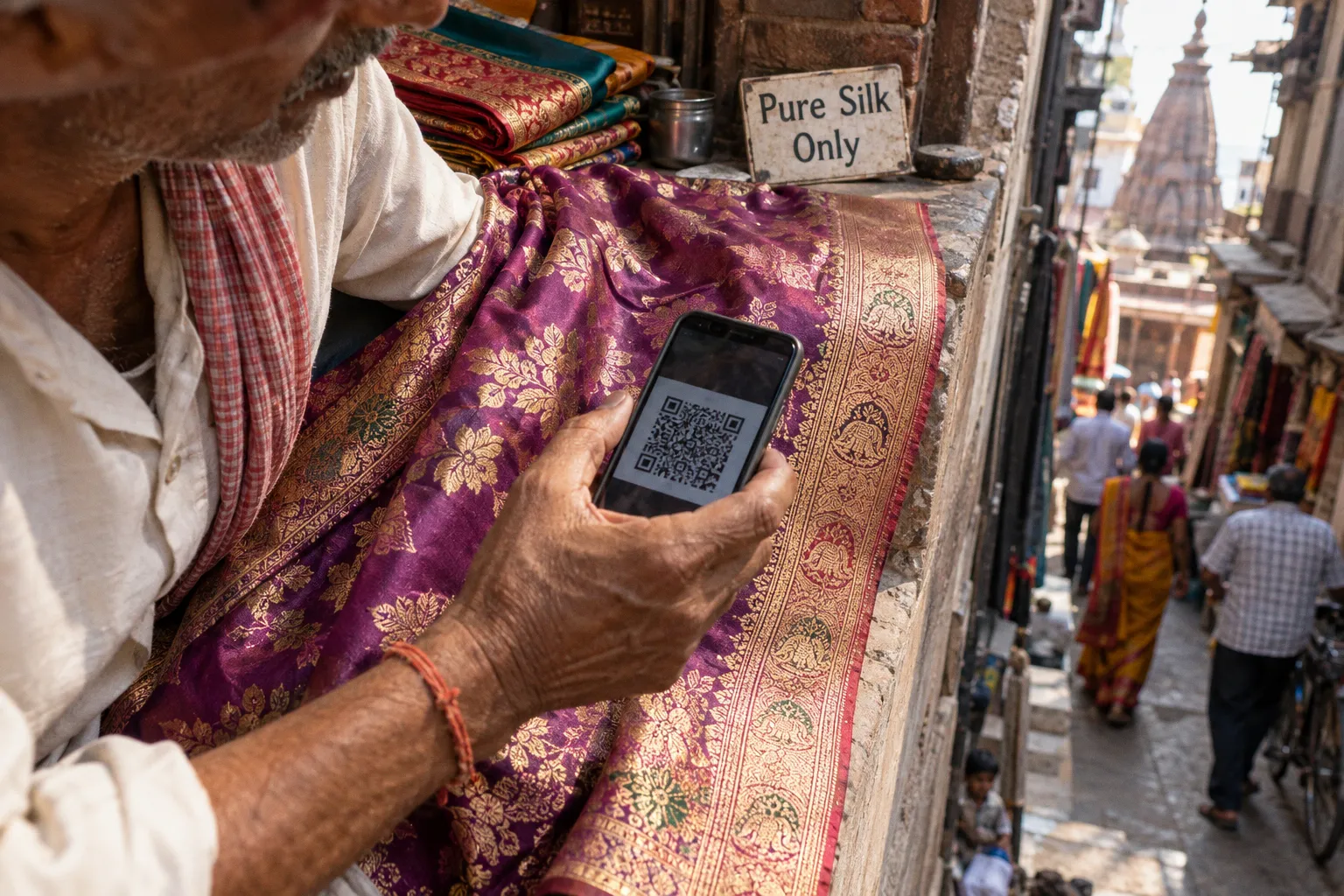
Banarasi Silk Saree Prices: How to Avoid Common Retail Traps
That difference does not always indicate dishonesty: the saree may carry costs for design development, weaving time, zari, transport, shop rent, and several layers of retail commission. The difficulty begins when a machine-made imitation is presented as handwoven Banarasi silk and priced as though it carries the same labour and lineage.
To understand Banarasi silk saree price factors and hidden markups, we need to look beyond colour, shine, and the confidence of the salesperson. An authentic saree is not defined by a high price alone. Its significance lies in the relationship between material, place, technique, and the hands that made it. In practical terms, you should learn to separate three questions: whether the yarn is genuinely silk, whether the saree is handwoven, and whether the design and production belong to the Banarasi weaving tradition protected by the Geographical Indication system.
Why an authentic Banarasi saree costs more
A Banarasi saree is not simply a length of shiny fabric with a familiar motif. Traditional Banarasi brocade, often called kinkhwab when the surface is especially rich and densely patterned, depends on a complex interaction between silk yarn, supplementary patterning, loom preparation, and the skill of the weaver, or karigar. The visible surface may look effortless; the labour behind it is not.
The first price factor is the fibre itself. Pure silk yarn costs more than polyester or blended synthetic yarn, and its handling on the loom requires a different level of attention. A synthetic fabric can be manufactured rapidly and may imitate the appearance of silk closely enough to confuse a visitor under shop lighting. It may have a bright surface, a smooth fall, and a convincing pattern, yet still lack the material quality and handwoven labour associated with an authentic Banarasi silk saree.
The second factor is weaving time. A powerloom can produce a machine-made saree in a single day. A handwoven saree may require roughly fifteen days to several weeks or even months, depending on the intricacy of the design, the density of the brocade, the type of zari, and the preparation required before weaving begins. That time is not an ornamental detail added to the price after the fact. It is the central economic reality of the textile.
Design complexity also matters. A saree with a restrained border and a small number of repeated motifs will not demand the same labour as one covered in dense floral patterning, elaborate jaal work, or a heavily brocaded pallu. In textile vocabulary, jaal refers to a net-like design spread across the field of the saree, while the pallu is the decorated end that falls over the shoulder. These areas often contain the strongest visual statement, but they also require careful control of the pattern throughout the weaving process.
Zari introduces another layer of distinction. The word generally refers to metallic thread used for decorative weaving, traditionally associated with precious metals and now available in different qualities and compositions. A seller may describe a saree as having zari without clearly explaining whether the thread is tested, imitation, or made with another metal base. There is no single standardized retail price table that allows every visitor to compare zari quality across Varanasi’s weaving quarters, so the claim should be treated as a material specification to clarify, not as proof of luxury.
A useful way to read the price is to ask what kind of labour and material it represents:
| Price factor | What it can indicate | What it does not prove |
|---|---|---|
| Pure silk yarn | A higher-value natural fibre with a distinct handle and drape | That the saree was handwoven |
| Handloom production | Extended labour, skilled pattern work, and slower output | That every component, including zari, is of premium quality |
| Dense brocade or jaal work | More time spent preparing and executing the design | That the saree is authentic merely because it looks elaborate |
| High-quality zari | Additional material value and surface richness | That the saree has pure silk yarn |
| GI and Silk Mark documentation | A stronger basis for checking origin and fibre claims | A guarantee that the asking price is fair |
| Tourist-market presentation | Added retail costs, commission, and service | That the saree is counterfeit |
The most expensive saree in a showroom is not automatically the most authentic. Equally, a lower price does not by itself establish that a saree is fake. We are trying to identify the relationship between the stated claim and the evidence supporting it.
A high price is only a number; the meaningful question is what, precisely, that number is paying for.
The GI tag and Silk Mark are different kinds of protection
Visitors often treat the GI tag and the Silk Mark label as interchangeable, but they answer different questions.
Banarasi brocades and sarees received a Geographical Indication tag in 2009. The protection covers handwoven products made within the Varanasi region and five surrounding districts: Mirzapur, Chandauli, Bhadohi, Jaunpur, and Azamgarh. This geographical boundary matters because Banarasi identity is not only a visual style. It is connected to a particular production landscape and its weaving lineage.
The GI designation helps establish that the product belongs to the protected regional category, but it should not be used as a vague synonym for anything decorated with a Banarasi-style motif. A machine-made saree can reproduce the appearance of a traditional pattern, and a pure silk saree can still be made on a powerloom. These distinctions are important when avoiding fake Banarasi silk scams: material authenticity, production method, and geographical certification are related, but they are not identical.
The Silk Mark label addresses the fibre. Issued by the Silk Mark Organisation of India, it certifies that the yarn is 100% pure silk. Modern labels may include a QR code that allows the buyer to verify the label digitally. This is particularly useful when a seller uses the word “silk” loosely or when the saree’s surface has been designed to create a silk-like sheen.
A Silk Mark label does not, by itself, tell you that the saree was handwoven. Its significance is narrower and clearer: it supports the claim about the purity of the silk yarn. If you want to purchase an authentic handwoven Banarasi saree, you should consider the Silk Mark alongside evidence of handloom production and the relevant GI documentation, rather than treating either label as a complete substitute for the other.
When examining a label, do not be embarrassed to ask for time. Read the wording. Look for the label’s identifying details. If a QR code is present, use it when practical instead of accepting a printed tag as unquestionable proof. A seller who is accustomed to informed customers should be able to explain what the label certifies without turning the conversation into a test of your politeness.
What to ask before discussing the price
Keep the questions simple and specific:
- Is the saree handwoven or powerloom?
- Is the yarn 100% pure silk?
- Is there a Silk Mark label, and can its QR code be checked?
- Is the saree covered by GI documentation?
- What type of zari has been used?
- How long did the weaving require?
- Is the design woven into the fabric or printed onto it?
- Does the final price include a blouse piece, taxes, packaging, or delivery?
These questions do not accuse the seller of misconduct. They create a clear vocabulary for the transaction. If the answers remain vague while the seller insists that the saree is “original,” the uncertainty belongs in your assessment of the price.
The powerloom trap: appearance is not provenance
Powerloom sarees are not automatically worthless, and a powerloom saree may even use silk yarn. The issue is not that every machine-made product is fraudulent. The issue is misrepresentation: a machine-made saree being sold as though it carries the labour, process, and regional significance of a handwoven Banarasi textile.
Low-cost polyester powerloom sarees that imitate Banarasi patterns are sold online for approximately ₹500 to ₹2,000. Their low price can be a useful warning when the same visual style is presented elsewhere as a pure silk handloom product, but price alone cannot identify the fibre or production method. A seller may also offer a machine-made saree in pure silk, which means the material claim and the handloom claim must still be examined separately.
Under showroom lighting, synthetic fabric can be persuasive. It may reflect light strongly and feel smooth when folded. A more reliable inspection begins with the overall behaviour of the cloth.
Look at the reverse side. Handwoven brocade often reveals the logic of its construction: the pattern, floats, and thread movement may appear less mechanically uniform than a printed surface or a mass-produced imitation. This does not mean that irregularity alone proves authenticity. Skilled weaving can be extremely precise, and a machine-made textile can be carefully finished. The reverse is simply one piece of evidence.
Examine the selvedge, where the woven width ends. Check whether the decorative elements appear integrated into the structure of the fabric rather than sitting only on its surface. Hold the saree in your hands and observe its fall, weight, and response to movement. Pure silk has a distinctive handle, but touch is a trained skill rather than a magical form of authentication; a first-time buyer should not rely on touch alone.
The design itself can also reveal a mismatch. A seller may use “Banarasi” to describe a colour arrangement, a floral motif, or a general brocade effect, even when the textile has no connection to Varanasi’s handloom tradition. Ask whether the saree is being sold as a Banarasi-style imitation or as a GI-linked Banarasi handloom product. Those are different categories and should not carry the same explanation or expectation.
Common signs of a misleading presentation
1. The seller leads with the discount rather than the material.
A very large reduction can create urgency, but it does not establish whether the saree is silk, handwoven, or regionally certified.
2. The words “pure,” “original,” and “Banarasi” are used without a precise explanation.
Ask which claim each word refers to: fibre, production method, or geographical origin.
3. The saree has a Silk Mark label, but the seller presents this as proof of handloom production.
The label supports the pure-silk claim; it does not answer every question about the loom.
4. The price is justified by zari, but the type of zari is not explained.
Request a clear description rather than assuming that every metallic thread has the same value.
5. The seller refuses to show the reverse side or the label.
A saree is a textile object, and its construction should be available for inspection before purchase.
6. The same saree appears in several shops at sharply different prices.
This may reflect commission, location, or negotiation, but it is a reason to pause and compare the stated specifications.
Understanding Varanasi’s retail layers
The price you hear in a Varanasi market may include far more than the cost paid to the weaving household. A saree can pass through a weaver, a local trader, a wholesaler, a commission agent, and a retail showroom before it reaches the visitor. Each layer may add handling, transport, storage, presentation, and profit. In a tourist-facing lane, the cost of maintaining a large showroom and serving short-term visitors may also be built into the asking price.
This does not mean that every intermediary is exploiting either the buyer or the weaver. Textile production has always depended on networks of specialization, and many buyers benefit from the ability of established sellers to organize designs, sizes, packaging, and shipping. The ethical question is whether the final description remains honest.
Wholesale versus retail silk prices are therefore not a simple contest between a “fair” price and an “unfair” one. Wholesale access may reduce some retail layers, but a wholesale-looking shop can still quote a retail figure, and a small seller may provide valuable guidance that is part of the service. Rather than asking only for the lowest possible price, compare like with like.
If two sarees are being compared, write down the essential specifications:
- fibre: pure silk, blended silk, or synthetic;
- production: handloom or powerloom;
- certification: Silk Mark, GI-related documentation, or neither;
- design density: border, pallu, body, and jaal work;
- zari: the seller’s stated composition and quality;
- weaving time: the approximate duration claimed;
- included items: blouse piece, fall, edging, packaging, or shipping;
- return and exchange conditions, particularly for online purchases.
This turns negotiation into an informed conversation. You are not bargaining over an abstract object; you are comparing two production claims.
Negotiating without turning the textile into a contest
Negotiating prices in Varanasi markets is part of the retail environment, but it does not require contempt for the seller or suspicion toward every quotation. Begin by asking for the best final price after you have established what the saree is. A discount offered before the fibre, loom, and certification are clear may be theatrical rather than meaningful.
If the seller changes the description as the conversation progresses—from pure silk to silk blend, or from handloom to “handloom design”—treat that change as more significant than the discount. A modestly higher price for a clearly documented handwoven saree may carry more value than a dramatic reduction on an uncertain product.
You can also explain your own boundary plainly: you are looking for a handwoven saree, or you are comfortable with a powerloom imitation if it is described honestly. This distinction often makes the exchange easier for both sides. It allows the seller to show you the appropriate range instead of trying to move every buyer toward the most expensive claim.
Physical verification: what you can examine safely
The traditional burn test is sometimes mentioned as a way to distinguish silk from synthetic fibre. Pure silk yarn, when burned, produces an odour resembling burnt hair and leaves fine ash, while synthetic fibres tend to melt and smell like burning plastic. The difference relates to the chemical composition of the fibre.
However, you should never cut or burn a saree without the seller’s explicit permission. A burn test can damage the fabric, affect the border, and create a fire hazard in a crowded shop. It is also not a complete authentication method: it may help distinguish certain fibre types, but it cannot prove that the saree is handwoven, GI-protected, or worth the quoted price. If testing is appropriate, ask whether a loose yarn or a small sample can be examined safely. If the seller cannot permit testing, rely on documentation and physical inspection rather than attempting an improvised test.
A careful inspection can proceed in stages:
1. Start with the label and stated claim.
Determine whether the seller is promising pure silk, handloom production, GI status, or a combination of all three.
2. Check the fibre documentation.
Look for the Silk Mark label and verify its QR code where available. Remember that this establishes the silk-yarn claim, not the entire production history.
3. Examine the woven structure.
Inspect the reverse side, selvedge, border, and pallu. Look for evidence that the decorative elements belong to the construction of the fabric rather than being merely printed.
4. Handle the cloth without rushing.
Notice its drape, weight, surface, and response to folding. Treat touch as one observation among several, not as final proof.
5. Ask about the loom and weaving time.
The answer should be consistent with the complexity of the design. A densely brocaded handwoven saree cannot be explained in the same way as a machine-made item produced in a day.
6. Compare the description across sellers.
If similar-looking sarees are described differently, ask why. Differences in fibre, loom, zari, and design density should have corresponding differences in price.
7. Record the transaction details.
Keep photographs of labels, the bill, and the seller’s written description, especially when purchasing online or arranging delivery.
For online purchases, the risks are slightly different. A photograph can hide the reverse side, flatten the texture, and make synthetic shine appear luxurious. Ask for images of the selvedge, label, pallu, and back of the brocade. Request the exact fibre and production description in writing. If the listing uses only broad language such as “designer Banarasi” or “silk finish,” do not silently interpret it as pure silk handloom.
For a wider view of how India’s textile traditions connect material, community, and ritual use, you may also find this guide to India’s living craft heritage useful.
What a fair purchase should leave you with
A respectful purchase does not require you to become a textile historian before entering a Varanasi shop. It does require you to recognize that the saree’s price is built from claims that can be examined. Pure silk is one claim. Handloom production is another. GI-linked regional identity is another. Zari quality, design complexity, and weaving time complete the picture.
When these elements are clearly described, you can make a decision even if the saree is beyond your budget. A powerloom imitation may be the right choice for you if it is honestly presented and priced according to its material and production. The problem is not choosing a less expensive textile. The problem is paying for a handwoven lineage that the saree does not possess.
The practical etiquette is simple: ask calmly, inspect carefully, and allow the seller to explain the saree in concrete terms. Do not mistake a confident sales performance for documentation, and do not assume that a high price guarantees authenticity. In Banaras, the most responsible purchase is the one in which you understand what you are taking home—the fibre, the loom, the labour, and the cultural lineage expressed through the cloth.