Banarasi silk saree care: preserving handloom weaves at home
A pure handloom Banarasi saree is one of the few objects in a wardrobe that genuinely straddles centuries.
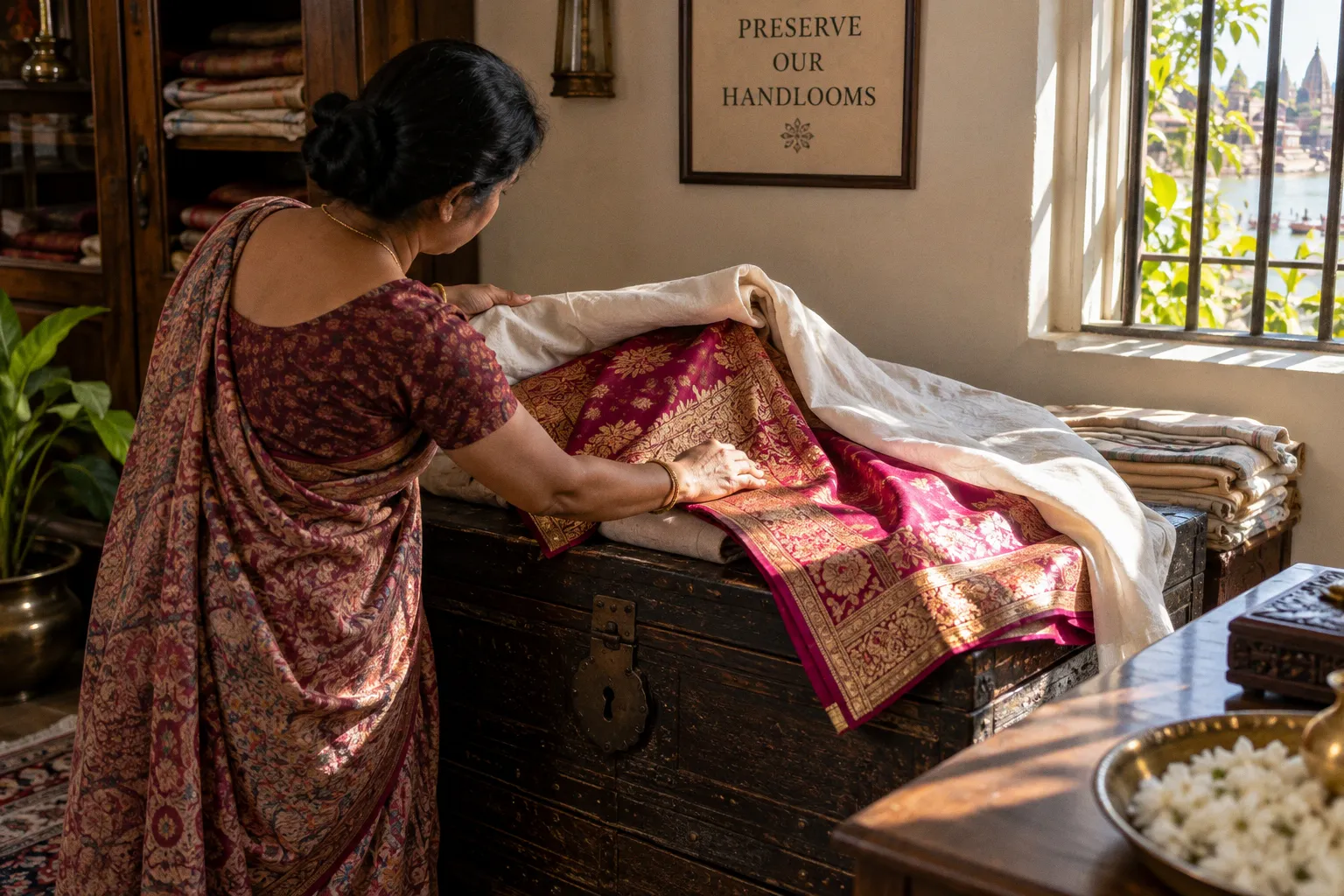
The weavers of Varanasi — many of them working in family lineages that stretch back generations — interlace fine silk with metallic zari, a thread traditionally drawn from real gold or silver, and the resulting fabric carries both the weight of cultural significance and the physical delicacy of the loom that produced it. When such a saree enters your home, whether as a wedding gift, a family heirloom, or a personal purchase, it arrives with an unspoken etiquette of care: certain rituals of folding, certain enemies in storage, certain allies in handling, and a clear line between what you should do at home and what must be left to a professional.
The most common misconception we encounter is that a precious saree is best preserved by sealing it away. Plastic covers, vacuum bags, tightly wrapped polyethylene sheets — these feel protective, but they are in fact among the most damaging environments you can create for handloom silk. The textile needs to breathe, and over the next several sections we will walk through the small, repeatable practices that keep a Banarasi supple, lustrous, and structurally sound across decades rather than years.
A pure handloom Banarasi is a working textile, not a museum piece, and it asks for a measured kind of attention if it is to outlive a single generation.
The Science of Breathable Storage: Why Plastic is the Enemy
Silk is a protein fiber, and zari — the metallic thread that gives a Banarasi its unmistakable sheen along the border and pallu (the decorative loose end draped over the shoulder) — is susceptible to humidity in ways that are easy to underestimate. When a saree is sealed in a plastic or polythene cover, the small amount of ambient moisture present in any home cannot escape. Over months, that trapped humidity works on two fronts simultaneously: it begins to yellow the silk itself, and it oxidizes the metal in the zari, leaving dull, brownish patches along the weave that no amount of home cleaning can reverse.
The correct alternative is almost disarmingly simple. Wrap your saree in a layer of soft, undyed cotton or, ideally, traditional muslin cloth. Both fabrics allow air to circulate while shielding the silk from dust, light, and abrasion. The wrap should be loose — you are not strangling the saree, you are giving it a cotton shawl. Avoid starched or heavily sized cotton, which can leave residue on the silk fibers over time, and avoid colored cloth whose dyes can transfer onto pale or pastel weaves.
If you are storing several sarees together, the rule of positioning matters more than most owners realize. Heavy zari borders and very sheer weaves — particularly the feather-light Kora organza style that some Varanasi workshops still produce — should sit at the top of the pile or, better, be laid flat in their own muslin wrap on a single shelf. Weight crushes them. A silk saree at the bottom of a stack of ten will, within a year, develop creases that begin to weaken the very fibers the weaver spent months coaxing into place.
The Three-Month Rotation: Preventing Permanent Fiber Creases
Every fold you make in a saree eventually becomes a line of stress. Handloom silk is forgiving for a long time, but if a saree is left folded along the same creases for years — especially under its own weight or the weight of other textiles — those creases harden, the fibers along the fold begin to crack, and what was once a soft drape becomes a brittle line that threatens to split under the strain of being worn.
The remedy is one of the gentlest disciplines in textile care, and it asks for very little of your time. Every three to six months, take each saree out of its muslin wrap, unfold it fully, and lay it flat in a shaded part of your home for an hour or two. It needs to breathe, just as it does in storage, but it also needs to forget the shape you last folded it into. When you refold it, do so along different lines than before — shift the fold by a few inches, change the direction of the central crease, rotate the pallu. The saree will then rest on untouched fibers for the next season.
Think of this as a small conversation rather than a chore. In the weaver's workshop in Varanasi, the saree you hold was lifted, inspected, and adjusted at almost every stage of its production; refolding at home simply continues that lineage of attentive hands. It is also the single most effective habit you can adopt if you own heirloom pieces that have been sitting in storage for a decade or more — older silk benefits more, not less, from this rotation, because the fibers have had longer to settle into rigid positions.
Protecting Metallic Zari from Oxidation and Tarnishing
The shimmer along the border of a Banarasi — the dense floral brocade, the running paisley, the kalga and bel motifs — is not paint or printed foil. In pure handloom work, it is real metallic thread: silver coated or gilded, sometimes both, twisted around a silk core. The cultural significance of zari in Indian textile traditions is profound; it has long signaled celebration, devotion, and ceremonial status, and on a wedding night or a festival morning the light it catches is part of how the garment performs its role. But the same metallic quality that makes zari luminous also makes it vulnerable.
Three enemies will tarnish zari faster than anything else: moisture, direct sunlight, and alcohol. The first we have already addressed through breathable storage. The second is straightforward — never store a saree where sunlight falls directly on the wrap, and never air one in the sun for long. UV exposure dulls metallic thread over time and bleaches the silk around it. The third is the one that catches most owners by surprise. Alcohol-based perfumes, deodorants, and body sprays are an everyday presence in modern dressing, and a single direct application along the zari border can leave a stubborn dark stain that dry cleaners struggle to lift. The habit we recommend is simple: apply your scent first, let it dry, and only then put the saree on. The same goes for hairspray, which can drift onto the pallu without your noticing.
If you ever do notice the early signs of tarnish — a faint dulling or a slight greenish cast on silver zari — resist the urge to polish it. Metallic zari is far thinner than jewelry wire, and commercial silver polishes will strip it. This is the work of a specialist dry cleaner familiar with handloom textiles, and we will return to that question shortly.
Safe Handling: Avoiding Common Damage from Hangers and Perfumes
Closets are full of small hazards. A wooden hanger feels sturdy; a padded velvet hanger feels luxurious; a metal wire hanger feels disposable. For a Banarasi saree, only the first two are acceptable, and ideally the saree should not hang at all. Metal hangers oxidize in the humidity of a closed wardrobe, and that oxidation leaves rust marks on the silk that can become permanent. Wire hangers in particular can catch on the loose end of a zari border and tear it in a single careless motion.
When you do hang a saree briefly — for instance, to air it after a refolding session — use a broad, padded hanger and drape the fabric so that the bulk of its weight rests along the bar, not on a single fold or knot. Never hang a saree by its pallu, which is both the heaviest and the most ornamented part of the garment, and never hang a Kora organza or any sheer silk by anything other than its mid-shoulder line for any longer than necessary.
Equally important is the sequence of dressing. We have already mentioned perfume, and the rule extends to everything you apply before you put the saree on. Lotions, oils, deodorants, even the residue of a freshly applied sunscreen on the inner edge of the arm — all of these can transfer onto the inner lining of the pallu or the blouse area, and they tend to set into silk more stubbornly than they would into cotton.
Treat the saree as the final step of dressing, not the first. Every product you apply after you are already wearing the garment is one more thing the silk must quietly endure.
A small but useful habit is to keep a soft cotton shoulder cloth between the saree and your skin where the pallu rests, especially on a hot day. It absorbs perspiration before it reaches the silk, and it is far easier to wash a small shoulder cloth every few weeks than to coax a yellowed patch out of an heirloom pallu.
Professional Cleaning Standards for Handloom Masterpieces
There is a single hard rule in the care of a pure handloom Banarasi: dry cleaning only. Hand washing, regardless of how gentle the detergent or how careful the agitation, risks disturbing the tension of the loom-set weave and lifting the metallic zari from its silk core. The risk is highest in vintage pieces and in any saree with concentrated zari work along the border, but it applies to almost every handloom Banarasi in your wardrobe.
If, in an emergency, you need to spot-clean a saree at home — a small splash of turmeric-laden food, perhaps, or a smear from temple prasad — keep the contact with water to the absolute minimum. A brief soak of no more than ten to fifteen minutes in cool water with a pH-neutral, silk-safe detergent is the outer limit. Anything longer allows the silk fibers to swell and the zari to begin loosening. Pat the area dry with a clean white cotton cloth, never wring it, and take the saree to a professional cleaner as soon as you can.
Ironing is the other moment when damage happens quickly and silently. Always iron on the reverse side of the fabric, never directly on the zari or on the face of the brocade. Use the lowest heat setting on your iron — many machines label this "silk" — and place a clean cotton press cloth between the iron and the saree. The cloth distributes heat and prevents shine marks on the silk. Keep the iron moving; do not let it rest on any one fold.
A short comparison is useful here, because the difference between home care and professional cleaning is often misunderstood:
| Care step | At home (routine) | At the professional cleaner |
|---|---|---|
| Airing and refolding | Every 3–6 months in a shaded space | Not applicable |
| Spot treatment | Cool water, pH-neutral detergent, max 10–15 minutes soak | Targeted stain analysis with fiber-safe reagents |
| Full cleaning | Not recommended | Required: dry clean only, with a handloom-aware service |
| Ironing | Low heat, reverse side, cotton press cloth, iron in motion | Steaming and pressing on calibrated textile equipment |
| Zari tarnish | Do not polish; leave to a specialist | Reversible treatment by a textile conservator |
The row to underline is the third. Many owners, understandably, treat a saree the way they treat a cotton kurta and assume a careful home wash will do no harm. With handloom Banarasi silk, that assumption is the most expensive mistake in the entire care routine, because the damage it causes is rarely visible at first and almost always irreversible by the time it shows.
A practical note on choosing a cleaner: in Varanasi itself, many of the best dry cleaners work directly with the weaving community and understand the difference between a mill-made polyester imitation and a handloom silk with real zari. Outside Varanasi, ask the cleaner directly whether they handle handloom silk with metallic thread, and whether they press on the reverse with a barrier cloth. A cleaner who hesitates on either question is the wrong cleaner for this saree.
A Closing Note for the Heirloom Keeper
If your saree is older than you are — if it belonged to a grandmother, a mother, an aunt who wore it on her wedding day — you are now part of its lineage. The hands that wove it on a wooden handloom in Varanasi are gone, but the textile they produced has continued to move through time, through storage trunks, through bridal suitcases, through the careful folds of whoever came before you. The act of caring for it is not sentimental; it is mechanical, repeatable, and quietly profound. Muslin wraps, seasonal refolding, dry cleaning on a measured schedule, the discipline of dressing before the saree goes on — these are the small rituals that keep a handloom Banarasi alive across generations.
The etiquette of caring for a saree is, in the end, the etiquette of caring for any heirloom that still has work to do in the world. Treat it as the working textile it is, give it the air and the attention its fibers ask for, and it will repay you with decades of light along its zari border — worn, gifted, passed on, and remembered.