Banarasi silk sarees: government emporium or private boutiques
The most common mistake in Banarasi silk saree shopping is to treat the choice of shop as a choice between safety and beauty: the government emporium is assumed to be reliable but limited, while the…
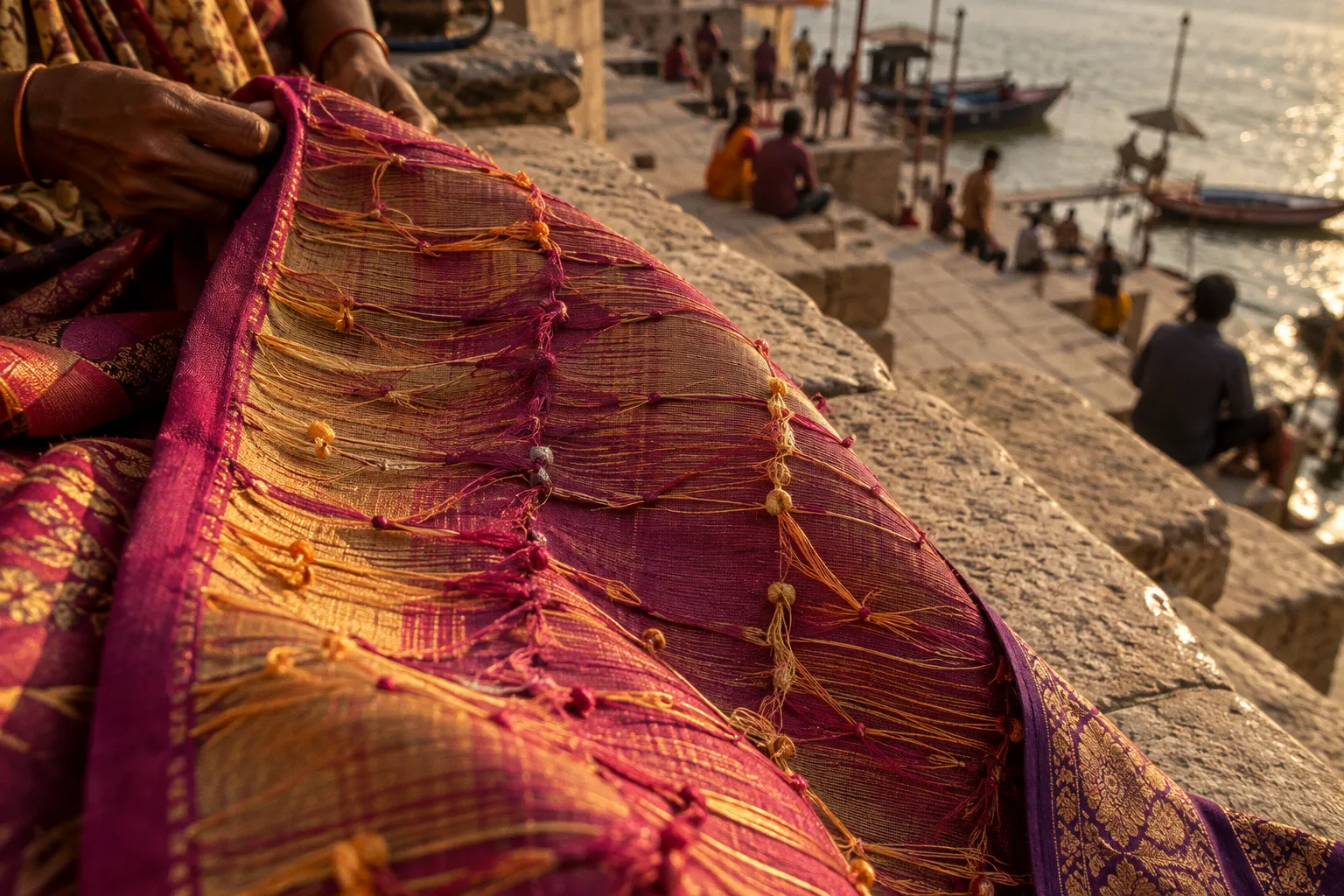
The most common mistake in Banarasi silk saree shopping is to treat the choice of shop as a choice between safety and beauty: the government emporium is assumed to be reliable but limited, while the private boutique is expected to offer the more beautiful saree at a negotiable price. The reality is more useful than that simple opposition. Each setting serves a different purpose, and the better decision depends on whether your priority is verified handloom provenance, design variety, bargaining, bridal detail, or the confidence to inspect the fabric carefully.
In Varanasi, a government handloom emporium gives you a controlled buying environment: fixed pricing, certified handloom pieces, and less pressure to make a decision quickly. Private boutiques and traditional market shops in Chowk, Vishwanath Gali, and Godowlia may open access to a much broader lineage of designs, family-run weaving networks, and more flexible pricing, but they also require stronger judgment. Tourist-facing areas near Dashashwamedh Ghat and Godowlia can quote prices between 40% and 200% above local market rates, while genuine private sellers may still offer authentic silk and carefully made handloom work.
The question, then, is not simply where to buy a Banarasi silk saree. It is how much verification you want the shop to provide, and how much of the observance of buying responsibly you are prepared to undertake yourself.
The case for government emporiums: a calmer way to begin
For a first-time buyer, the government silk emporium in Varanasi is often the most legible starting point. The UP Handloom Emporium, also known as the Government Handloom House, is located in the Godowlia area and sells certified Banarasi silk sarees at fixed prices. There is no bargaining requirement, and the atmosphere is generally more pressure-free than in a busy market shop where several sellers may be presenting fabrics at once.
That fixed-price structure has a particular significance. It does not mean that every government-emporium saree will be cheaper than every private-boutique saree; that would be an inaccurate comparison. The price reflects the stated handloom and certification standards, while private shops may carry everything from budget blends and powerloom fabrics to expensive, genuinely handwoven bridal pieces. A fixed price removes one uncertainty, but it does not erase the need to understand what you are buying.
The emporium is especially useful when:
- you are unfamiliar with the difference between handloom and powerloom weaving;
- you need a saree with documented or certified provenance;
- you do not want to bargain over every piece;
- you are buying a significant gift and prefer a more formal retail setting;
- you want to compare colors, motifs, and price bands without the immediate pressure of a market negotiation.
A government emporium may not display every experimental color combination or highly individual family design found in the old market quarters. Yet that limitation can be helpful. It narrows the field and makes the buying process less vulnerable to the persuasive language that sometimes surrounds luxury textiles.
We should also separate two ideas that are frequently mixed together: certification and quality. A certified handloom saree is not automatically the most beautiful saree for your purpose, and an independent boutique is not automatically unreliable. Certification is evidence about provenance and production standards; beauty, comfort, weight, drape, zari character, and suitability for the occasion still require your own response to the textile.
A government emporium sells reassurance through structure; a private boutique sells possibility, but asks you to bring your own scrutiny.
What private boutiques offer that emporiums cannot
Private boutiques and traditional market shops remain essential to Banarasi saree culture because the city’s textile tradition is not contained in one retail format. In Chowk, Vishwanath Gali, and the wider Godowlia area, you may encounter shops connected to long-established trading families, cooperative networks, or weavers whose knowledge of motifs and regional preferences has been passed through generations.
The variety can be substantially wider. A private shop may show a customer a lighter saree for repeated festive wear, a densely ornamented bridal piece, a modern interpretation of a traditional butidar pattern, or a fabric selected for a particular family ceremony. The seller may know which motifs are associated with older Banaras design lineages and which have been adapted for contemporary wardrobes. That kind of context is difficult to reproduce in a standardized retail environment.
Private boutiques can also be the better setting if you already know what you want. A buyer who can distinguish pure silk from a blend, understand the difference between handloom and powerloom construction, and ask for the saree’s documentation is in a stronger position to explore the market without treating every negotiation as a trap.
The risks are equally real:
- Tourist-facing shops may begin with prices substantially above local market levels.
- A saree described broadly as Banarasi may be powerloom rather than handloom.
- The fabric may contain synthetic fibers or blends that are not clearly explained.
- A shop may use the visual language of luxury silk without offering reliable verification.
- A hurried buyer may focus on the surface shine and miss the construction on the reverse side.
This does not mean that all private market shops sell fake silk. Many traditional weaver families and certified private sellers offer genuine silk, and some private boutiques carry pieces with Silk Mark or GI-related documentation. The point is more precise: in a private shop, the range of outcomes is wider. You can find an exceptional saree, but you must establish what makes it exceptional.
How to shop privately without losing the thread
Begin by asking the seller to separate the categories rather than presenting every Banarasi-looking textile as one product. Ask whether the saree is handloom or powerloom, whether it is pure silk or a blend, and what documentation accompanies the claim. If the response remains vague, the saree may still be attractive, but you should not pay a handloom-silk price for an unverified fabric.
Look at the reverse side before becoming attached to the front. A genuine handloom Banarasi saree typically shows visible thread floats, tied-off knots, and slight structural asymmetries. These are signs of the textile’s making, not defects to be concealed. A machine-made powerloom saree tends to have a much cleaner, more uniform reverse, with floats clipped neatly and a regularity that can reveal its industrial production.
You should also ask to see more than one saree at the same price. This creates a useful comparison inside the shop itself. If one piece feels unusually light, stiff, glossy, or smooth in a way that does not match the others, ask why. A knowledgeable seller should be able to explain the difference in fiber, weave, zari, or finishing rather than relying only on the saree’s color and ornament.
Authentic Banarasi silk identification: read the reverse before the label
The front of a Banarasi saree is designed to attract the eye. Zari borders, buti motifs, rich color, and the fall of the fabric all influence the first impression. Authenticity is more often clarified by the less decorative side: the reverse, the selvedge, the joins, and the small irregularities created during hand production.
A handloom saree is made through a slower process. A genuine handloom Banarasi saree typically takes between 15 and 30 days to weave, while a powerloom version can be produced within hours. This does not mean that every saree taking longer to make is automatically superior, nor does it mean that every powerloom saree is poorly made. It does mean that the production method has consequences for price, texture, construction, and the kind of labor represented in the fabric.
When examining a saree, pay attention to these details:
- The reverse side: Look for thread floats, tied-off knots, and slight asymmetries rather than an entirely uniform surface.
- Motif construction: Handloom motifs may show small variations in spacing or tension; they should not look carelessly damaged, but they need not be mechanically identical.
- The drape: Pure silk generally has a distinctive body and fall, although weight varies according to weave and zari work.
- The selvedge and edges: Examine whether the finishing appears integrated into the weave or simply cleanly sealed like a mass-produced textile.
- The explanation: A seller who understands the piece should be able to identify its fiber, production method, and documentation without changing the subject.
These observations are not a substitute for documentation, but they help you interpret it. A tag alone cannot explain the fabric’s behavior in your hands, and visual confidence alone cannot establish provenance.
Handloom versus powerloom: what the difference means in practice
The handloom-powerloom distinction is often presented as a moral judgment, but a more careful approach respects both the material and the maker. Powerloom textiles can be affordable, visually appealing, and appropriate for buyers who want the Banarasi aesthetic without the cost of a handwoven silk saree. The ethical problem begins when a powerloom imitation is sold as a handloom original, or when synthetic fiber is represented as pure silk.
| Feature | Handloom Banarasi saree | Powerloom or machine-made saree |
|---|---|---|
| Production time | Typically 15–30 days for a genuine handloom piece | Often produced within hours |
| Reverse side | Visible floats, tied-off knots, and slight asymmetries may be present | Usually cleaner, more uniform, and mechanically regular |
| Price logic | Reflects slower weaving, skilled labor, silk, zari, and design complexity | Can be substantially lower, especially when made with synthetic fibers or blends |
| Buying risk | Main concern is whether the certification and seller claims are clear | Main concern is misrepresentation as handloom or pure silk |
| Best suited to | Buyers seeking verified craft lineage and handwoven construction | Buyers prioritizing lower cost or a particular appearance |
The table is not a ranking. It is a way to keep the categories separate. A customer may consciously choose a powerloom saree, but that choice should be made with accurate information.
Banarasi saree price comparison: why the shop changes the number
Price in Varanasi is shaped by more than the word silk. Fiber content, weaving method, zari, density of motifs, border complexity, finishing, age of the design, and the seller’s location all contribute to the final figure. A saree displayed close to the major visitor routes may carry a substantial tourist-facing markup before negotiation begins.
Tourist-heavy markets near Dashashwamedh Ghat and Godowlia are reported to quote prices 40% to 200% above local market rates. That range should not be turned into a universal formula: a busy location does not prove that a saree is overpriced, and a quiet lane does not prove that it is fairly priced. It does, however, tell you to compare before committing.
The entry-level handloom market can also include smaller or lighter pieces. Handloom dupattas, for example, may begin at around ₹4,000, while synthetic or powerloom saree options in budget markets may be offered under ₹1,200 to ₹2,500. These figures are useful as orientation, not as a complete price list for Banarasi silk. A heavily woven bridal saree made with pure silk and elaborate zari belongs to a different category from a light synthetic saree carrying a Banarasi-inspired pattern.
The most reliable comparison is between like and like:
1. Compare pure silk with pure silk, not pure silk with a synthetic blend.
2. Compare handloom with handloom, not certified weaving with an unverified machine-made piece.
3. Ask whether the zari and border work are included in the description or being treated as a separate luxury.
4. Compare several shops before discussing a final price.
5. Record the seller’s explanation of fiber, weave, and certification so that a lower number does not quietly conceal a different product.
Negotiation is part of many private-market transactions, but it should not become a performance in which the seller first names an impossible price and the buyer assumes that any reduction is a victory. A saree’s final price is meaningful only when you know what has been included in it.
Government emporiums, by contrast, use fixed pricing. This makes them easier for a buyer who wants a straightforward Banarasi saree price comparison, particularly when the buyer does not yet know how to evaluate market claims. The fixed price may not be the lowest available, and it may not cover the same range of qualities found in private shops. Its value lies in transparency and reduced pressure, not in a promise that every item is a bargain.
GI registration, cooperative lineage, and the question of proof
The Geographical Indication, or GI, designation connects Banarasi sarees to the recognized geographical and craft identity of the region. In practical terms, GI-related verification matters because it helps distinguish a textile associated with Banaras weaving traditions from a generic product using the city’s name as decoration.
Banaras Bunkar Samiti, based in Sarnath, holds the GI registration for authentic Banarasi sarees and acts as a point of contact for verified cooperative sourcing. For a buyer, this makes cooperative lineage more than a marketing phrase. It offers a path toward understanding who stands behind the textile and how the claim of authenticity is supported.
You should still read a GI tag as one part of the evidence. It does not tell you whether the color suits your wardrobe, whether the weight will be comfortable for a long ceremony, or whether the seller has explained the fiber composition honestly. Nor should its absence from a casual explanation be treated as automatic proof of fraud; documentation practices can vary, and not every genuine textile is presented in the same way. The correct response is to ask direct questions and compare the answers with the fabric in front of you.
When purchasing a high-value saree, especially for a wedding or an important family observance, ask for:
- the stated fiber composition;
- the production method;
- any GI, Silk Mark, or cooperative documentation available;
- the name or location of the producing network where the seller can provide it;
- a written bill that describes the purchase rather than using only a generic product label.
The lineage of a Banarasi saree is part of its significance. It links the finished garment to a skilled weaving community, but that lineage should be explained rather than romanticized.
The burn test: useful knowledge, poor shop etiquette
Pure silk threads burn slowly, smell like singed hair, and leave a crushable grey ash. Synthetic fibers burn rapidly, produce a chemical odor, and leave hard beads. This distinction is sometimes offered as a simple way to identify silk, but the test requires care and should not be performed casually on a finished saree in a shop.
A burn test can damage the textile, the zari, the border, or the seller’s inventory, and it is not a complete method for establishing whether a saree is handloom. It tells you something about the fiber sample, not about the weaving method, the provenance, or the honesty of the product description. In a responsible transaction, documentation, reverse-side inspection, tactile examination, and a clear seller explanation should come first.
If a seller offers a loose thread sample for testing, treat that as a more appropriate setting than pulling from the saree itself. Even then, a result should be interpreted cautiously. Blended fabrics can behave differently from pure silk, and a buyer without textile-testing experience can misread smell, ash, or burn speed. The test is best understood as a supporting observation, not a final verdict.
A burn test can identify a fiber clue; it cannot tell you the story of the loom.
Where to buy silk in Varanasi: choosing the right setting for your purpose
The best place to buy silk in Varanasi depends on the kind of decision you are trying to make.
If you want a first purchase with minimal bargaining and a clearer retail structure, begin at the UP Handloom Emporium in Godowlia. Use the visit to understand the weight, finish, color range, and price logic of certified handloom sarees. You do not have to purchase immediately. A calm first comparison can make later market visits much more productive.
If you are looking for unusual motifs, family-specific knowledge, bridal textiles, or a broader range of prices, explore private boutiques and traditional shops in Chowk, Vishwanath Gali, and Godowlia. Move slowly between sellers, and do not let the proximity of a famous ghat become your only reason for choosing a shop. A busy tourist location can offer genuine textiles, but it also deserves a more deliberate comparison.
If you are visiting Sarnath or are interested in cooperative sourcing, Banaras Bunkar Samiti provides a useful point of reference for verified cooperative connections. The purpose is not to turn a living craft tradition into a certification exercise. It is to give the buyer a clearer route toward the people and organizations connected to the textile.
A practical shopping sequence might look like this:
1. Establish your category. Decide whether you need pure silk, a silk blend, handloom, powerloom, a saree, or a lighter textile such as a dupatta.
2. Visit a fixed-price emporium first. This gives you a baseline for certified handloom construction without the immediate need to bargain.
3. Explore private shops with the baseline in mind. Compare like-for-like fabrics rather than comparing only colors or surface shine.
4. Inspect the reverse. Look for floats, knots, and the slight asymmetry associated with handloom construction.
5. Ask for documentation and a detailed bill. Let the seller’s explanation become part of your assessment.
6. Leave time between selection and payment. A saree bought for a major ceremony deserves consideration, not a decision made because the next shop is waiting.
This sequence also protects the cultural etiquette of the exchange. We are not only trying to avoid an inflated price; we are entering a craft economy whose makers, traders, and cooperative institutions have different roles. Respectful participation means asking clear questions without assuming that every seller is deceptive, and refusing a purchase without turning uncertainty into accusation.
Government emporium versus private shop: the decision in plain terms
A government emporium is usually the stronger choice when certainty, fixed pricing, and a low-pressure environment matter most. It is particularly valuable for visitors who have not previously handled Banarasi silk and do not yet recognize the difference between a handloom reverse and a powerloom finish.
A private boutique is usually the stronger choice when design range, personal guidance, family-run expertise, and negotiation matter more. It can lead you to a saree with greater individuality, but the responsibility for verification shifts toward you. You need to separate authentic handloom from powerloom, pure silk from synthetic fiber, and a reasonable price from a tourist markup.
Neither route should be treated as morally superior. The government emporium represents institutional structure; the private shop represents a more varied and personal marketplace. The right choice is the one that matches your knowledge and the importance of the purchase.
For a first-time visitor buying one significant Banarasi silk saree, the most balanced approach is to use both. Start with the government emporium to establish your understanding of certified handloom fabric and fixed-price retail. Then visit private boutiques and traditional market shops with more precise questions and a clearer sense of what you are seeing. If the private seller offers a saree that is more beautiful, more suitable, or more connected to the design lineage you want, proceed—but only after the fabric and documentation justify the category and price.
A Banarasi saree is not authenticated by the brightness of its zari or the confidence of its sales pitch. Its significance lies in the relationship between material, loom, labor, place, and observance. Buy slowly enough to see that relationship, ask respectfully enough to understand it, and choose the shop whose method of selling allows you to participate with confidence rather than haste.