Banarasi silk sarees: avoiding damage during long-term storage
The most common mistake in Banarasi silk saree care and storage tips is also the one that appears most protective: wrapping the saree in plastic and putting it away until the next wedding. Plastic does not create a safe seal for silk.
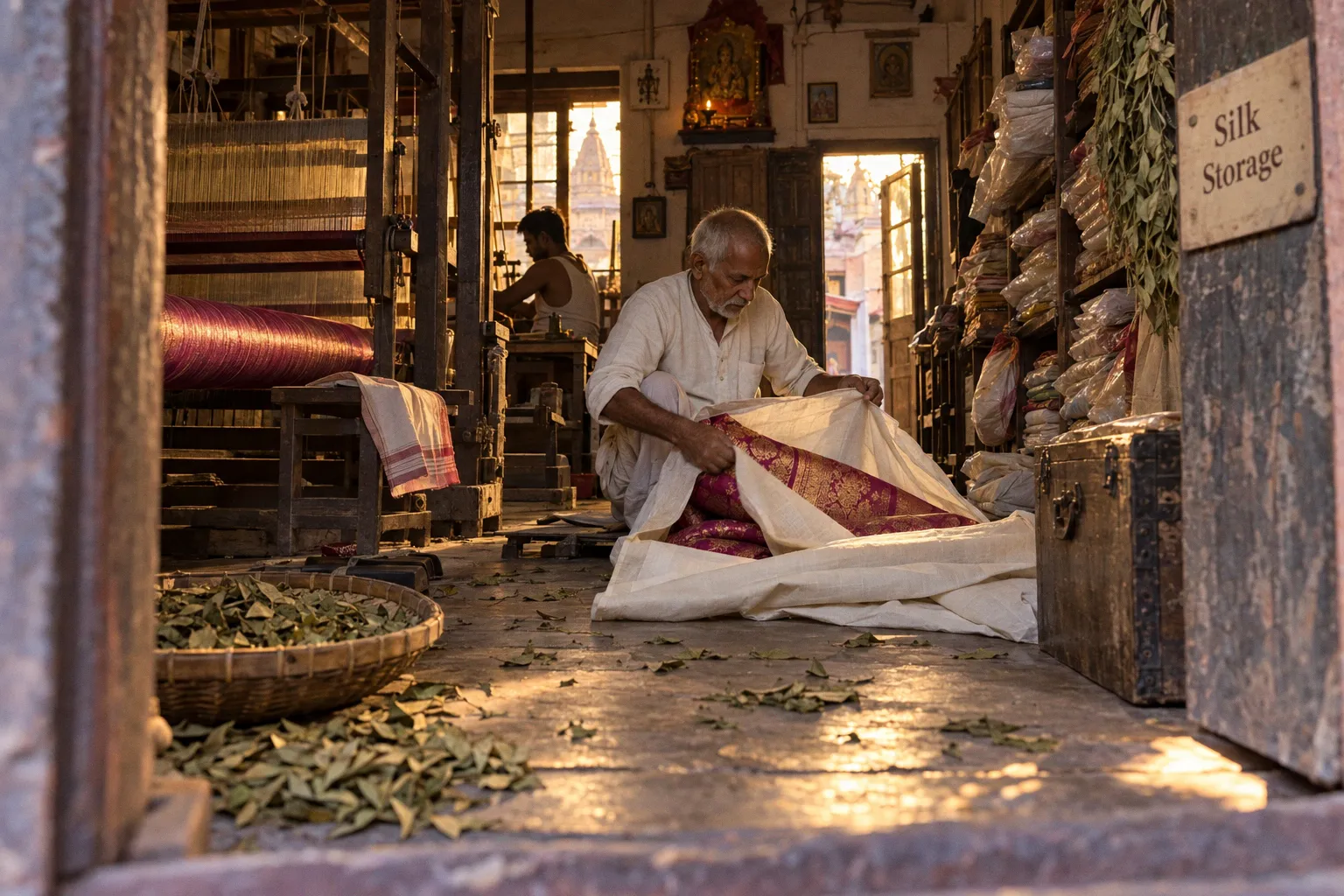
It traps humidity against the fabric, restricts airflow, and can encourage mildew while accelerating the darkening of silver-based zari, the metallic thread that gives a Banarasi weave much of its characteristic radiance.
A Banarasi saree is not simply a valuable garment waiting for another occasion. It carries the lineage of a weaving tradition in which silk, pattern, metallic thread, and patient handwork are held together in a structure that can last for generations, provided its storage respects the material. Long-term preservation is therefore less about elaborate products than about a few disciplined habits: breathable wrapping, low light, gentle handling, regular refolding, and distance from chemicals.
The dangers of plastic, perfume, and chemical exposure
When we speak about protecting a Banarasi silk saree, we are protecting two different but interdependent surfaces. The silk fibres need protection from friction, stains, heat, and insects. The zari needs protection from oxidation, chemical residue, and pressure. A storage method that helps one while harming the other is not a successful method.
Polythene bags and plastic covers are especially unsuitable because they hold moisture close to the saree. Even when the fabric appears completely dry, the enclosed space can become humid through changes in room temperature and surrounding air. That trapped moisture creates conditions in which fungal growth and mildew become more likely, while the silver-based metallic threads may oxidise and turn dark.
This is why plastic should not be treated as acceptable simply because the saree is being stored for a short period. It may keep dust away, but it does so at the expense of the airflow that silk and zari require. If a saree has been brought home from a shop in plastic packaging, remove it from that packaging before putting it into the wardrobe.
The same principle applies to chemical exposure. Perfume, deodorant, and body spray should never be applied directly to the saree. Their alcohol and other chemical ingredients can dull metallic zari and may leave stains that become permanent on pure silk. Apply fragrance to the skin and allow it to settle before dressing; the few extra minutes are a small act of etiquette toward the garment.
Naphthalene balls also deserve caution. They should not touch the saree. Direct contact can discolour the zari, weaken delicate silk fibres, and leave a persistent chemical odour. If pest protection is needed, use a barrier that keeps the protective material separate from the fabric rather than placing mothballs inside the fold.
A Banarasi saree is preserved not by sealing it away, but by allowing the silk and zari to remain clean, dry, gently supported, and able to breathe.
Breathable wrapping is the first line of protection
For storing handloom silk sarees, the wrapping material matters almost as much as the cupboard or chest in which the saree rests. Soft, unbleached muslin or pure cotton is the appropriate choice because it allows air to circulate while creating a protective layer between the saree and its surroundings.
Wrap each saree individually. This prevents zari borders from rubbing against another textile and makes it easier to inspect one saree without disturbing the entire collection. Individual wrapping also helps preserve the distinct identity of each piece: its colour, weave, pallu, border, and place within a family wardrobe are easier to remember when the sarees are not compressed together in one crowded bundle.
Avoid strongly dyed or chemically treated cloth for the inner wrap. Unbleached muslin or pure cotton reduces the risk of chemical transfer, particularly when the saree will remain folded for several months. The fabric should be clean and completely dry before it comes into contact with the silk.
The wrapping itself should be protective but not tight. Do not compress the saree into a narrow parcel, and do not use adhesive tape, pins, or metal clips to hold the wrap in place. These can catch the weave, create pressure points, or leave residues. A loose cotton cover or a carefully folded muslin layer is sufficient.
The storage environment should be:
- Cool and dark, away from direct sunlight, which can gradually alter colour and weaken exposed fibres.
- Dry but not sealed, so that humidity does not remain trapped around the saree.
- Clean and stable, without dust accumulation, leaking walls, or strong household chemicals nearby.
- Spacious enough for flat or rolled storage, rather than forcing heavy sarees into sharp folds.
A wardrobe shelf is often more suitable than a hanger rail, particularly for heavily embellished pieces. If the storage area has a history of dampness, address that problem before returning the saree to it. The fabric may be wrapped correctly and still suffer if the surrounding cupboard is persistently humid.
Flat storage or rolling: choosing the gentler position
Heavy Banarasi silk sarees should generally be stored flat or rolled for long periods. Their weight is not evenly distributed: the zari border, pallu, and densely woven motifs may place additional strain on particular sections. When such a saree hangs for months, gravity pulls on the shoulders and pallu, gradually stretching or distorting the weave.
Flat storage is suitable when the shelf is broad enough to support the saree without forcing it into a tight stack. If the saree must be rolled, roll it carefully around a smooth, clean support rather than creating a hard central fold. The aim is to distribute pressure, not to create a new shape in the textile.
A storage arrangement might be organised in this way:
| Storage choice | Best use | Main caution |
|---|---|---|
| Flat, individually wrapped | Heavy zari sarees and heirloom pieces | Do not place excessive weight on top |
| Rolled around a smooth support | Sarees that would develop hard central creases when folded | Roll loosely and keep the fabric clean |
| Long-term hanging | Not recommended for heavy Banarasi silk | Weight can stretch the shoulders, pallu, and weave |
| Plastic or polythene cover | Not suitable for silk storage | Traps humidity and may encourage oxidation and mildew |
If several sarees are stored on one shelf, place the heavier pieces below lighter ones, but do not build an unstable pile. The most frequently worn sarees should remain accessible so that removing one does not require pulling at the folded edge of another.
Refolding and airing are part of the observance
A saree that remains untouched for years is not necessarily a saree that has been preserved. Long-term care requires periodic attention, and the schedule need not be complicated. Refold each saree along different lines every three to four months. This prevents a single crease from becoming permanent, particularly where the fold crosses a heavy zari border.
Repeated pressure on the same crease can eventually contribute to fabric cracking. The risk is greater when the fold runs through a densely worked area, because the metallic thread and silk do not respond in exactly the same way to stress. Rotating the fold lines distributes that pressure across the textile.
Airing should take place at least twice a year, ideally before and after the monsoon. The purpose is not to expose the saree to harsh sun. Instead, remove the wrapping in a clean, shaded, well-ventilated room and allow the fabric to rest open for a while. This gives you an opportunity to notice early signs of moisture, odour, insect activity, or zari discolouration before a small problem becomes permanent.
A gentle airing routine can follow four steps:
1. Prepare a clean, dry surface large enough to support the saree without dragging it across the floor.
2. Unwrap the saree carefully, supporting the folded bundle from beneath rather than lifting it by one corner.
3. Open it in the shade, allowing air to reach the folds without placing the silk in direct sunlight.
4. Inspect the borders, pallu, and fold lines before refolding along a different pattern and returning it to fresh, dry muslin if necessary.
Do not air the saree in a damp room, near a kitchen, or in strong midday sunlight. Do not leave it outdoors unattended. The observance is gentle ventilation, not prolonged exposure.
This regular attention is particularly meaningful for heirlooms that are worn only during weddings, religious observances, or important family gatherings. A saree that spends most of its life in storage still needs care between occasions. The fact that it is rarely worn does not protect it from humidity, pressure, or chemical damage.
Cleaning a Banarasi silk saree without compromising the weave
Questions about how to clean Banarasi silk often begin after a visible stain, but the best time to decide on cleaning is before an accident occurs. Pure silk and zari should not be treated like ordinary clothing, and home experiments with strong detergent, soaking, or vigorous rubbing can damage both the fibre and the metallic work.
Professional dry cleaning is recommended after every two or three wears or before long-term storage. This does not mean that a saree should be cleaned automatically without considering its condition; it means that perspiration, dust, and residue should not be sealed into the folds for months. Before handing over the saree, tell the cleaner that it is a Banarasi silk piece with zari and ask for handling appropriate to delicate silk and metallic thread.
Avoid placing a damp saree directly into storage. If a spill occurs during an event, blot gently with a clean, absorbent cloth rather than rubbing the area. Do not apply perfume, household stain remover, bleach, or detergent to the affected spot. A rubbing motion can disturb the weave and spread the stain across the silk, while an unsuitable chemical may alter the colour or dull the zari.
After wearing the saree, allow it to air briefly before folding it away. This is not a substitute for professional cleaning when cleaning is required, but it prevents body heat and residual moisture from being enclosed immediately. Ensure that the saree is fully dry before wrapping it.
When selecting a professional cleaner, the relevant questions are practical rather than decorative:
- Does the cleaner regularly handle pure silk and zari?
- Will the saree be cleaned separately rather than placed with heavily dyed garments?
- Are the borders and metallic areas treated with appropriate care?
- Can the saree be returned without plastic packaging?
- Will it be pressed at a low temperature or with a protective cloth?
A good cleaning process should leave the saree ready for storage, not merely looking temporarily brighter.
Hanging and ironing habits that weaken silk
Hanging is convenient for daily clothing because it keeps garments visible and reduces folding. It is less suitable for a heavy Banarasi silk saree stored over a long period. The shoulders and pallu bear the strain, while the weight of the border pulls downward. Over time, this can stretch the weave and distort the fall of the saree.
If a saree needs to be hung briefly before or after wearing, use a broad, smooth support and avoid leaving it there for months. Long-term storage should return the saree to a flat or gently rolled position, individually wrapped in breathable cotton or muslin.
Ironing requires equal restraint. High heat applied directly to zari can flatten the metallic weave and permanently reduce its lustre. The safest approach is low heat with a press cloth, or steam ironing from the reverse side while keeping the iron from pressing directly onto the embellishment. Never drag a hot iron repeatedly over a dense border in an attempt to make it perfectly sharp.
A Banarasi saree does not need an aggressively crisp fold to look cared for. In fact, forcing sharp lines through the same areas repeatedly may create the very damage that careful storage is meant to prevent. Soft, controlled folding is more respectful of the textile’s structure.
Natural pest protection without direct contact
Pests are a legitimate concern in any textile collection, but the solution should not introduce a new source of damage. Dried neem leaves, cloves, or cedar wood blocks can be used as natural alternatives for pest protection, provided they are kept separate from the saree and do not touch the silk or zari directly.
Place the chosen material in a small breathable pouch or container within the storage area, rather than scattering it inside the folds. The saree should remain wrapped in its own clean muslin or cotton covering. Replace or refresh the natural material when its scent has faded, and inspect the cupboard regularly instead of relying on fragrance as proof that the fabric is protected.
Keep the storage space clean and avoid storing food, damp cloth, or cardboard that has already absorbed moisture nearby. If you notice insects, webbing, powdery residue, or unusual damage, remove the affected textile from the rest of the collection and seek professional advice. Do not respond by spraying household insecticide directly onto the sarees.
The distinction between protection and contact is important here. A pest deterrent may be useful in the surrounding cupboard, but it should never become part of the saree’s wrapping or lie against the zari. Metallic thread and silk are both too vulnerable for casual chemical solutions.
A practical maintenance rhythm for heirloom sarees
The most reliable Banarasi saree maintenance guide is one that fits naturally into the household calendar. Care is easier when it is connected to occasions that already recur, such as the change before and after the monsoon, the annual wardrobe review, or the preparation for a wedding season.
A simple rhythm looks like this:
1. After wearing: Allow the saree to air in the shade, checking for moisture, food, cosmetics, or perfume residue.
2. Before storage: Arrange professional dry cleaning when the saree has been worn two or three times or when it is going away for a long period.
3. Every three to four months: Open the wrap and refold along different lines, keeping pressure away from the same zari borders.
4. Twice a year: Air the saree in a clean, shaded, well-ventilated room, particularly before and after the monsoon.
5. Whenever it is handled: Support the full folded bundle and avoid pulling at the pallu, tassels, or embellished edge.
6. During every inspection: Look for mildew, unusual odour, darkening zari, insect traces, or cracking along old creases.
These intervals are not a replacement for observation. If the storage room becomes damp, if a saree is worn during heavy rain, or if a spill occurs, the schedule should change accordingly. The principle is steady attention rather than mechanical compliance.
The heirloom survives through ordinary disciplines: clean hands, breathable cloth, changing fold lines, low heat, and the patience to inspect what we might otherwise leave forgotten.
Preserving the lineage in the fabric
A Banarasi silk saree may be purchased for a celebration, but its significance often extends far beyond that single occasion. It can mark a wedding, a festival, a family relationship, or a passage between generations. Preserving it does not require treating the saree as untouchable. It requires understanding how to handle it so that wearing and preservation support one another.
The best storage is therefore neither elaborate nor expensive. Remove plastic. Keep perfume and chemicals away. Wrap each saree in clean, unbleached muslin or pure cotton. Store it flat or gently rolled rather than hanging it for years. Refold every three to four months, air it at least twice a year, and use low heat with a press cloth when ironing is necessary. Keep natural pest deterrents separate from the textile, and arrange professional dry cleaning before long-term storage when the saree has been worn.
These habits protect more than silk fibres and metallic threads. They preserve the evidence of a craft lineage: the fall of the weave, the clarity of the motifs, the depth of the colour, and the quiet brilliance of the zari. When you return a Banarasi saree to its wrapping after an occasion, do so with the next wearer in mind. That is the most practical form of reverence the garment can receive.