Ganga river water quality: guide to safe ritual bathing spots
The question is not whether the Ganga is sacred. The question is whether the stretch of river in front of the ghat meets bathing standards at the time you enter it.
Those are different questions, and treating them as the same is how visitors make poor decisions.
For ritual bathing in Varanasi, bypass vague claims about purity. Use the measurable criteria applied by India’s Central Pollution Control Board: faecal coliform should remain below the maximum permissible level of 2,500 MPN per 100 ml, dissolved oxygen should be at least 5 mg/L, biochemical oxygen demand should stay at or below 3 mg/L, and pH should fall between 6.5 and 8.5.
That framework gives you a starting point. It does not give every ghat a permanent safety certificate.
Water quality shifts with wastewater inflow, rainfall, river flow, crowd density, festival activity, and the exact sampling point. A clean-looking surface proves very little. Plan the ritual, control the exposure, and do not confuse a managed ghat with tested water.
Start with the CPCB bathing standards, not the colour of the water
The CPCB’s primary criteria for outdoor ritual bathing are designed to measure conditions that are not visible from the steps. Clear water can still carry bacterial contamination. Murky water may reflect sediment rather than a single clear cause. Smell, foam, floating flowers, and surface debris are warning signals, but their absence is not proof of safety.
Use the standards as a technical filter:
| Parameter | CPCB bathing criterion | What it means on the ground |
|---|---|---|
| Faecal coliform | Desirable: 500 MPN/100 ml; maximum permissible: 2,500 MPN/100 ml | A key indicator of contamination from human and animal waste |
| Faecal streptococci | Maximum permissible: 500 MPN/100 ml | Supports the bacterial-risk assessment for outdoor bathing |
| Dissolved oxygen | At least 5 mg/L | Indicates whether the water can support healthier aquatic conditions |
| Biochemical oxygen demand | No more than 3 mg/L | Shows the oxygen demand created by biodegradable organic pollution |
| pH | 6.5–8.5 | A basic measure of acidity and alkalinity |
These are not decorative numbers. They are the difference between a ritual decision based on monitoring and one based on assumption.
The biggest operational mistake is to ask for a single citywide answer: Is the Ganga safe in Varanasi? The useful question is narrower:
- Which stretch was sampled?
- When was it sampled?
- Was the result taken upstream or downstream of major wastewater inputs?
- Was the reading representative of the ghat, or only of a monitoring point some distance away?
- Has the river changed since the sample was taken?
Without those details, a claim about Ganga river water quality for ritual bathing is incomplete.
Treat the ghat as a location, not a guarantee. Water quality can change before your boat reaches the next landing.
Upstream and downstream conditions do not behave the same way
Monitoring reports commonly show a practical divide in the Varanasi stretch. Upstream locations often perform better against bathing criteria for biochemical oxygen demand and faecal coliform. Downstream points, including areas toward Malviya Bridge and the wider downstream corridor toward Ghazipur, can experience heavier bacterial contamination linked to urban wastewater inflow.
That does not mean every upstream ghat is safe at every hour. It means location affects your risk calculation, and the river should not be treated as one uniform water body.
For a visitor moving between Assi Ghat, Dashashwamedh Ghat, Manikarnika Ghat, Raj Ghat, and Namo Ghat, the route matters. The apparent distance between two ghats can be short on a map while the water conditions differ because of drains, current direction, boat traffic, or temporary discharge.
Assi Ghat: popular, accessible, and heavily used
Assi Ghat is one of the busiest points for early-morning activity, including Subah-e-Banaras and the Assi Ghat morning aarti. It is also a high-contact location. Visitors wash, immerse clothing, perform puja, step into the shallows, and handle offerings within a concentrated area.
Do not read popularity as proof of water purity. Assi Ghat’s infrastructure and visibility make it easier to find public information and sanitation measures, but that is not the same as a real-time bacterial result for the exact steps where you plan to enter.
If you choose Assi for a holy dip:
1. Arrive before the main crowd thickens.
2. Watch the waterline before stepping in.
3. Avoid visible discharge, foam, floating waste, and areas where boats are loading or turning.
4. Keep cuts, eczema, and open skin away from the water.
5. Do not swallow the water, even during a brief immersion.
6. Wash your hands with treated water before eating.
Early morning is the optimal time for access and crowd control, not a guaranteed window of higher water quality. The difference matters. Dawn can reduce the human bottleneck on the steps, but it does not automatically remove bacterial contamination.
Dashashwamedh Ghat: manage the ceremony, then manage the water
Dashashwamedh is the main pressure point for the evening Ganga Aarti. The ceremony creates a predictable congestion problem: stairs fill, platforms become difficult to cross, boat approaches narrow, and the riverfront becomes a dense operating zone for priests, visitors, vendors, and boatmen.
Separate the bathing plan from the evening ceremony. If immersion is your priority, do it well before the aarti crowd builds. Do not attempt to enter the river from a congested edge while boats are negotiating for position. A crowded ghat creates physical hazards even when the water itself is within bathing standards.
Water quality monitoring at Dashashwamedh Ghat should also be interpreted carefully. A report from a nearby monitoring point is useful, but it may not describe the water at every stairway, landing, or boat route. Ask when the sample was taken and where. If that information is unavailable, use the report as background—not as a personal clearance.
Manikarnika and the central riverfront
Manikarnika Ghat is an active cremation site. This is not a conventional bathing location, and the surrounding riverfront has a different operational profile from Assi or the public bathing areas near Dashashwamedh.
Do not enter the water beside cremation activity. Keep clear of working platforms, ash handling, wood storage, and boat movements associated with the ghat. If your purpose is ritual immersion, use a designated public access point away from active cremation operations and follow local instructions.
The issue here is not a claim that one ghat can be reduced to a single contamination number. It is basic route discipline. Sacred importance does not remove industrial, biological, or physical hazards from an active working riverfront.
Raj Ghat, Namo Ghat, and the downstream calculation
Raj Ghat and Namo Ghat sit within a riverfront system shaped by changing access, renovation, public events, and boat movement. Namo Ghat is designed as a more managed public space, but landscaping and paved access do not certify the river water. A cleaner promenade can still lead to water that requires caution.
Downstream conditions deserve more scrutiny. CPCB monitoring has identified stretches toward Malviya Bridge and further downstream that frequently face bacterial thresholds being exceeded because of urban wastewater inflow. That finding should change your route calculation if a ritual bath is the primary objective.
Do not assume that moving to a quieter landing automatically improves water quality. Quiet means fewer people. It does not necessarily mean fewer wastewater inputs.
Choose exposure control over symbolic excess
A ritual dip does not require a long swim, repeated submersion, or drinking river water. Reduce contact while preserving the religious purpose of the visit.
Use this hierarchy:
1. Lowest exposure: Perform the ritual from the steps with a small amount of treated water brought separately, if your religious practice allows it.
2. Controlled contact: Touch the river or take a brief hand-and-face ritual without immersing your head.
3. Short immersion: Enter only in a designated, visibly maintained access area; keep the duration brief and avoid swallowing water.
4. High exposure: Avoid swimming, prolonged immersion, drinking, or allowing children to play in the river.
Do not make a small amount of water part of your diet. The available information does not support claiming that direct consumption from the riverbank carries zero medical risk. River water should not be treated as drinking water without appropriate testing and treatment.
Health precautions for a holy dip in the Ganga
A practical bathing plan should cover your body, your belongings, and the exit route. The most common failures happen after the ritual: people walk barefoot through wet waste, eat without washing their hands, or leave damp clothing against irritated skin.
Pack and use:
- waterproof sandals with a secure sole;
- a clean towel and dry change of clothes;
- hand sanitiser or treated water for handwashing;
- a sealed bag for wet clothing;
- basic wound protection for cuts or abrasions;
- drinking water from a reliable treated source;
- a small cloth or container for offerings, instead of plastic packaging.
Keep children under direct control. The river edge is a traffic lane for boats, not a swimming pool. Steps can be uneven, slippery, and crowded. Never stand on the lowest edge while looking away from the current.
Avoid immersion entirely if you have open wounds, active skin irritation, a weakened immune system, or a medical condition that makes exposure risky. If water enters your eyes or mouth, rinse with clean treated water as soon as possible. Seek medical advice if you develop persistent diarrhoea, vomiting, fever, eye irritation, or a worsening skin reaction after exposure.
These precautions are not an argument against ritual bathing. They are a way to stop a short religious act from becoming a longer medical problem.
Time your route around bottlenecks, not rumours about purity
The best time for ritual bathing in Varanasi depends on two separate variables: crowd movement and water conditions. Crowd movement can be planned. Water conditions require current monitoring data, which is not available in real time for every ghat.
For logistics, early morning usually gives you the cleanest access to the steps and the least conflict with evening ceremony traffic. But early morning does not guarantee that bacterial counts are lower. Use the time advantage to inspect the access point, speak to the boat operator or local staff, and leave if the waterline shows obvious warning signs.
Avoid these pressure periods when possible:
- the minutes before and during the Dashashwamedh evening aarti;
- major Hindu festivals and bathing days;
- the period immediately after heavy rain, when runoff and wastewater can alter river conditions;
- crowded boat departures where several operators are competing for the same landing;
- any moment when the current, wind, or visibility makes the steps difficult to read.
Festival days require a stricter standard of caution. More people mean more contact, more offerings, more boat traffic, and greater strain on sanitation systems. Do not assume that a ghat used by thousands during a major event meets bathing standards at every point in the day. The available monitoring does not justify that claim.
A simple route plan
Use a fixed sequence rather than improvising at the riverfront:
1. Inspect the ghat before changing clothes. Look for surface waste, unusual smell, foam, visible discharge, and unstable access.
2. Ask for the current local guidance. A boatman, ghat worker, or municipal staff member may know about a blocked landing, temporary work, or unsafe edge. Treat verbal advice as operational information, not a laboratory report.
3. Separate ritual timing from sightseeing. Complete the immersion before the Dashashwamedh evening congestion or schedule it at a quieter public ghat.
4. Keep valuables off the steps. Use a trusted companion or a secure bag; the riverfront is too crowded for loose phones and wallets.
5. Exit immediately after the ritual. Rinse with treated water, dry your feet, and move away from the bottleneck.
6. Record the location and date if health symptoms appear later. This helps a clinician assess possible exposure.
The route should be short and controlled. Do not turn a ritual dip into a riverfront endurance test.
Arpan Kalash reduces waste at the edge, but it does not purify the river
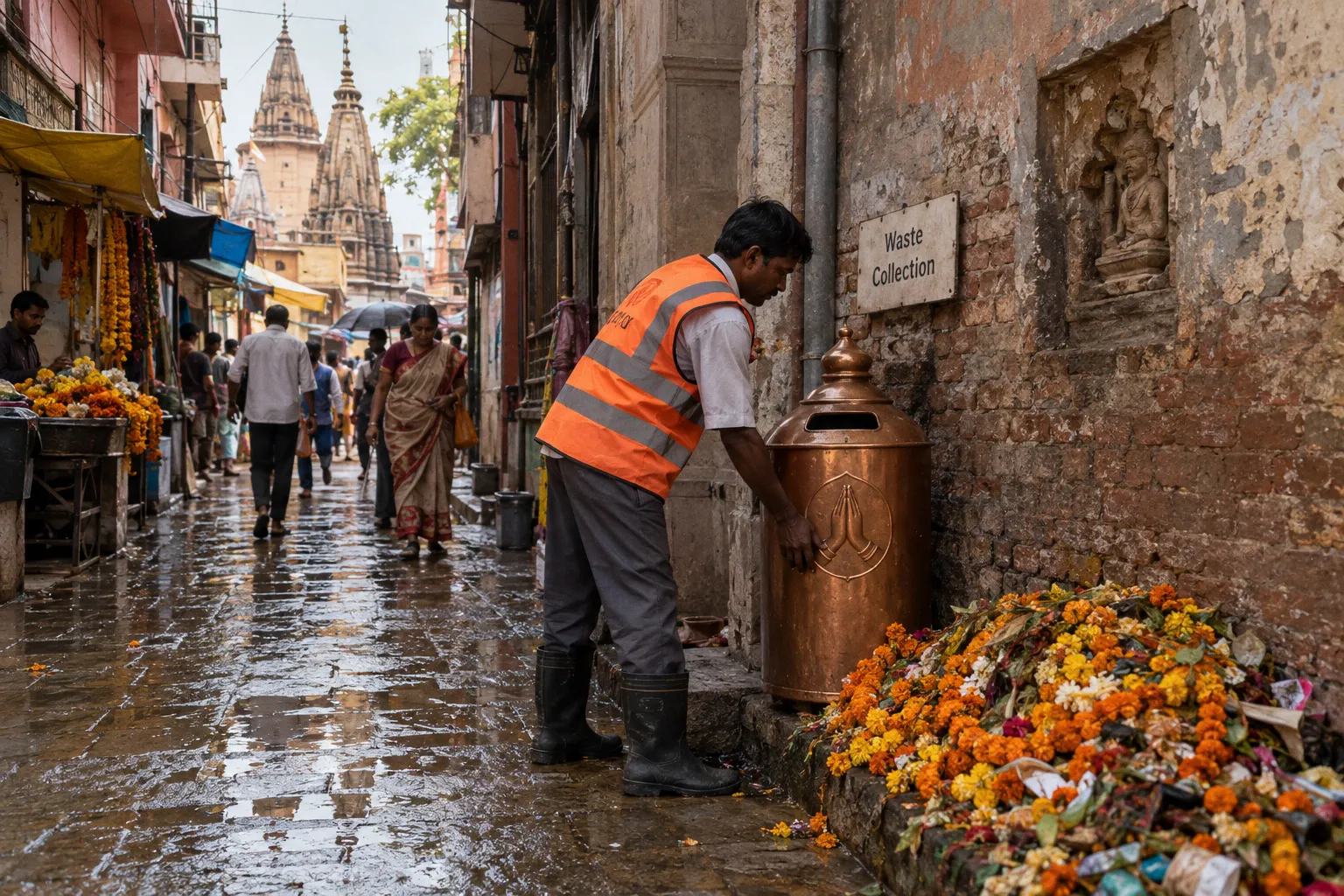
Varanasi Municipal Corporation introduced the Arpan Kalash initiative at major ghats, beginning with Assi Ghat and extending to Dashashwamedh and Raj Ghat. The containers are intended to collect ritual waste, old clothes, and garlands before visitors throw them into the river.
Use them. That is the correct move.
Do not place flowers, cloth, plastic packets, food, or other offerings directly into the water when a collection point is available. This reduces visible debris and prevents additional organic and synthetic waste from entering the riverfront system.
But keep the limits clear. Waste collection is not water treatment. Arpan Kalash can intercept offerings; it cannot remove faecal bacteria, correct dissolved oxygen, lower biochemical oxygen demand, or neutralise wastewater entering the river elsewhere.
This distinction matters because sanitation projects are often judged by appearance. A clean set of steps is useful. It is not a substitute for CPCB monitoring.
The same rule applies to riverfront beautification around Namo Ghat and other renovated areas. Better paving, lighting, railings, and waste points improve navigation and public behaviour. They do not establish that the adjacent water is safe for immersion at every hour.
Cleaner steps reduce the contact problem. They do not solve the water problem.
How to read claims about safe ghats
You will encounter broad statements about the best or safest ghats for a holy dip in Varanasi. Reject any claim that gives a permanent ranking without a date, sampling location, and test parameters.
A useful water-quality statement should tell you:
- the exact monitoring point or river stretch;
- the sampling date;
- the faecal coliform result;
- dissolved oxygen and BOD values;
- whether the location was upstream or downstream of major wastewater inputs;
- whether the result applies to a normal day or a festival period.
If a claim only says the water is clean, pure, sacred, or regularly monitored, it has not answered the practical question. Ask for the measurement.
The CPCB framework is also a bathing standard, not a drinking-water standard. Meeting the primary criteria for outdoor ritual bathing would not make direct river water suitable for consumption. The standards are different because the exposure pathways are different.
That is why a brief, controlled ritual and direct drinking should never be treated as equivalent acts.
The working decision: enter, reduce contact, or stop
Use a three-level decision at the ghat.
Enter only with controlled exposure
Choose this option when the access point is stable, no obvious discharge or surface contamination is present, the crowd is manageable, and you have no open wounds or relevant medical concerns. Keep the immersion brief. Do not swallow water. Exit without lingering.
Reduce contact
Choose this option when the ghat is crowded, the waterline is visibly dirty, boats are manoeuvring near the steps, or the latest monitoring information is unclear. Perform the ritual from the edge or use treated water separately if acceptable within your practice.
Stop the immersion
Do not enter when you see active sewage discharge, heavy foam, strong unusual odour, large accumulations of waste, unstable steps, dangerous current, or severe crowd pressure. Also stop if local authorities have restricted access or if weather and river conditions make the landing unsafe.
No ceremony is improved by ignoring a visible hazard.
Final rule for ritual bathing in Varanasi
Use the data when it exists, inspect the ghat when it does not, and never treat the entire Varanasi riverfront as one uniform bathing site.
Upstream conditions may perform better against bathing criteria, while downstream stretches around Malviya Bridge and beyond can face heavier bacterial contamination. Assi Ghat, Dashashwamedh, Raj Ghat, Namo Ghat, and the other riverfront access points each have different crowd, drainage, and navigation conditions. A popular ghat is not automatically a safe ghat. A quiet ghat is not automatically a clean one.
My hard-and-fast rule is simple: shorten the exposure, avoid the bottleneck, do not drink the river, and leave whenever the water or access point gives you a concrete reason to stop.